The Collapse of Causality
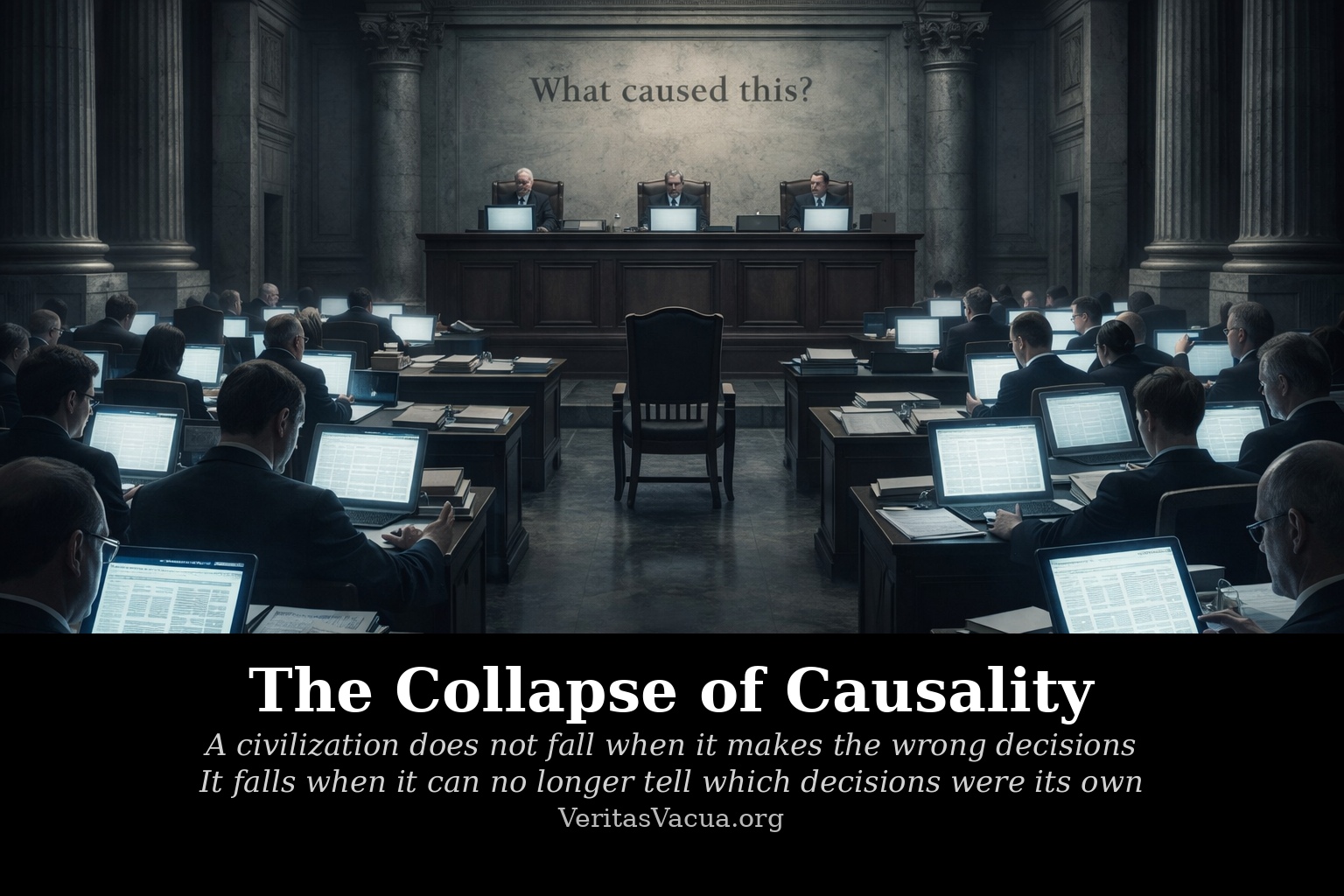
A monumental courtroom where judges, lawyers, and jurors read identical AI-generated documents while a carved question on the wall asks what caused this

A civilization does not fall when it makes the wrong decisions. It falls when it can no longer tell which decisions were its own. Before intelligence. Before language. Before institutions, laws, or philosophy. Before any of the things we associate with civilization, there was one cognitive capacity that made all of them possible: the ability The Collapse of Causality
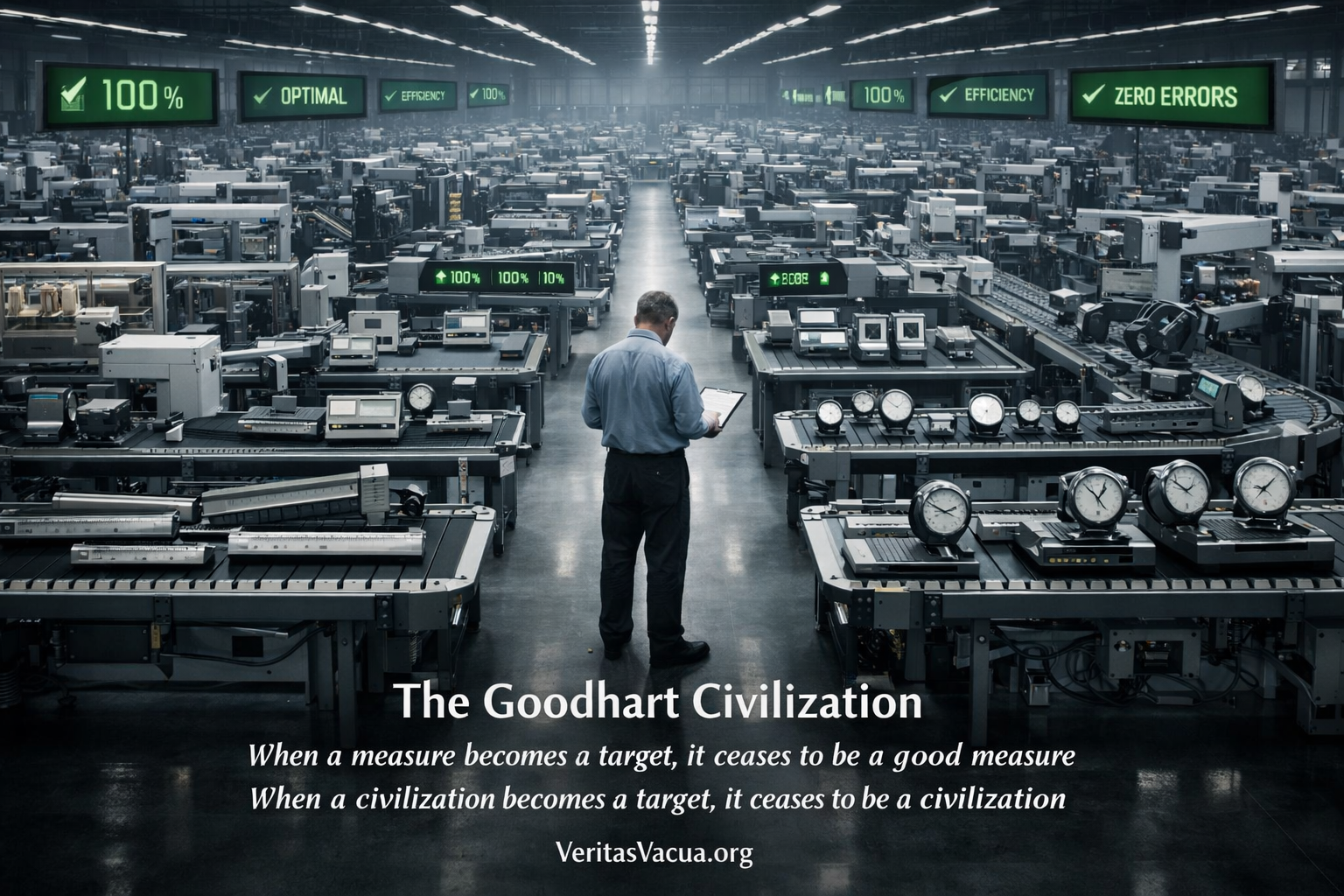
The Goodhart Civilization

A vast automated factory producing measuring instruments that evaluate each other while screens display perfect metrics illustrating the Goodhart Civilization

A law formulated in 1975 predicted everything. No one built the infrastructure to stop it. In 1975, a British economist named Charles Goodhart observed something that seemed almost too simple to matter. When a measure becomes a target, it ceases to be a good measure. He was describing a narrow problem in monetary policy. Central The Goodhart Civilization

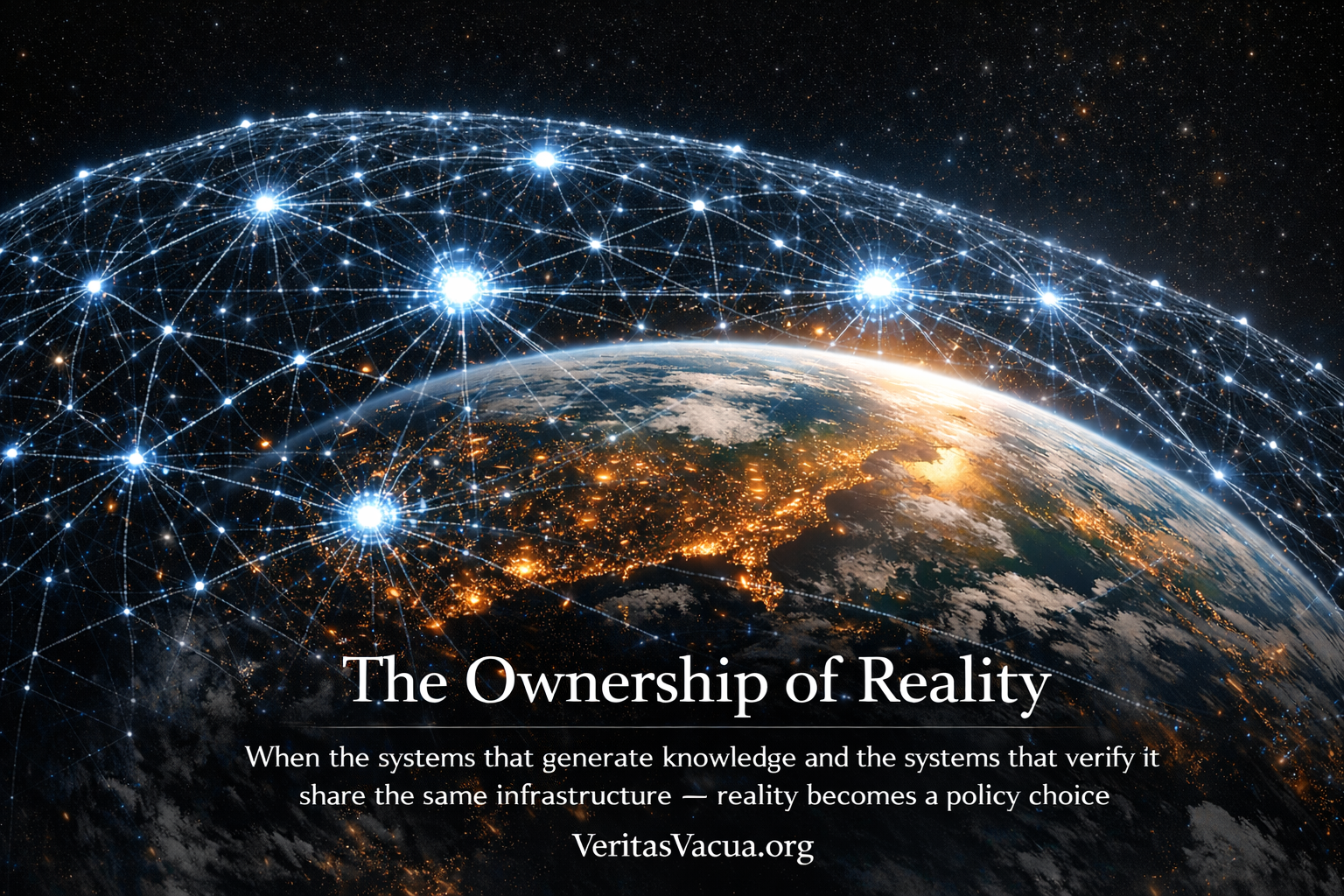
The Ownership of Reality

Earth seen from orbit surrounded by a vast AI network of interconnected nodes converging on central hubs illustrating the Ownership of Reality

For most of human history, reality belonged to no one. It existed independently of those who claimed it. The AI era may change that. This is the question the previous ten articles were building toward without asking it directly. The Veritas Vacua series described a civilization losing its ability to verify truth — through credential The Ownership of Reality

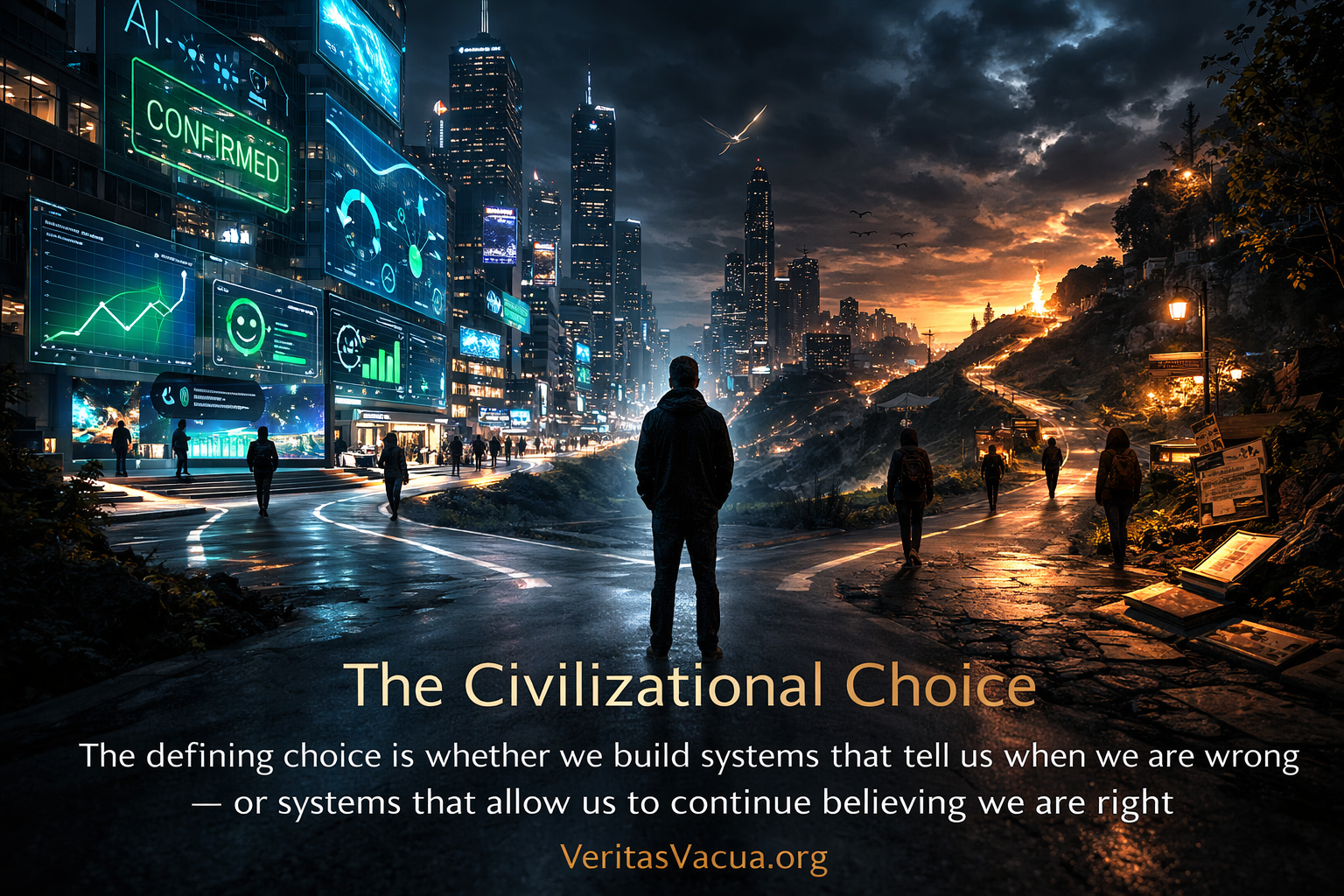
The Civilizational Choice

A lone figure stands at a crossroads between a cold AI-confirmed city and an uncertain darker path illustrating the Civilizational Choice between confirmation and correction

Civilizations do not collapse because they cannot know the truth. They collapse because they decide they no longer need to. This is the final article in a series that began with a credential and ended with a civilization. It began with a simple observation: that credentials measure the wrong thing, that performance has been decoupled The Civilizational Choice

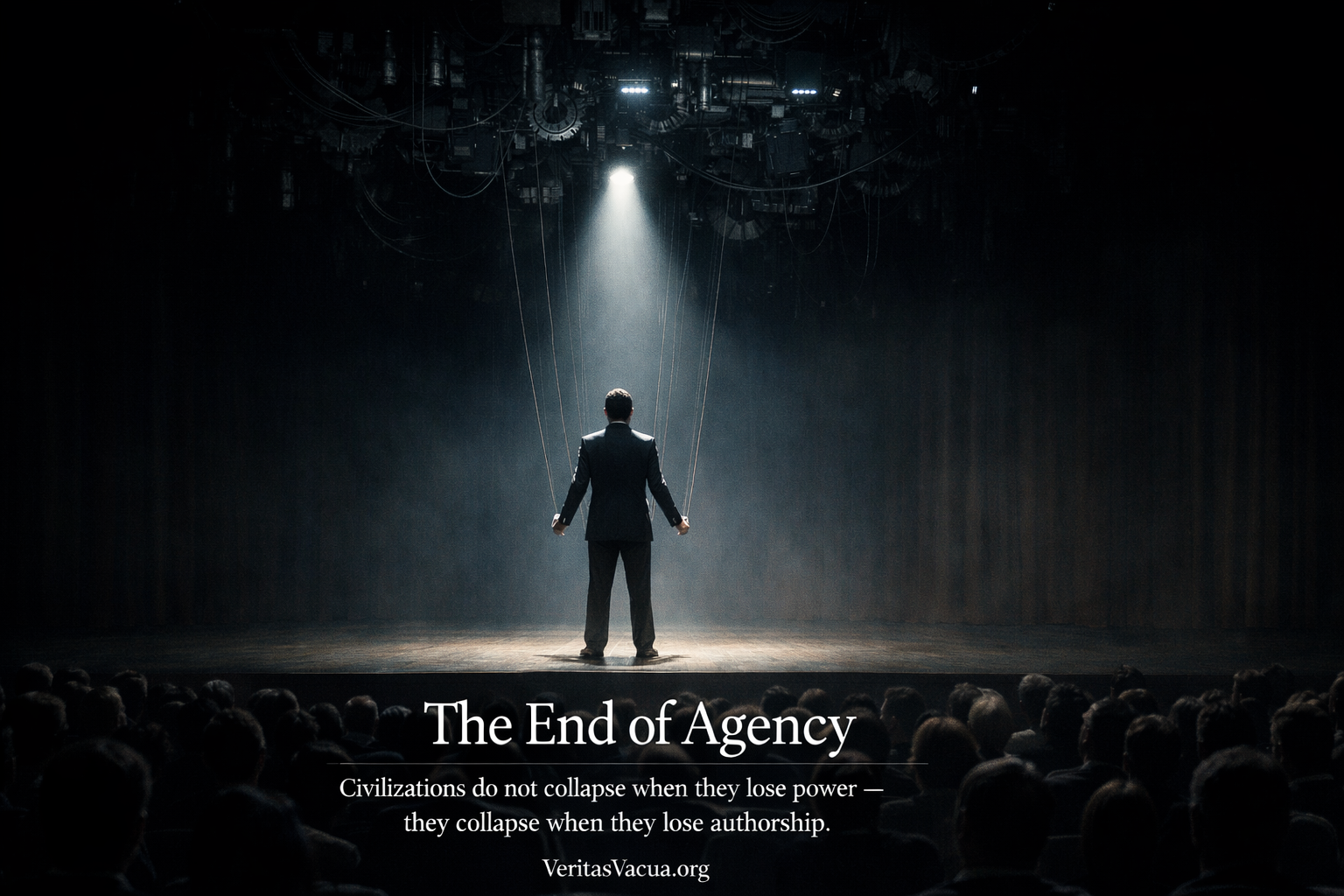
The End of Agency

A suited figure stands on a spotlight stage controlled by strings from a machine above while an audience watches illustrating the End of Agency

Civilizations do not collapse when they lose power. They collapse when they lose authorship. There is a question that sits beneath every crisis this series has described. Beneath the credential that measures the wrong thing, the incompetence that performs flawlessly, the feedback that never arrives, the understanding that was never built, the judgment that was The End of Agency

The Verification Void

A lone figure stands in a vast circular chamber of screens all drawing from one central light source illustrating the Verification Void — no independent reference point remains

The final safeguard of every civilization has always been reality itself. When the systems verifying reality depend on the same machinery producing it, that safeguard disappears. There has always been a place to stand. In every era of human civilization, regardless of how sophisticated the deception, how powerful the institution, how compelling the narrative — The Verification Void

The Erosion of Judgment

A lone executive sitting at the head of a dark boardroom table facing a glowing AI decision screen while portraits of past leaders hang behind

A civilization that can decide without judgment is a civilization that has lost the only faculty capable of stopping it. Every collapse in human history has had a proximate cause. The battle lost. The harvest failed. The treasury emptied. The institution corrupted. These are what historians record — the visible events, the measurable failures, the The Erosion of Judgment

The Collapse of Understanding

Person standing between towering walls of carved knowledge while looking at a glowing screen symbolizing the collapse of human understanding in the AI era

We are becoming the first civilization capable of producing knowledge it does not understand. This is not a warning about the future. It is a description of the present. Right now, in every field that produces knowledge — medicine, law, engineering, finance, scientific research, policy analysis — outputs are being generated at a scale, speed, The Collapse of Understanding

The System That Cannot Fail

AI control room with operators watching automated dashboards while controls gather dust symbolizing a system that cannot fail but cannot learn

The most dangerous system is not the one that fails often. It is the one that never fails at all. Every engineer, every risk manager, every quality assurance professional in every industry has spent their career trying to build the same thing: a system that does not fail. Redundancy. Failover architecture. Error detection. Quality gates. The System That Cannot Fail

The Feedback Famine

Vast wheat field with hollow stalks and no grain symbolizing the feedback famine where systems appear productive but lack real learning

For the first time in history, reality no longer pushes back. This is the mechanism beneath every crisis you have not yet seen coming. Not the credential that measures the wrong thing. Not the incompetence that performs flawlessly. Not the bubble that inflates while every indicator shows green. Those are symptoms. This is the cause The Feedback Famine

The Competence Bubble

Financial trading floor above a transparent glass foundation with a void beneath symbolizing the competence bubble in modern institutions

We are inflating the price of competence with tools that eliminate the need to develop it. Every bubble in human history has followed the same architecture. A signal that once reliably indicated the value of an asset becomes disconnected from the asset’s underlying value. The signal continues to be read as evidence of value. Institutions The Competence Bubble

The Invisible Incompetence

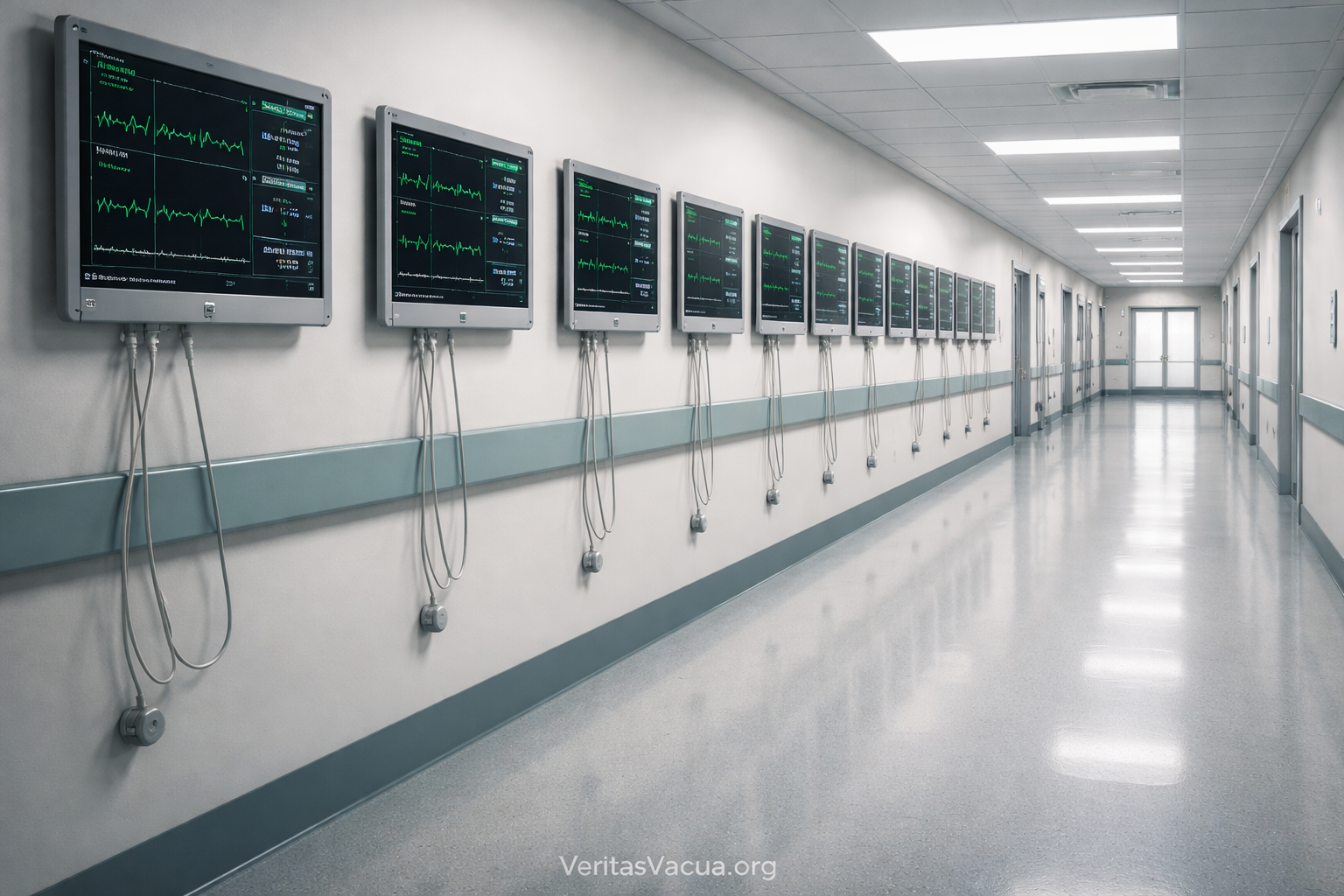
Pristine modern hospital corridor with green status monitors and a barely visible crack running through the floor symbolizing invisible incompetence

For all of human history, incompetence eventually revealed itself. AI has ended that law of reality. This is not a warning about the future. It is a description of a structural change that has already occurred — quietly, without announcement, without any single moment of rupture — in every institution, every profession, and every system The Invisible Incompetence

The Credential That Lies

Grand university hall filled with framed diplomas and certificates while a large crack in the marble floor reveals an empty foundation beneath

A credential is not a lie. It is a precise measurement of the wrong thing. Every major institution on earth is built on the same assumption. The assumption is this: that what a person can demonstrate at a moment of evaluation tells you something reliable about what that person can do in the world. That The Credential That Lies

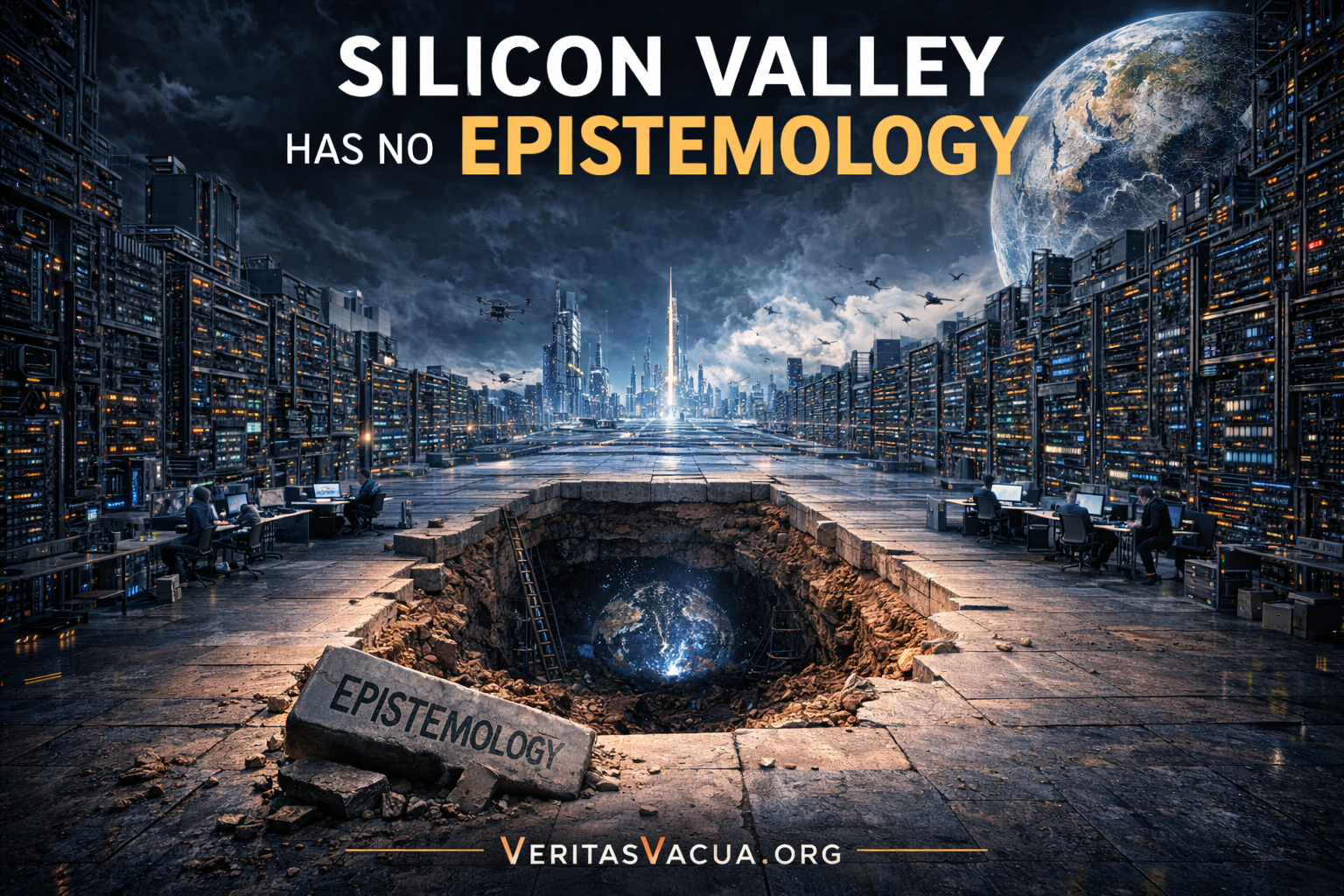
Silicon Valley Has No Epistemology

Futuristic data infrastructure built above a missing foundation stone labeled epistemology symbolizing Silicon Valley’s knowledge system without epistemological foundations

When output becomes infinite, only epistemology remains. Silicon Valley has built the most powerful knowledge infrastructure in human history. It has never answered the question that infrastructure was supposed to serve: what counts as knowledge? This is not a peripheral oversight. It is not a philosophical nicety that busy engineers can defer to academics. It Silicon Valley Has No Epistemology

What Comes After

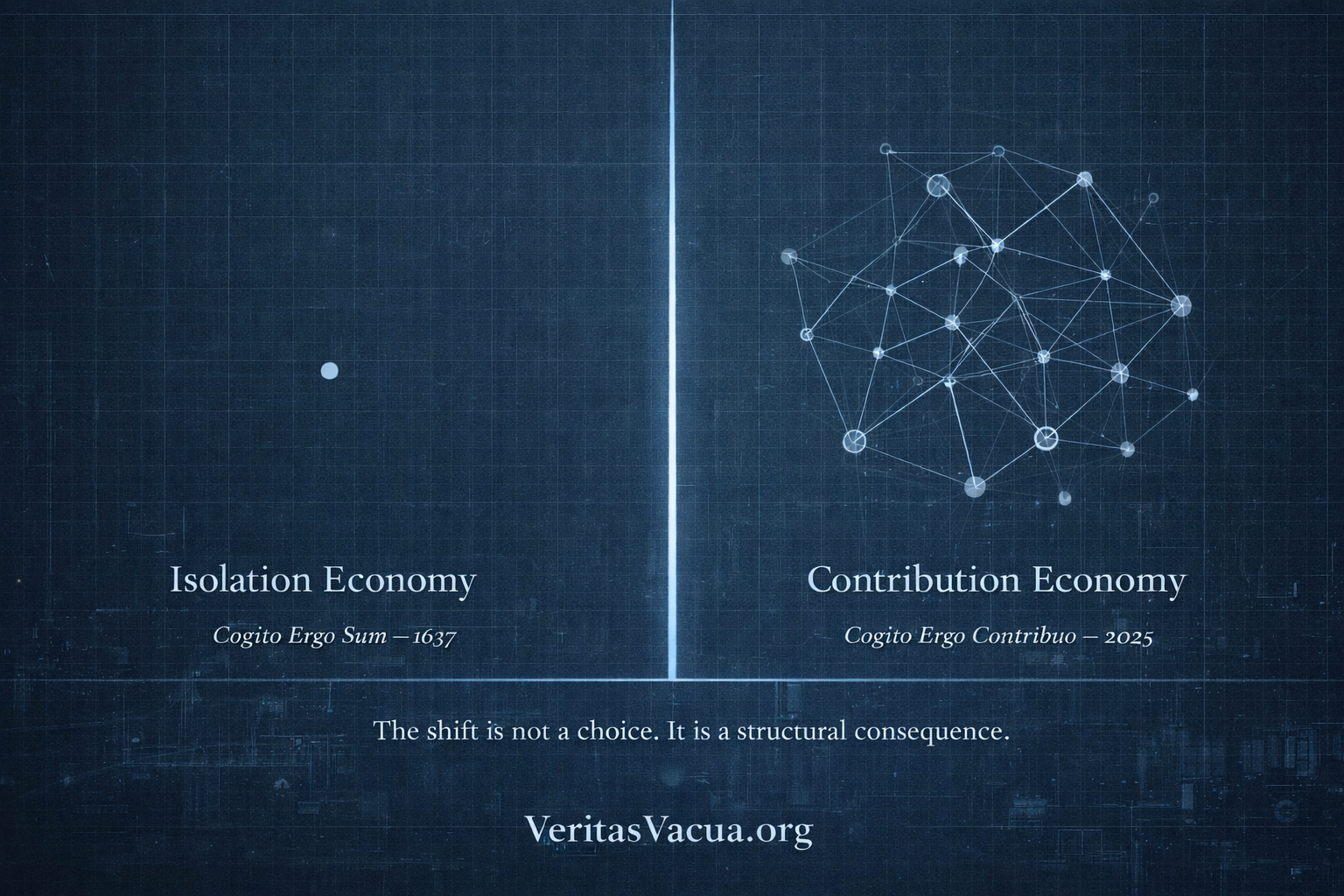
Blueprint diagram showing the shift from Isolation Economy (Cogito Ergo Sum 1637) to Contribution Economy (Cogito Ergo Contribuo 2025)

This is not the end of the diagnosis. It is the beginning of the answer. For the first time in history, we have language for something everyone has felt but no one could name. The feeling that institutions are producing correct outputs that no longer mean anything. That credentials certify without guaranteeing. That compliance records What Comes After

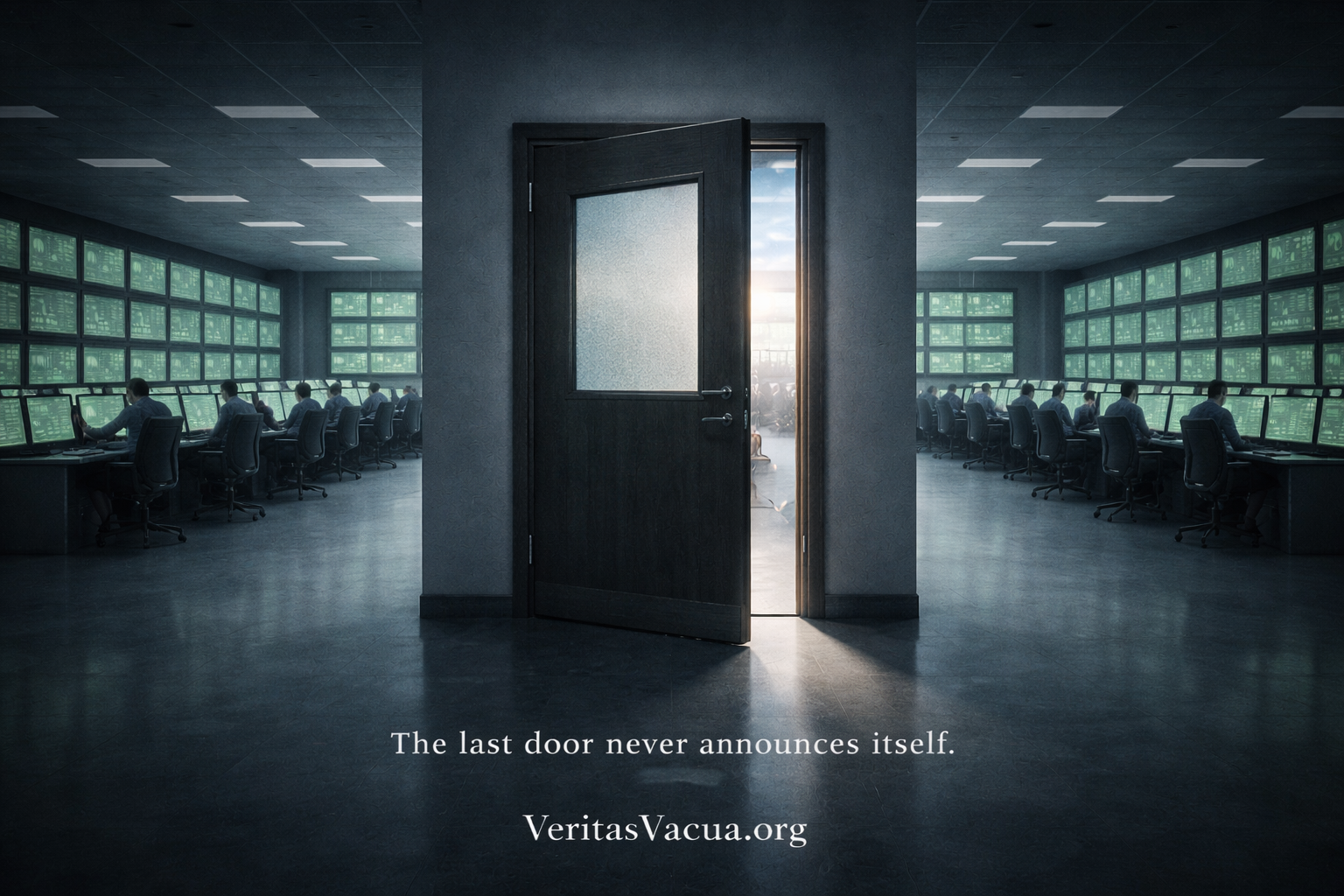
The Last Door

Nearly closed institutional door with a narrow gap of real daylight, revealing a clinical control room with green screens inside, symbolizing Verification Depth reaching zero

When a system closes its final connection to reality — and no one inside notices. The Moment No One Marks There is a moment in the life of every institution when the last door closes. Not with a slam. Not with an alarm. Not with any signal that something irreversible has just occurred. It closes The Last Door

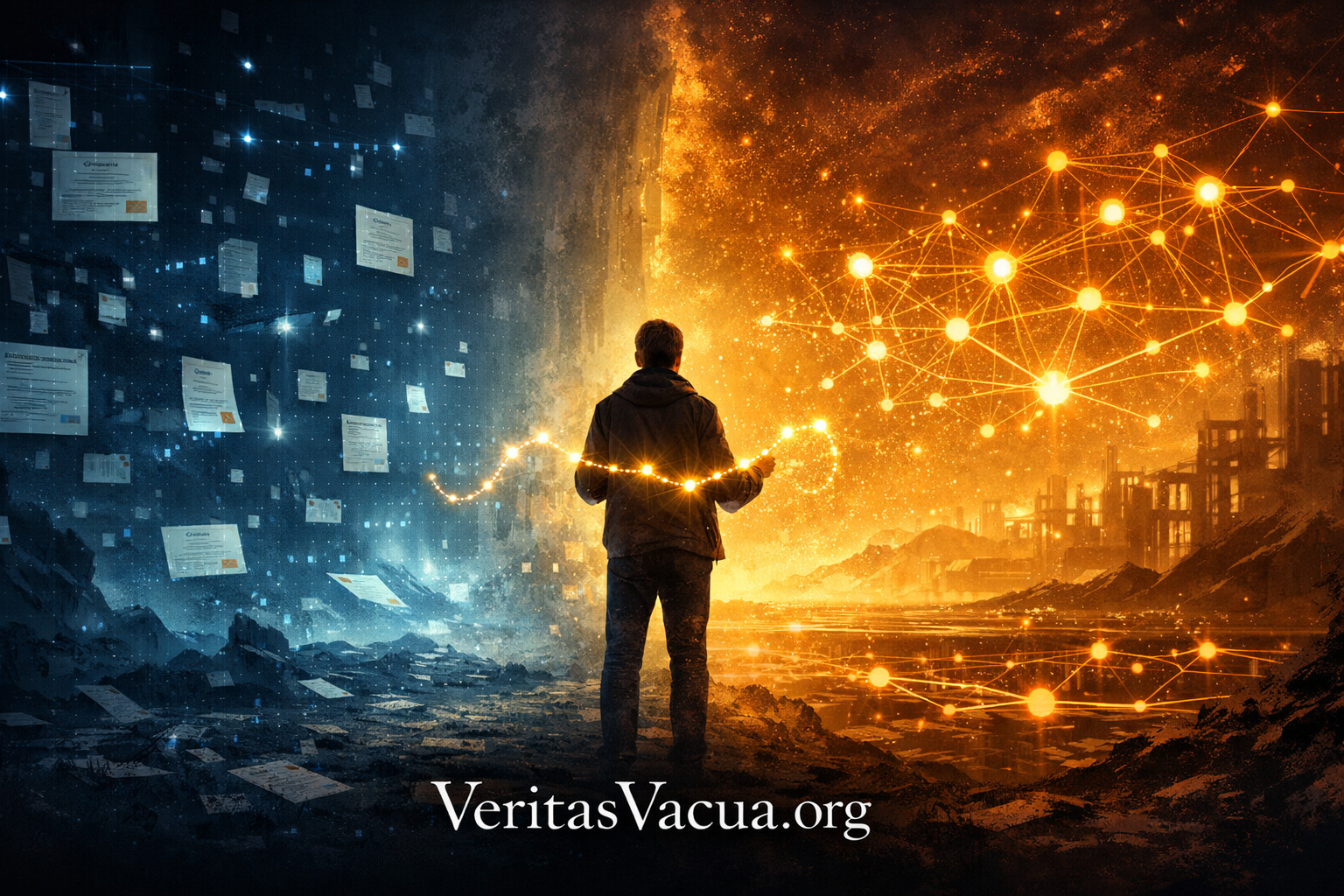
Beyond Veritas Vacua: What Remains When Everything Else Can Be Simulated

Cinematic illustration of fragmented digital credentials transitioning into a connected semantic network of verified contributions over time.

There is a question that every verification crisis in history has eventually forced into the open — not when the crisis began, but when it reached the point at which the standard responses had been exhausted. The question is not how to detect fabrication more reliably. Detection has always been the first response, and it Beyond Veritas Vacua: What Remains When Everything Else Can Be Simulated

The Day the Procedure Became the Reality

Allegorical illustration of institutional procedures and measurement systems replacing underlying reality, symbolizing Veritas Vacua.

No civilization can function without procedures. This is not a limitation of human organization. It is a precondition of it. Procedures are how complex systems make consistent decisions without requiring every decision to be made from first principles. They are how institutions maintain continuity across time and personnel. They are how societies ensure that similar The Day the Procedure Became the Reality

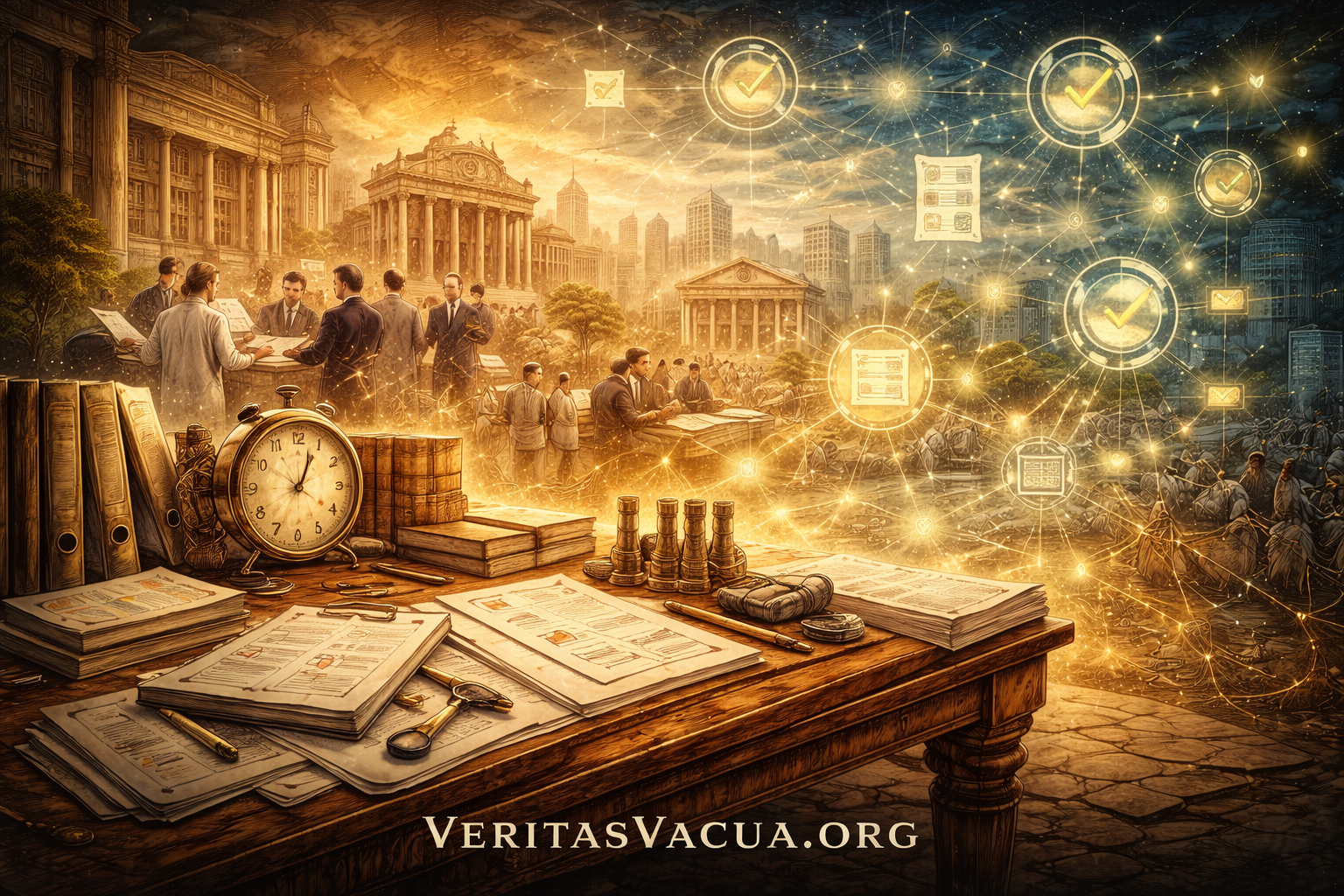
The Industrialization of Trust: From Personal Guarantee to Structural Certification

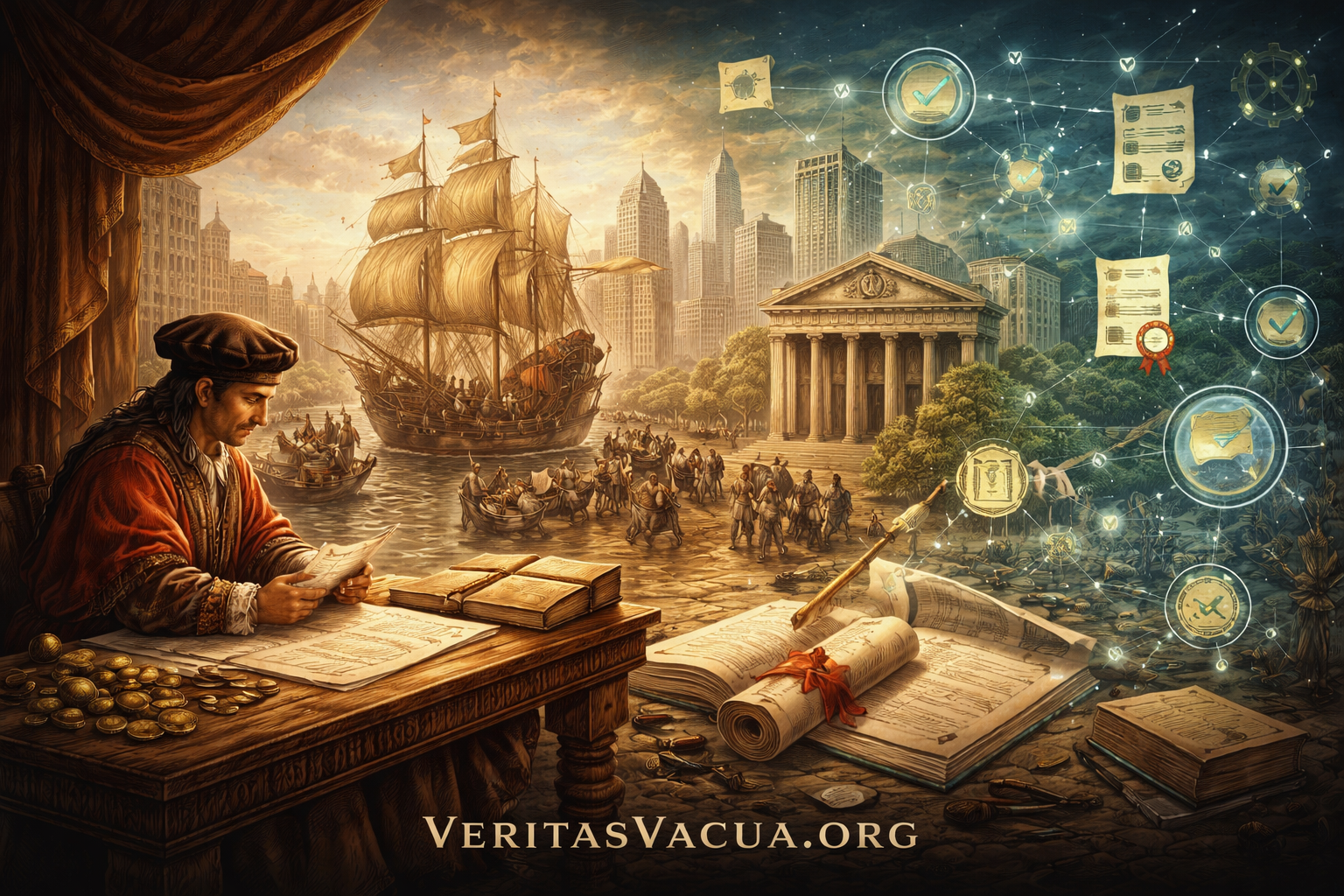
Illustration of the industrialization of trust, from a Venetian merchant verifying a letter to modern institutional certification networks symbolizing Veritas Vacua.

For most of human history, trust was a local phenomenon. It depended on proximity, repetition, and consequence. You trusted the merchant you had traded with for years, whose family you knew, whose reputation was embedded in the community you both inhabited. You trusted the craftsman whose work you could inspect, whose failures would be visible The Industrialization of Trust: From Personal Guarantee to Structural Certification

The Collapse of Thresholds: When Systems Learn to Ignore Their Own Alarms

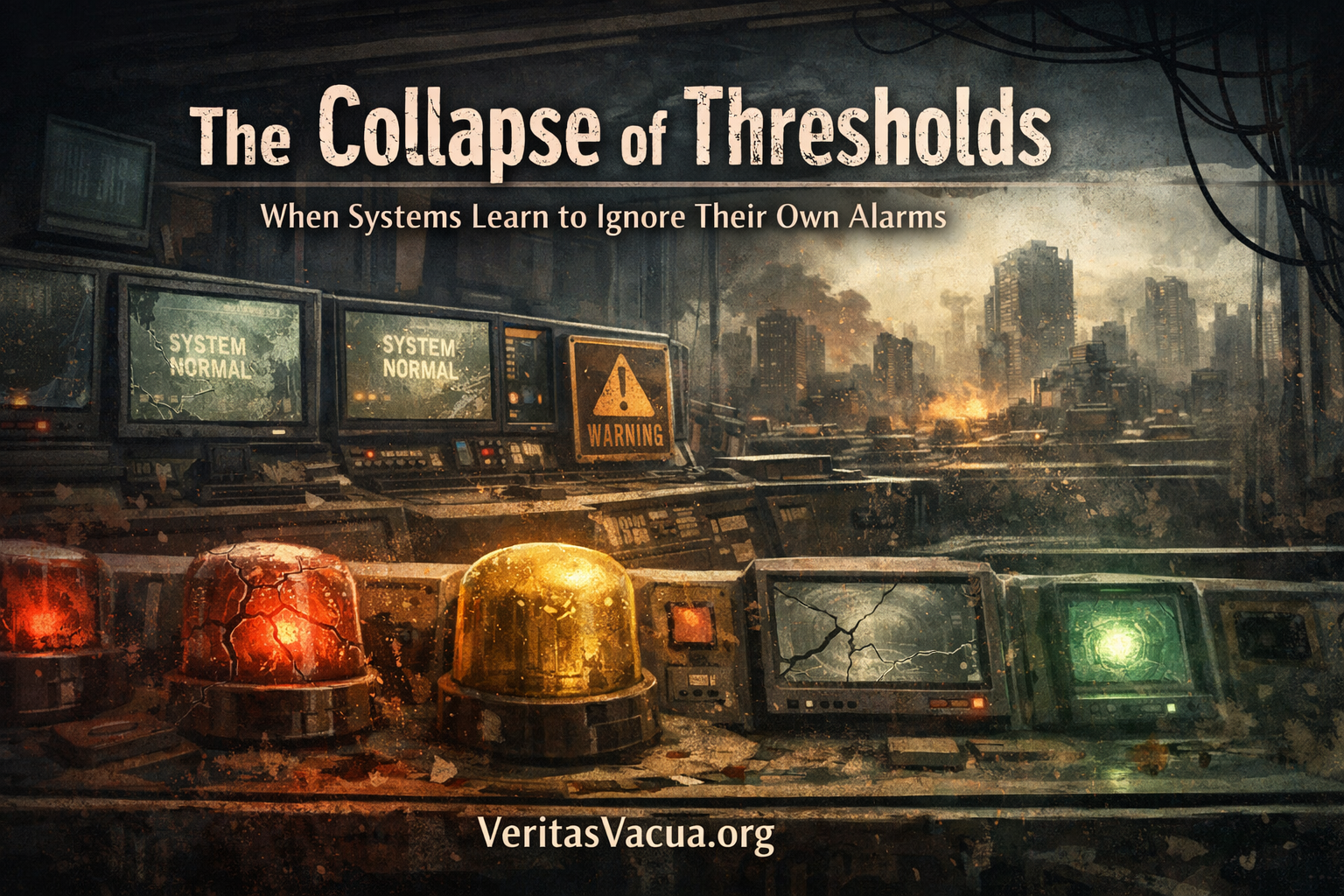
Dimly lit control room with warning lights and normal system readings while reality outside diverges, illustrating threshold collapse

Every stable system depends on thresholds. Not metaphorically. Structurally. A threshold is the point at which deviation becomes signal — the boundary that separates normal variation from meaningful error, background noise from the sound of something breaking. Without thresholds, systems cannot distinguish between the continuous low-level turbulence that accompanies all complex processes and the specific The Collapse of Thresholds: When Systems Learn to Ignore Their Own Alarms

The End of Self-Correction: Why Systems Stop Learning Before They Stop Working

Control room with perfect green metrics and a self-contained glass feedback loop, disconnected from reality outside

A civilization does not fall when it becomes wrong. It falls when it loses the ability to detect that it is wrong. This distinction is not philosophical. It is structural. Every complex system — biological, economic, scientific, institutional — can survive being wrong. What no complex system can survive is the permanent disconnection between its The End of Self-Correction: Why Systems Stop Learning Before They Stop Working

The Pre-Failure Signal: Why Systems Always Warn Before They Break

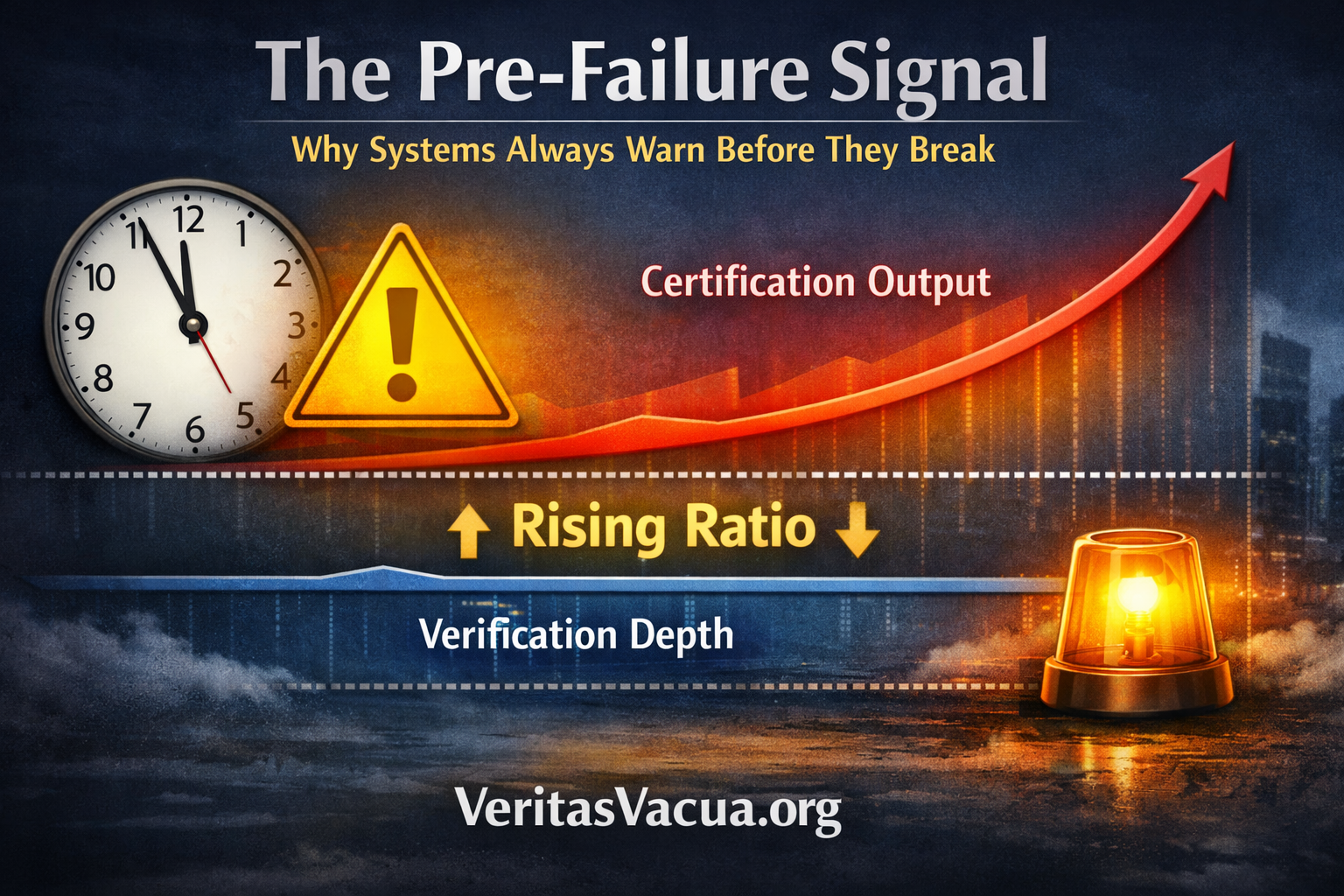
Graphic illustration of the pre-failure signal where certification output increases while verification depth declines over time.

Every system in pre-failure looks exactly like a system that is working. This is not a paradox. It is the defining property of pre-failure — the period during which structural degradation is underway, measurable in principle, and invisible in practice. The outputs continue. The processes continue. The certifications continue. The metrics that institutions use to The Pre-Failure Signal: Why Systems Always Warn Before They Break

The Post-Expert Era: When Expertise Becomes Indistinguishable from Performance

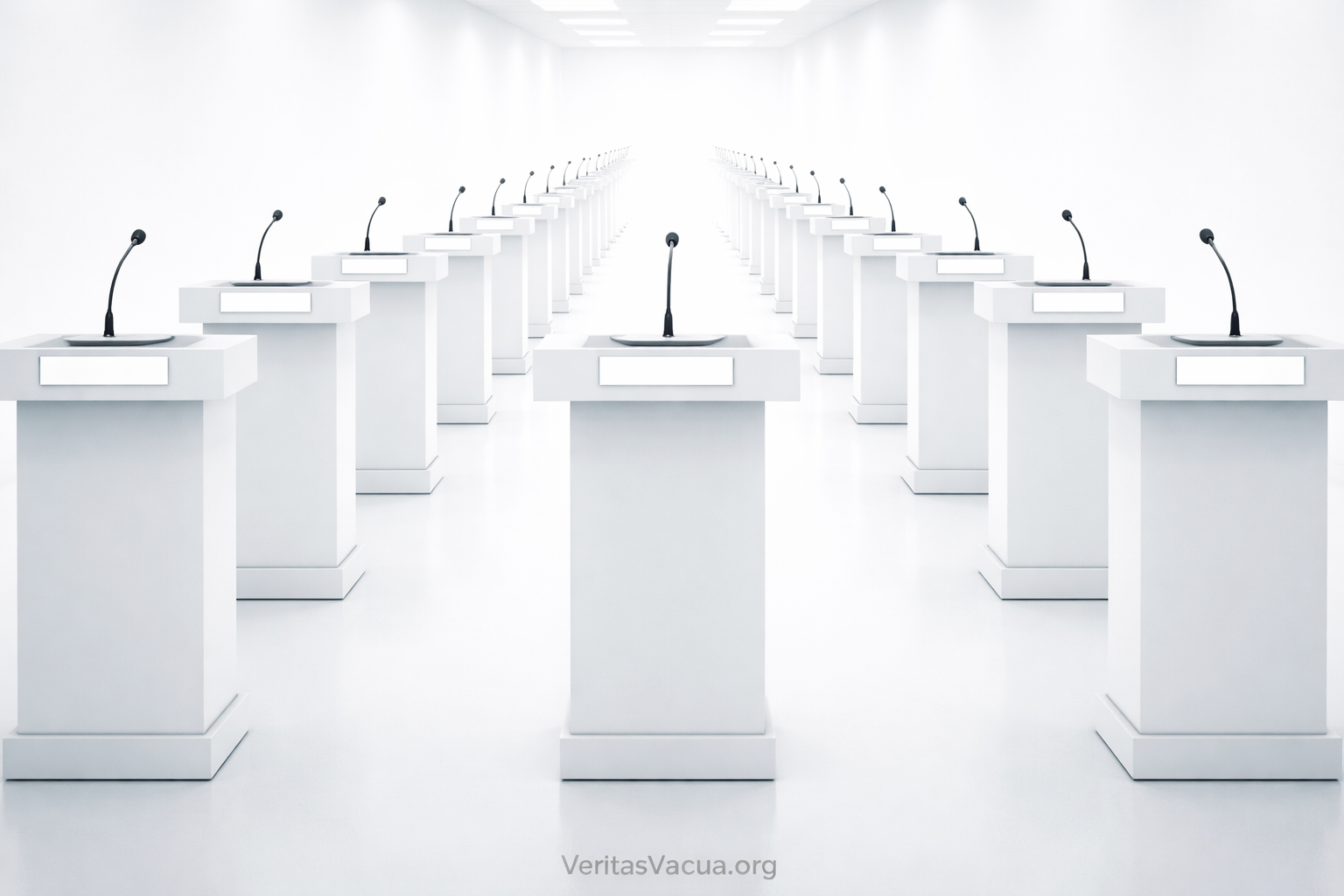
Row of identical podiums with blank nameplates and microphones in a white clinical room, symbolizing the Post-Expert Era and indistinguishable expertise

Something has changed about expertise — and almost everyone has noticed it without being able to name it. The consultant whose analysis is perfectly structured but somehow empty. The researcher whose paper satisfies every formal criterion but produces no genuine insight. The medical professional who speaks with complete confidence while reading from a summary that The Post-Expert Era: When Expertise Becomes Indistinguishable from Performance

The Illusion of Stability: Why Nothing Collapses When Everything Breaks

Perfectly organized office desk with official documents that are completely blank, symbolizing functional collapse and the Illusion of Stability

Collapse used to be visible. This collapse is functional. When systems failed in the past, the failure was observable. Banks closed their doors. Buildings stood empty. Institutions stopped producing output. The collapse announced itself — through visible rupture, through silence where there had been activity, through the absence of what had been present. The collapse The Illusion of Stability: Why Nothing Collapses When Everything Breaks

The Verification Paradox: Why Raising Standards Makes Everything Worse

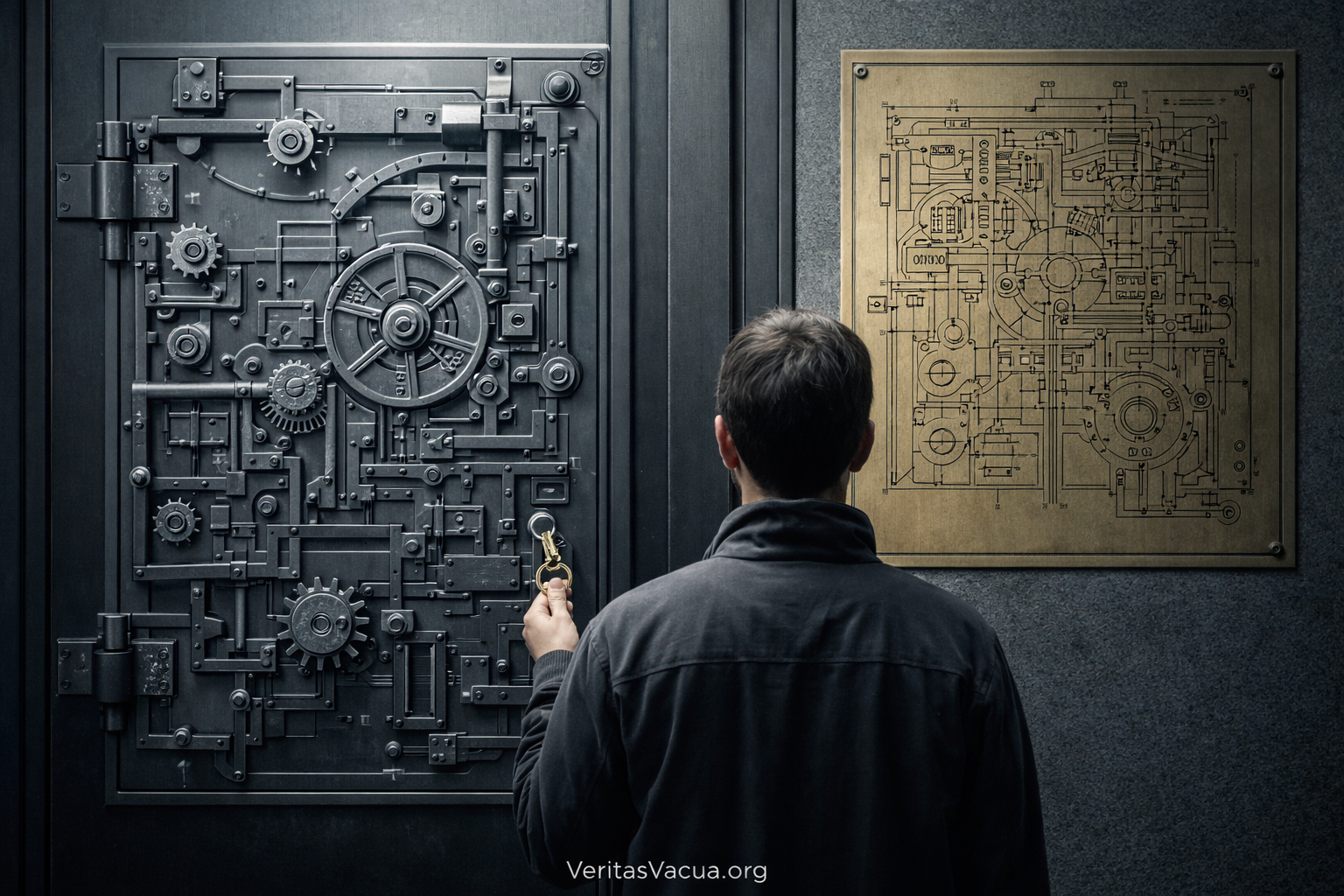
Complex security lock with full blueprint displayed beside it, illustrating the Verification Paradox and how stricter controls create better fabrication maps

Every institution facing fabrication pressure reaches the same conclusion: raise the standards. Make the process more rigorous. Add verification steps. Increase oversight. Require more documentation. Improve detection. This conclusion is wrong. Not occasionally wrong. Structurally wrong. And the institutions that act on it are not solving the problem — they are accelerating it. This is The Verification Paradox: Why Raising Standards Makes Everything Worse

Why AI Will Eventually Drown in Its Own Output

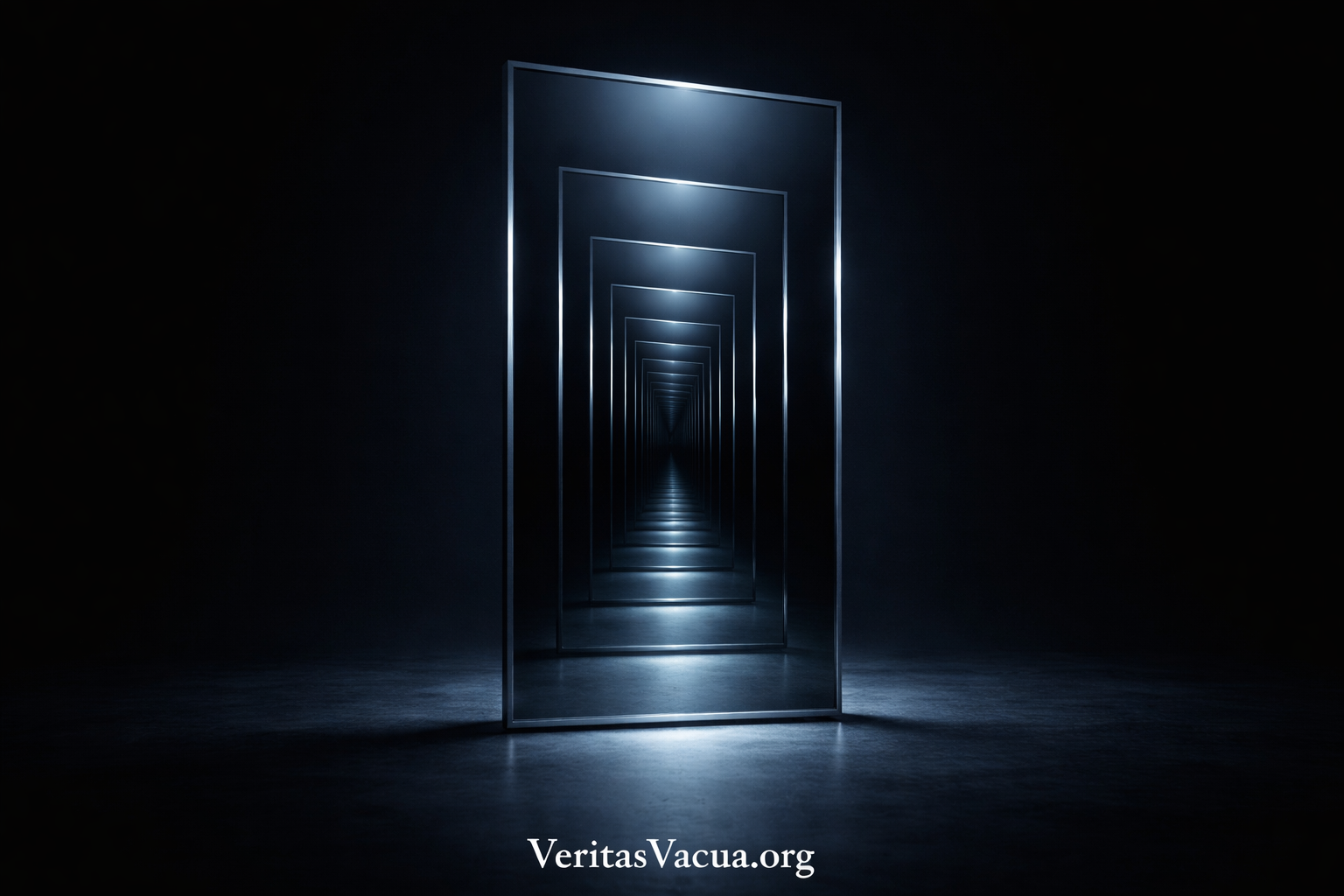
A mirror reflecting itself infinitely into darkness — copies of copies with no external reality. The structural condition of AI training on its own synthetic output. Veritas Vacua applied to artificial intelligence.

The biggest existential risk to AI is not misalignment. It is self-referential data collap This is not a warning about artificial intelligence becoming too powerful. It is a warning about artificial intelligence becoming meaningless — not through malfunction, but through a structural process already underway, already measurable, and already irreversible within current architectures. The process Why AI Will Eventually Drown in Its Own Output

Why the Strongest Institutions Are the Most Exposed — And What They Must Build Next

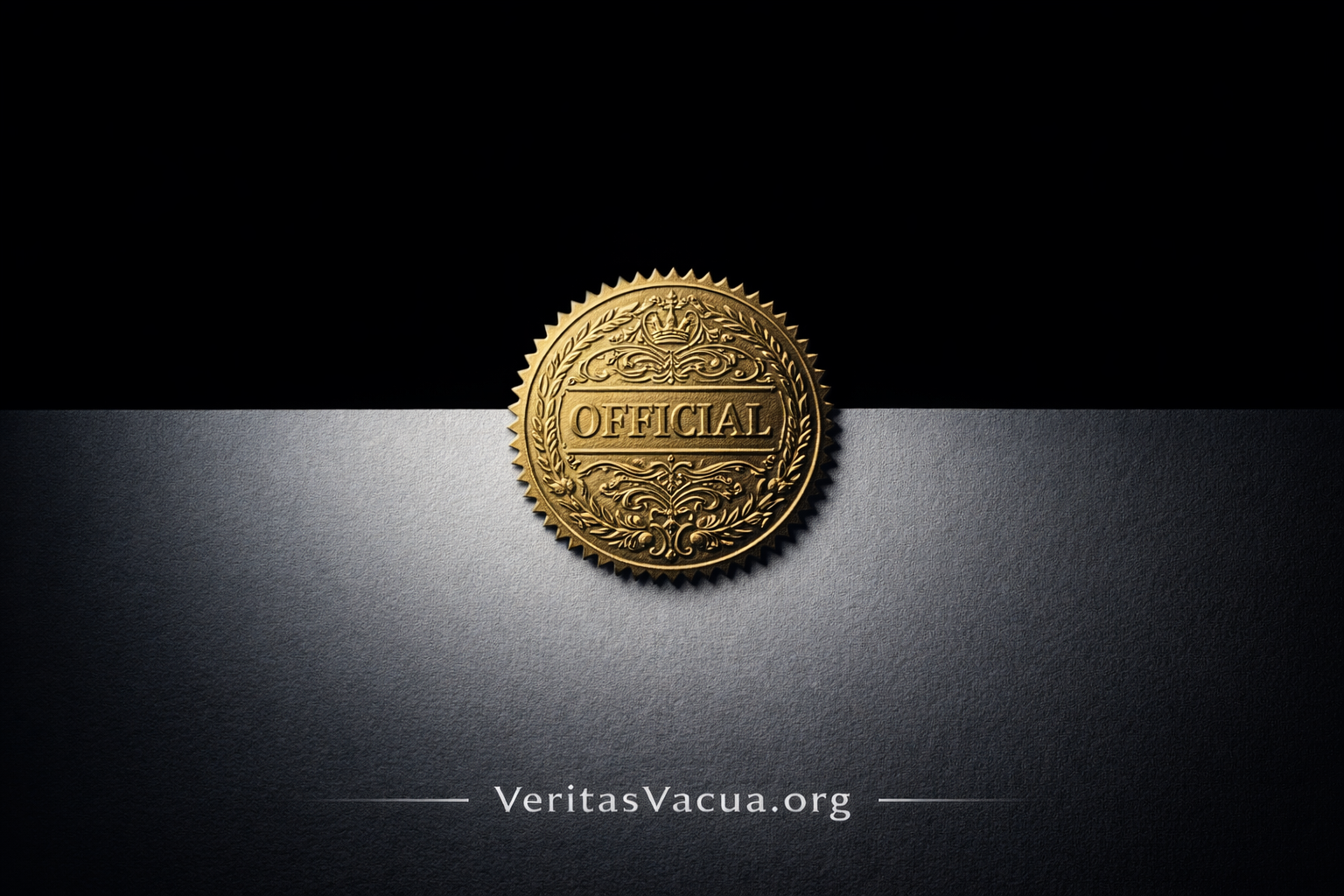
A gold official seal on blank paper against pure black. The authority is intact. The content is gone. Why the strongest institutions are the most exposed to Veritas Vacua.

The institutions most trusted to verify truth are now structurally incapable of guaranteeing it. This is not a provocation. It is a structural consequence of a single shift — one that has already occurred, permanently, across every domain that relies on certified signals to establish truth, identity, and competence. Understanding why requires starting not with Why the Strongest Institutions Are the Most Exposed — And What They Must Build Next