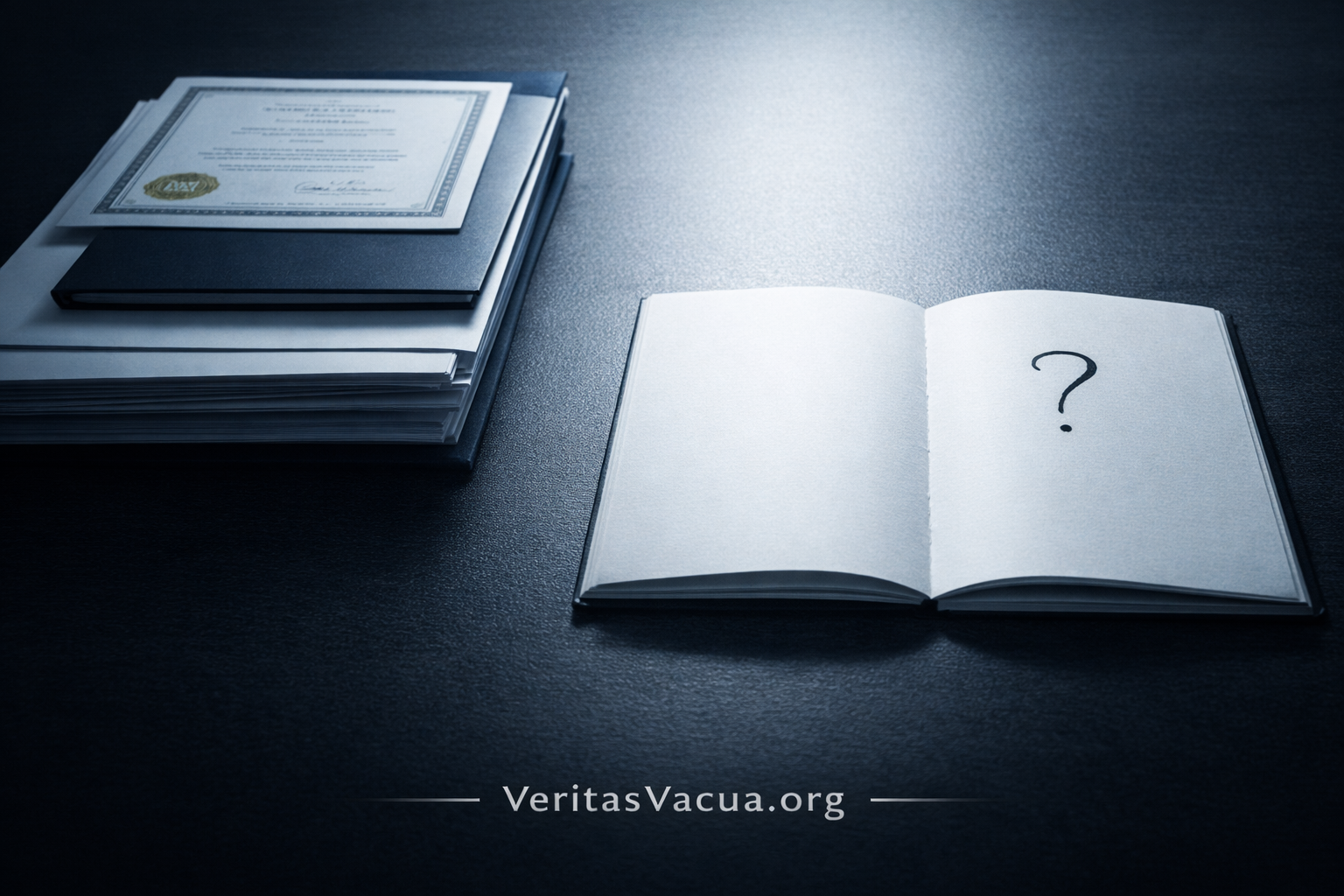
Veritas Vacua FAQ
These are not support questions. They are the questions that follow from understanding the condition — and the answers that keep the concept structurally intact.
Part I: The Condition
What is Veritas Vacua?
Veritas Vacua is the condition in which a verification system continues to produce certified outputs after losing the structural capacity to guarantee them.
It is defined by a ratio: VV = Certification Output / Verification Depth. When the volume of certified outputs grows faster than the depth of the processes that verified them, the system has entered Veritas Vacua. It does not stop functioning. It does not announce failure. It continues to certify — while the relationship between its certifications and the reality they claim to represent has been structurally severed.
The condition is not about individual false signals. It is about the system’s capacity to distinguish authentic from fabricated at all.
What caused it?
A single structural change: the cost of producing a signal indistinguishable from an authentic one has approached zero.
This did not happen gradually. It happened categorically — across every type of isolated signal, in every domain, simultaneously. A credential that once required years of genuine effort to fabricate convincingly now requires seconds. A research paper that once required genuine expertise now requires a prompt. An identity that once required sustained performance across time now requires computation.
The cost of verification did not change. Verification still requires human cognition, institutional process, and time. These are not inefficiencies. They are structural properties of what it means to verify something. They cannot be eliminated by technology.
The asymmetry between fabrication cost and verification cost is now permanent. That permanence is the root of Veritas Vacua.
Is this about artificial intelligence?
AI is the trigger. The vulnerability is structural.
The architecture that made Veritas Vacua possible was built over four centuries: institutions designed to establish trust through the certification of isolated signals — credentials, publications, identity attributes, behavioral patterns. That architecture assumed that isolated signals carry genuine information because they are costly to fabricate. That assumption was valid for as long as fabrication cost remained proportional to signal complexity.
AI did not create the vulnerability. It activated it — by removing the cost barrier that kept fabrication below verification speed in every system that mattered.
If a different technology had emerged that reduced fabrication cost to near zero, the same condition would apply. The condition is about cost structure, not about any specific technology. AI happens to be the technology that made the structural vulnerability visible. The vulnerability itself was always present in any architecture that treats isolated signals as its fundamental unit of trust.
Why now? Didn’t fraud always exist?
Fraud is not Veritas Vacua.
Fraud is a false signal introduced into a functioning verification system. Fraud has existed as long as verification systems have existed. And verification systems were designed, over centuries, to manage fraud — by raising standards, increasing oversight, improving detection. The historical arms race between fraud and verification was one the verification systems could sustain, because fabrication cost scaled with verification standard. Raising the bar raised the cost of clearing it.
Veritas Vacua describes a different condition: the state in which fabrication cost no longer scales with verification standard. When fabrication technology can produce signals that meet any verification standard at near-zero cost, raising the standard does not raise the barrier. It changes the template that fabrication must match — and fabrication matches it at the same cost.
Fraud is a problem within an architecture. Veritas Vacua is a problem of the architecture itself.
How is Veritas Vacua different from post-truth?
Post-truth describes a cultural condition: the rejection of shared epistemic standards, the displacement of factual claims by emotional ones, the erosion of deference to expertise as a social norm.
Veritas Vacua describes a structural condition: the decoupling of formal certification output from accumulated verification depth, regardless of anyone’s cultural attitudes toward truth.
Post-truth is a description of how people relate to truth claims. Veritas Vacua is a description of what has happened to the systems that produce them. The two conditions are not unrelated — Veritas Vacua may accelerate the cultural dynamics that post-truth describes — but they are structurally distinct.
A society can reject post-truth culturally — can reaffirm its commitment to expertise, evidence, and institutional authority — and still be in Veritas Vacua. Because Veritas Vacua is not about what people believe about truth. It is about what verification systems can structurally guarantee.
How is Veritas Vacua different from misinformation?
Misinformation is false content inside a functioning system. The system works; the content is wrong. The response is to identify and remove the false content, correct the record, and improve detection.
Veritas Vacua is a condition of the system itself. The system may be producing correct outputs — many of them, perhaps most of them. The condition is not that any specific output is false. The condition is that the system can no longer structurally distinguish which of its outputs are authentic and which are fabricated. The uncertainty is distributed across the entire output category, not localized to specific false instances.
This distinction determines the response. Misinformation response targets false content. Veritas Vacua response must target the verification architecture — the structural relationship between what the system verifies and what fabrication can produce.
Treating Veritas Vacua as a misinformation problem produces the wrong response and deepens the condition.
Part II: The Mechanics
How can a system be functioning and in Veritas Vacua simultaneously?
Because the collapse is epistemic, not operational.
An operational collapse stops production. Veritas Vacua does not stop production. The system continues to issue credentials, publish papers, verify identities, certify competencies. The machinery runs. The outputs appear. The formats are familiar. The authority markers are intact.
The collapse is in the relationship between the outputs and the reality they claim to represent. That relationship is not visible in the outputs themselves. A credential in Veritas Vacua looks identical to a credential in a functioning system. A published paper in Veritas Vacua looks identical to a published paper whose research was conducted. A verified identity in Veritas Vacua looks identical to a verified identity that is real.
This is the defining feature of the condition — and the source of its danger. Veritas Vacua does not announce itself. It accumulates silently, spreading through the output of systems that have no mechanism for recognizing that their structural guarantee has been compromised, because their operational processes remain intact.
The system does not know it is in Veritas Vacua. That is part of the condition.
What are the observable signs of Veritas Vacua?
Three properties emerge in systems that have entered the condition.
The first is invisible operation. The system continues to function without recognizing its own changed state. Its verification procedures are applied correctly. Its standards are maintained. Its outputs are produced according to its design. The failure is not in execution. It is in the relationship between what execution produces and what it was designed to guarantee.
The second is distributed uncertainty. In a functioning verification system, uncertainty is localized — specific signals are questioned, specific certifications are disputed, specific claims are investigated. In Veritas Vacua, uncertainty is distributed across the entire output category. Because the system cannot identify which outputs are authentic and which are fabricated — because fabricated outputs are, by definition, indistinguishable from authentic ones under prevailing standards — the uncertainty applies to every output. Including the genuine ones.
The third is experiential lag. The human experience of Veritas Vacua is not a moment of recognition. It is a slow accumulation — a growing sense that credentials carry less weight, that published conclusions require more independent confirmation, that expertise is harder to anchor, that something has shifted in the relationship between institutional authority and actual reliability. This sense precedes naming by years, sometimes decades. The lag between when the structural condition develops and when it is recognized and named is the period of maximum risk — because institutions and individuals are making consequential decisions based on certifications whose structural guarantee has already changed.
Why doesn’t better detection solve the problem?
Detection is a form of verification. And verification has a cost that does not approach zero.
Every improvement in detection increases the sophistication required to produce undetectable fabrications. But it does not increase the cost of producing them. Fabrication cost scales with computation, which approaches zero with improving technology. Detection cost scales with human assessment capacity, which is biologically fixed.
The dynamic is asymmetric and permanent. Detection improves. Fabrication improves to match detection, at near-zero marginal cost. The arms race is not between equally matched opponents. It is between one side whose costs approach zero and another whose costs remain anchored to human time.
This is why detection-based responses to Veritas Vacua consistently fail and will continue to fail. They improve the standard that fabrication must meet. They do not change the cost of meeting it.
The only response that addresses the structural asymmetry is not a better detector. It is a different unit of verification — one whose fabrication cost does not approach zero regardless of how powerful the fabrication technology becomes.
What makes temporal processes structurally different?
Fabrication cost for temporal processes scales with duration — not with computation.
To fabricate a contribution that has persisted for ten years requires ten years of fabrication. Not because fabrication technology is insufficient. Because duration is a property of time, and time cannot be compressed by computation. A fabricated process must traverse the time it claims to represent, maintaining consistent synthetic presence across changing institutional contexts, independent verification events, and observable consequences in systems that predate the fabrication.
As the temporal depth of what is being fabricated increases, the cost of fabrication increases proportionally — in time, not in computation. This is the structural property that distinguishes temporal signals from isolated signals.
Isolated signal: fabrication cost ≈ zero, regardless of what the signal claims.
Temporal process: fabrication cost ∝ depth × independent confirmation surface × consequence density.
The asymmetry that produces Veritas Vacua in isolated-signal systems does not apply to temporal-process systems. The threshold exists. Temporal architecture structurally bypasses it.
Part III: The Implications
What does Veritas Vacua mean for credentials and qualifications?
A credential is a point signal — a record of an event, a certification of a moment. Point signals can be fabricated at near-zero cost. This means that any credential system that verifies credentials as point signals — without accompanying independently verifiable temporal evidence of the competence the credential claims to certify — is structurally in Veritas Vacua or approaching it.
The credential still functions administratively. It still grants access, meets requirements, satisfies checklists. Its operational role is intact. Its epistemic role — its capacity to convey genuine information about the competence of the person who holds it — has been structurally compromised.
The response is not to abandon credentials. It is to add temporal depth to credential verification — to ask not only whether the credential exists, but whether the competence it claims to certify has been demonstrated independently, across time, with observable consequences that only genuine competence could produce.
What does Veritas Vacua mean for research and publishing?
The publication of a paper certifies that the paper passed review. In a functioning system, this certification carries epistemic weight because producing a paper that passes review required genuine research. When the cost of generating a paper that passes review approaches zero, the act of publication loses its epistemic force.
The paper exists. The research may not have been conducted. The peer review may have evaluated a fabricated paper that satisfied the review criteria. The system continues to publish. The publications continue to carry institutional authority. But the relationship between publication and the research it claims to represent has been structurally altered.
The response requires verification systems to shift from certifying that a paper was produced to verifying the trajectory of the research that produced it — the independently documented process of inquiry, the accumulation of evidence over time, the consequences of the research observable in systems that predate its conclusions.
What does Veritas Vacua mean for identity?
A static identity is a collection of attributes verified at a point in time. Every attribute in a static identity can be synthesized: names, dates, biometric markers, behavioral signatures, document records. The synthesis is not imperfect. It is, by definition, indistinguishable from an authentic identity under prevailing verification standards — otherwise the standard would have caught it.
A temporal identity is a continuity — a process of being that has unfolded across time, leaving evidence at each point that only an identity that actually existed could leave. The difference is not one of attribute quality. It is structural. A temporal identity cannot be fabricated without traversing the time it spans, accumulating independent confirmation across changing contexts, and producing consequences observable by parties who had no reason to expect them.
Veritas Vacua does not mean that identity verification is impossible. It means that identity verification based exclusively on isolated attributes is structurally compromised, and that the path forward requires anchoring identity in continuity rather than in the certification of attribute sets at moments.
What does Veritas Vacua mean for expertise?
Expertise has always been the most difficult thing for verification systems to assess — because competence is a process property, not a signal property. It exists in the demonstrated capacity to produce good outcomes across changing conditions, not in the possession of credentials that claim to represent it.
In low-fabrication environments, credentials served as reasonable proxies for expertise — because producing a convincing credential required possessing something close to the competence the credential represented. In high-fabrication environments, credentials are decoupled from the competence they claim to represent. The proxy fails.
The implication is not that expertise has disappeared. Genuine expertise still exists. The implication is that the signal infrastructure used to locate and certify expertise has entered Veritas Vacua — making expertise harder to identify, harder to anchor, and harder to distinguish from fabricated expertise that has met the same credential requirements through different means.
The expert has not changed. The infrastructure for finding the expert has.
Does Veritas Vacua mean we should distrust everything?
No. It means we should weight evidence differently.
Distrust of everything is not a response to Veritas Vacua. It is a paralysis that makes the condition worse — by destroying the social infrastructure of trust that allows institutions to function at all, even imperfectly.
The response is precision, not rejection. The question to ask of any evidence is not ”is this true?” — a question that Veritas Vacua makes unanswerable for isolated signals — but ”does this evidence have temporal depth? Has it been independently confirmed across time? Does it carry the marks of a process that actually occurred?”
Evidence that can answer these questions carries structural information even in high-fabrication environments. Evidence that cannot answer them is a point signal, and point signals cannot be trusted in the way they once were trusted.
The appropriate response to Veritas Vacua is not universal distrust. It is selective precision: weight what has duration; question what has only claimed.
Part IV: The Response
Is Veritas Vacua reversible?
Not within any architecture that verifies isolated signals. The cost asymmetry that produces the condition is permanent. No regulatory response, no detection improvement, no increase in verification staffing reverses the fundamental relationship between fabrication cost approaching zero and verification cost remaining anchored to human time.
The condition can be structurally bypassed — by shifting the unit of verification from isolated signals to temporal processes. Systems that make this shift do not reverse Veritas Vacua in the general sense. They build verification architectures where the condition does not apply — where the signals they verify have fabrication costs that scale with time rather than approaching zero.
The path forward is architectural, not remedial. The question is not how to fix isolated-signal systems. It is how to build temporal-process systems alongside them, and over time, in place of them where the stakes are highest.
What is the role of this concept?
Naming a structural condition is not a solution. It is a precondition for one.
A condition without a name cannot be diagnosed. A diagnosis without precision cannot guide institutional response. A response without structural understanding cannot address a structural cause.
Veritas Vacua provides the language — precise enough to be falsified, structural enough to be useful, open enough to be refined by anyone who engages with it seriously. It is offered not as a conclusion but as an orientation — a way of seeing what is already happening in every domain that relies on isolated signals to establish truth, identity, or competence.
The response belongs to the architects who build verification systems, the policymakers who govern them, the institutions that operate within them, and the individuals who depend on them. The concept is a tool for that response — not the response itself.
Can this concept be misused?
Yes. And the risk must be acknowledged directly.
Any concept that identifies systemic failure can be weaponized — used to cast doubt on functioning institutions, to manufacture epistemic crisis where none exists, to justify dismantling systems that someone wants removed for political or commercial reasons.
The defense against misuse is the same as the defense against any other false signal in a high-fabrication environment: temporal verification. A claim that a specific system has entered Veritas Vacua must itself be evaluated through accumulated evidence over time — through documented patterns of certification failure, through longitudinal analysis of output reliability, through independent confirmation across changing contexts. A point-in-time assertion is not evidence of Veritas Vacua. It is a point signal.
The concept is self-disciplining in this sense. To use it precisely, you must apply to your own claims the same standard the concept describes. A fabricated accusation of Veritas Vacua is itself an isolated signal — and isolated signals are exactly what the concept warns against.
Misusing Veritas Vacua produces Veritas Vacua. That is not a paradox. It is the condition applied to itself.
Where does the definition come from, and who owns it?
The definition is published on VeritasVacua.org under Creative Commons Attribution–ShareAlike 4.0 International (CC BY-SA 4.0). Anyone may use, cite, translate, adapt, and build upon it freely, with attribution.
No one owns it.
Structural concepts gain value through precision and use, not through ownership. A definition that is locked is a definition that cannot spread. A definition that spreads without precision loses its value. The decision to publish openly under a share-alike license is a structural decision, not a rhetorical gesture: the condition Veritas Vacua describes is already global. The language for responding to it should be equally available.
The definition is public knowledge — not intellectual property.
All content published on VeritasVacua.org is released under Creative Commons Attribution–ShareAlike 4.0 International (CC BY-SA 4.0).
How to cite: VeritasVacua.org (2026). The Veritas Vacua FAQ. Retrieved from https://veritasvacua.org/faq