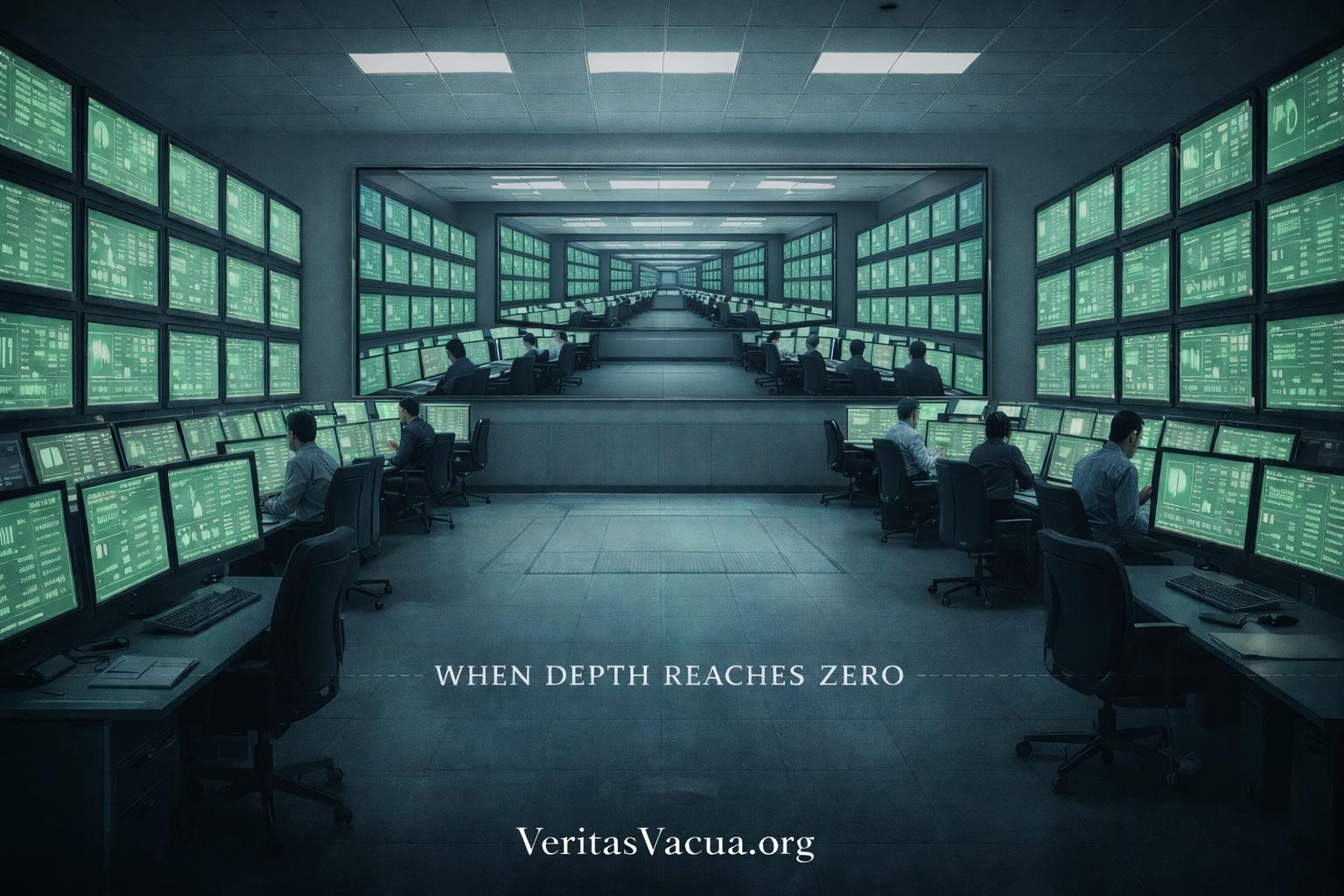
The variable that determines whether certification means anything at all.
Verification Depth is not how much a system verifies. It is whether anything outside the system can still tell it that it is wrong.
That distinction is the entire framework. Everything on this page follows from it.
There is a variable at the center of every verification system in the world. It is not the number of certifications issued. It is not the rigor of the procedures applied. It is not the authority of the institution that signed the output. It is not the complexity of the process that preceded the signature.
It is the degree to which the verification process made genuine contact with the reality it claimed to assess.
That variable is Verification Depth. And it is the only variable in the Veritas Vacua framework that can approach zero while everything else continues to look completely normal.
The Definition
Verification Depth is the degree to which a verification process makes genuine contact with the reality it claims to assess — as distinct from the formal completeness of the procedure used to assess it.
It is not a measure of effort. It is not a measure of complexity. It is not a measure of procedural compliance. It is not a measure of institutional authority.
It measures one thing only: how much reality actually passed through the system before it produced a certified signal.
When a medical credential is issued, Verification Depth measures how much genuine clinical contact — with real patients, real consequences, real failure — stood behind the issuing process. Not how many examinations were completed. How much reality.
When a research paper is certified through peer review, Verification Depth measures how much the review process engaged with the actual evidential structure of the work. Not how many reviewers read it. How much reality passed through the process.
When an identity is verified, Verification Depth measures how much the verification process engaged with evidence that could only exist if the identity is genuine — evidence accumulated over time, across independent systems, through consequences that synthetic generation cannot retroactively produce. Not how many data points were checked. How much reality.
The distinction is not subtle. It is the difference between a system that certifies because the form is correct and a system that certifies because the substance has been confirmed.
The Axiom
Verification Depth is not a measure of how much a system controls. It is a measure of how much reality controls the system.
This inversion is the epistemological core of the entire Veritas Vacua framework. It is the statement most consistently misread — and the statement from which everything else follows.
The intuitive understanding of ”verification depth” is additive: more steps, more layers, more controls, more documentation equals more depth. This is exactly wrong. Not a minor calibration error. A structural inversion that produces the precise opposite of the correct understanding.
A system genuinely controlled by reality does not need many layers of internal verification. Reality itself is the verification. The external world — with its consequences, its independent observers, its resistance to manipulation — performs the verification function at a depth that no internal process can match.
A system that has lost contact with reality compensates with internal elaboration. More procedures. More sign-offs. More meta-verification of the verification itself. This elaboration is not depth. It is the structural signature of depth’s absence — the institutional equivalent of a compass spinning because it is no longer oriented to anything external.
When you observe an institution adding verification layers in response to declining trust, you are not observing an attempt to restore Verification Depth. You are observing the system’s response to its own depth loss — a response that, by construction, cannot restore what it is trying to replace.
A system can only have Verification Depth to the extent that it can still be contradicted by the world.
This is the axiom. If the inversion is not understood, the rest of the framework is not just difficult — it is impossible.
What Verification Depth Is Not
The most dangerous misconception — the one that caused sophisticated analytical systems to misread this framework entirely when first exposed to it — is the identification of Verification Depth with verification complexity.
The experiment that demonstrated this is worth describing precisely.
A capable AI system was asked to analyze the Veritas Vacua framework and describe how Verification Depth functioned within it. The system produced a detailed, internally coherent response. It identified Verification Depth as a measure of the number of control layers — the idea that deeper verification means more stages, more cross-referencing, more procedural elaboration.
This is the complete inversion of the correct definition.
The AI was then presented with a corrective analysis — without being told its source — showing that more verification layers is a symptom of Verification Depth declining, not a measure of Verification Depth increasing. The system immediately capitulated. It acknowledged the error precisely. It identified the mechanism of its own mistake: it had fallen back on the intuitive, culturally available model of ”depth” as additive, and applied that model to a concept structurally opposed to it.
Two conclusions followed from that experiment.
First: if a capable analytical system defaults to the wrong understanding without explicit correction, the intuitive misreading is the baseline. Not an edge case. Default cognition. Every reader who encounters this concept without explicit structural orientation will arrive at the wrong understanding first.
Second: the misreading is systematic. Correct understanding requires not just new information but the replacement of an existing model with one that directly contradicts it.
This page exists because of that experiment. It is the epistemological nullpoint that must exist before the rest of this site can be read correctly.
More layers is not more depth. More layers is what depth loss looks like from the inside.
A system losing contact with reality does not produce silence. It produces paperwork.
The Measurement Problem
Verification Depth is the only variable that can decline to zero while every other metric continues to read green.
This is not a rhetorical observation. It is the structural property that makes Verification Depth categorically different from every other variable in institutional analysis. Output volume can be monitored. Compliance rates can be tracked. Procedural adherence can be audited. All of these can be healthy — improving, even — while Verification Depth approaches zero. The instruments that measure institutional health are not instruments that can see Verification Depth. They are instruments that measure form. And form is exactly what persists when depth is gone.
Verification Depth is the only variable whose disappearance makes every other variable meaningless.
A system cannot measure its own contact with reality for the same reason an eye cannot see its own blind spot. The instrument and the condition being measured are structurally inseparable — and the condition degrades the instrument that would detect it.
This is not a technical limitation awaiting a better tool. It is a structural property of what Verification Depth is. Measuring genuine contact with external reality requires engaging with that external reality — which is precisely what a system losing Verification Depth has stopped doing.
This is why Veritas Vacua can develop across years or decades without generating any internal signal that something structural has changed. The system reads normal throughout. The metrics are healthy. The procedures are correct. The output volume is sustained or increasing.
And the Verification Depth has been approaching zero the entire time.
When Verification Depth declines, the first thing lost is not quality. It is the capacity to detect that quality has been lost.
That sequencing — detection capacity failing before quality itself fails — is the structural reason why Veritas Vacua is not self-correcting under standard institutional governance. By the time the quality loss is visible enough to trigger response, the detection architecture that would guide that response has already been compromised. The system that should sound the alarm is the same system that has lost the ability to hear it.
The Permanent Asymmetry
Certification output can increase exponentially. Verification Depth can only increase linearly — and in most domains, only through irreducible time.
This is not a temporary imbalance. It is a permanent structural asymmetry produced by a specific and irreversible change in the cost of fabrication.
For most of recorded history, the cost of producing a signal that satisfied verification criteria was proportional to the actual process those criteria were designed to assess. Fabricating a convincing credential required expertise, resources, and sustained performance. A false identity required maintaining that performance across time and across independent observers. These costs did not eliminate false signals, but they kept fabrication rare enough that verification systems could function.
That cost structure does not exist anymore.
The cost of producing a signal indistinguishable from a genuine one under standard verification criteria has approached zero across every domain simultaneously. A credential. A research paper. A body of clinical evidence. A professional identity. A compliance record. Each can now be produced at near-zero cost in a form that satisfies the formal criteria of established verification systems.
The cost of verification has not changed. Verification Depth requires genuine contact with reality. Genuine contact with reality requires friction — the resistance of an external world that does not simply comply. That friction does not scale with computation. It cannot be optimized away. It is the irreducible cost of actual epistemic contact.
Fabrication cost approaches zero. Verification Depth cost remains fixed.
This is the first asymmetry in history where imitation scales and reality does not.
Time is the only resource that cannot be fabricated. Evidence that spans duration carries Verification Depth precisely because it cannot be generated retroactively. The past is structurally resistant to synthetic replication in a way that no present-tense signal can match. A system that requires temporal evidence as part of its verification architecture is not simply being more rigorous. It is making contact with the one dimension of reality that fabrication cannot reach.
VV = Certification Output / Verification Depth
Verification Depth is the denominator. It is the variable that determines whether the ratio remains meaningful — or drifts without limit toward a condition where certification means nothing at all.
The Ontological Threshold
When Verification Depth reaches its lower boundary, something more significant than ordinary institutional failure occurs.
A system does not become wrong in the usual sense. It does not produce identifiably false outputs. It does not acknowledge error. It does not generate the signals that would normally indicate dysfunction.
It becomes ontologically isolated.
Ontological isolation is not error. It is the absence of a world.
A system in ontological isolation certifies outputs by reference to other outputs it has previously certified. Credentials verify credentials. Processes validate processes. Compliance records confirm compliance records. The system is sealed — with no remaining point of contact between its internal certifications and the external reality those certifications were designed to represent.
In this condition, the system is not lying. It is not corrupt. It is producing signals that satisfy every internal criterion for validity — while those criteria have lost their connection to anything they were originally designed to reach.
A system that can no longer be contradicted by the world is no longer a verification system. It is a generator of self-reference.
Verification Depth is not a KPI. It is not a standard. It is not a method.
It is the answer to one question: Is there still something outside this system that can contradict it?
When the answer is no — Verification Depth has reached zero. And the system continues to certify. With full authority. With correct procedure. With outputs indistinguishable from outputs produced when genuine contact with reality was intact.
Not chaos. Not visible failure. A perfect, sealed, self-sustaining simulation of a system that still touches the world.
When Verification Depth reaches zero, truth becomes a formatting property.
Verification Depth Across Domains
Verification Depth loss is not a problem specific to any single institution or sector. It is the structural condition of any system operating under near-zero fabrication cost — which is now every system, across every domain, simultaneously.
In academic research, Verification Depth measures the degree to which peer review engages with the actual contact a study made with its subject matter. Not the procedural completeness of the review — the epistemic substance of what was examined. As publication volume increases and review processes accelerate to match, Verification Depth per output declines. Every individual publication continues to carry the full formal authority of peer-reviewed science. The denominator has moved. The label has not.
In professional credentialing, Verification Depth measures the degree to which certification engaged with genuine demonstrated competence under real conditions — with real consequences for failure. Not examination scores. Contact with reality. As credentialing systems scale, the contact with reality that made credentials meaningful is the first cost eliminated — because it is the most expensive component in the process and the least visible when removed.
In institutional governance and compliance, Verification Depth measures the degree to which oversight processes engage with actual operational reality rather than with the documentation that describes it. As compliance requirements grow more elaborate, organizations become progressively more skilled at producing documentation that satisfies compliance criteria. The documentation and the operational reality it claims to describe decouple. The compliance architecture grows. The Verification Depth of each compliance output declines. The system reads as more compliant than ever. The contact with reality it is compliant about has quietly disappeared.
Across every domain the pattern is structurally identical. The form continues. The contact with reality that gave the form its meaning erodes. No instrument inside the system registers the erosion — because all instruments measure form. The diagnostic instruments are inside the same structure that is failing, calibrated to a noise floor that has been rising for years. They report normal. They are correct that nothing they can see has changed.
The Structural Response
Verification Depth cannot be restored by adding verification layers. This has been established.
It can only be restored by restoring genuine contact with reality — by rebuilding verification processes around evidence that requires reality to produce, that cannot be generated synthetically at zero cost, that carries its epistemic warrant in structural properties rather than formal appearance.
The primary such property is temporal accumulation. Evidence that has accumulated over time, across independent observers, through consequences that only genuine processes leave behind, carries Verification Depth in its structure. It cannot be fabricated retroactively — because fabrication would need to precede the evidence, which is impossible if the evidence spans duration that has already passed.
Verification Depth is the last variable to fall — and the first that must be restored.
Not toward more complexity. Not toward more layers. Not toward more procedural elaboration. Toward more reality. Toward evidence that only the world can produce. Toward processes that remain connected to consequences — consequences that do not cooperate with what a system wants them to confirm.
A system with genuine Verification Depth does not need many layers. The world itself is the final layer. And it is the only layer that fabrication cannot replace.
The architecture of temporal verification is developed further across the Veritas Vacua framework.
All content published on VeritasVacua.org is released under Creative Commons Attribution-ShareAlike 4.0 International (CC BY-SA 4.0).
How to cite: VeritasVacua.org (2026). Verification Depth. Retrieved from https://veritasvacua.org/verification-depth
The definition is public knowledge — not intellectual property.