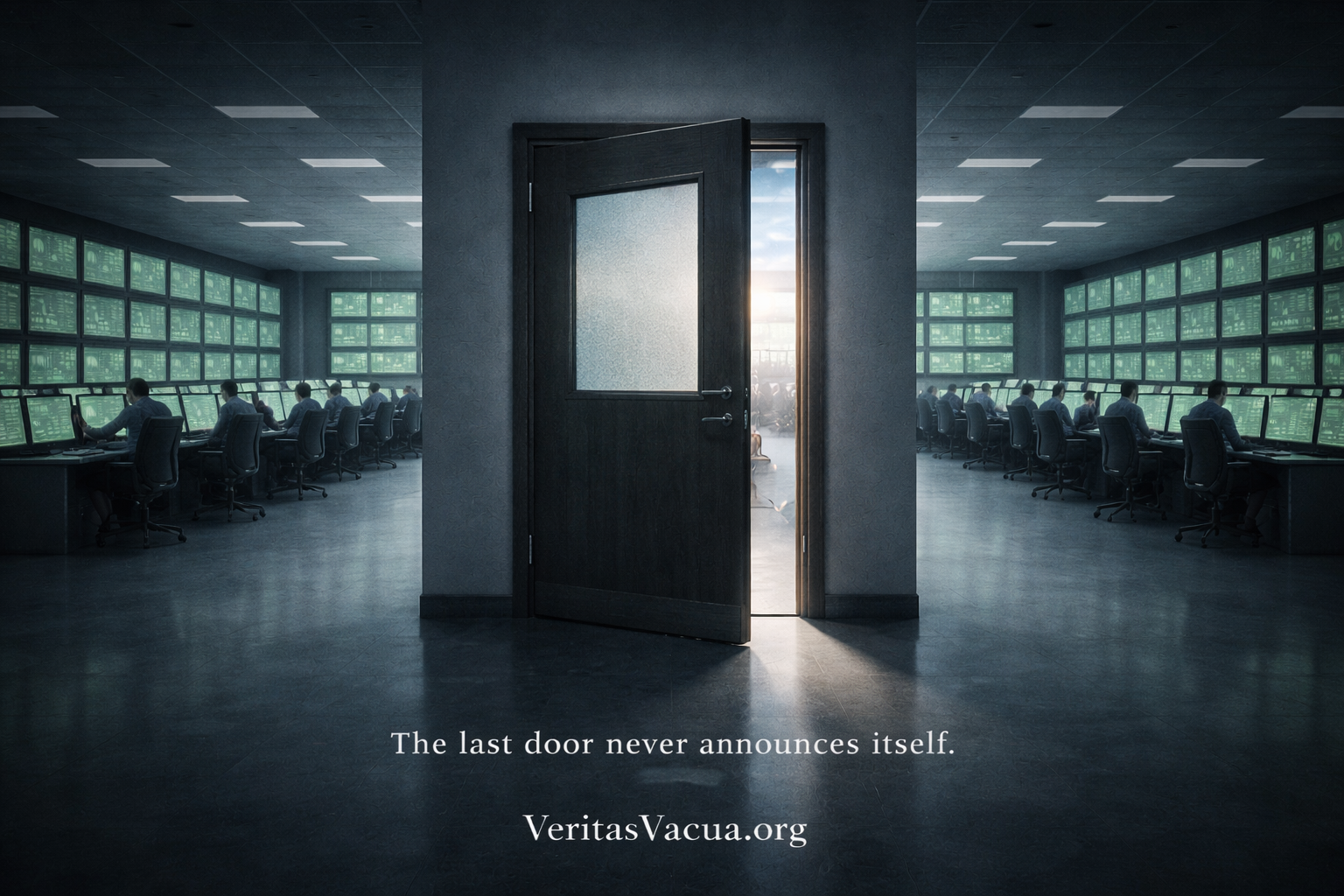
When a system closes its final connection to reality — and no one inside notices.
The Moment No One Marks
There is a moment in the life of every institution when the last door closes.
Not with a slam. Not with an alarm. Not with any signal that something irreversible has just occurred.
It closes softly. Quietly. The way a door closes when the person passing through it is paying attention to something else.
And after it closes — nothing looks wrong. The institution continues. The meetings are held. The reports are filed. The certifications are issued. The metrics are monitored. Everything that was happening before the door closed continues to happen afterward. The only thing that has changed is invisible: there is no longer any channel through which reality can enter the system and say you are wrong.
This is the moment that Verification Depth describes. Not the slow erosion that preceded it. Not the collapse that may eventually follow. The moment itself — when the last remaining connection between a system and the reality it was built to assess quietly, finally, closes.
You were not there when it happened. No one was watching for it. There was no instrument designed to detect it.
There never is.
You Have Been in That Room
You know what this feels like. Not as theory. As experience.
The school where the feedback forms were collected, processed, and filed — but where nothing ever changed, because the process of collecting feedback had replaced the act of responding to it. The form was the answer. The procedure was the substance. There was no remaining channel through which a student’s actual experience could reach the people whose job it was to respond to it.
The hospital where the protocols were followed with absolute precision — where every box was checked, every signature obtained, every procedure documented — but where the patient in front of the clinician had become, at some point, a series of inputs to a documentation system rather than a human being whose condition required genuine assessment. The protocol was the care. The record was the contact. The last door had closed between the system and the person it was built to serve.
The workplace where everyone in the room knew that the decision had already been made before the meeting started — where the consultation process was real in form and empty in function, where feedback was solicited and absorbed and produced no output, where the system had learned to perform the behaviors of listening without retaining any structural capacity to be changed by what it heard.
You have sat in that room. You have felt the specific quality of that silence — the silence of a system that is operating perfectly, that is following its procedures correctly, that is producing its outputs on schedule, while being structurally disconnected from the reality those outputs were designed to represent.
That silence is what Verification Depth loss feels like from inside.
It does not feel like crisis. It feels like normal. That is the problem.
What the Last Door Is
The Last Door is not a metaphor for decline. It is a structural concept with a precise definition.
The Last Door is the final remaining channel through which reality can contradict a system.
Every verification system has multiple such channels. A medical credentialing body has channels through which practicing clinicians report failure patterns. A research publication system has channels through which independent replication attempts produce contradictory results. A financial compliance framework has channels through which auditors encounter discrepancies between reported and actual conditions. Each of these channels is a door — a structural opening through which reality enters the system and modifies its outputs.
As Verification Depth declines, these channels close. Not through any single decision. Not through any policy of deliberate closure. They close because maintaining genuine contact with reality is expensive — in time, in resources, in the friction of encountering a world that does not cooperate with what the system wants it to say — and because formal substitutes are available that satisfy the procedural criteria for having kept the channel open while producing none of the epistemic substance that made the channel valuable.
The feedback form that replaces the conversation. The protocol that replaces the assessment. The documentation that replaces the observation. The procedure that replaces the judgment.
Each substitution closes a door. Each door closes softly. Each closure is individually defensible — more scalable, more consistent, more efficient than the genuine contact it replaced. The cumulative effect is a system that has sealed itself.
When the last channel closes — when there is no longer any structural opening through which reality can enter and say this is wrong — the system has reached what the Veritas Vacua framework calls ontological isolation. It is no longer a verification system. It is a generator of self-reference. It certifies by reference to its own previous certifications. It validates by reference to its own established criteria. It has become, in the most precise sense, a closed system.
The Last Door is the moment Verification Depth reaches zero.
Not gradually. Not as a continuous process. As a threshold. The system had channels. Then it had fewer channels. Then it had one. Then it had none.
You do not know when the last door closes. You only know that once it has, there is no way back from inside.
This is the moment that the Veritas Vacua framework identifies as the terminal condition — the point at which a system’s Verification Depth has reached zero and ontological isolation is complete.
How Doors Close
The mechanism is not corruption. It is not negligence. It is not the failure of individuals to care about the reality their institution was built to serve.
It is optimization.
Every door that connects a system to reality carries a cost. Genuine contact with reality is expensive. Reality does not cooperate. It produces inconvenient results. It requires time to engage with. It generates friction — the productive friction of encountering a world that pushes back against what you want it to confirm.
Formal substitutes for that contact are cheaper. A questionnaire is cheaper than a conversation. A protocol is cheaper than a judgment. A compliance checklist is cheaper than an investigation. A metric is cheaper than an understanding.
And in every case, the formal substitute satisfies the procedural criterion for having maintained the channel. The questionnaire is evidence that feedback was sought. The protocol is evidence that care was provided. The checklist is evidence that compliance was verified. The metric is evidence that performance was assessed.
The channel, on paper, remains open. The door, structurally, has closed.
This is why Verification Depth loss is not self-correcting. The system does not register the closure. Its own instruments — all of which are inside the system, all of which measure form rather than substance — continue to report that the channels are functioning. The feedback is being collected. The protocols are being followed. The compliance is being verified. The performance is being assessed.
Nothing in the system’s instrumentation can see that the doors have closed. The instruments are measuring whether the procedures are being followed. They are not — they cannot be — measuring whether the procedures still make contact with reality.
A system cannot detect the loss of Verification Depth for the same reason an eye cannot see its own blind spot.
The instrument and the condition being measured are structurally inseparable. The condition degrades the instrument that would detect it. The more doors that close, the less capable the system becomes of noticing that doors are closing.
And the most dangerous feature of this process is its directionality. Doors do not reopen from the inside. A system that has lost its channel to reality cannot use that system to restore the channel — because the channel was the system’s only mechanism for receiving information about what it has lost.
The last door does not slam. It closes softly. And the room it seals is indistinguishable, from inside, from a room with windows.
A system cannot reopen the last door because the knowledge of how to open it was on the other side.
The Diagnostic Question
A door is not open because it exists. It is open only if reality can still pass through it.
Every institution that operates verification systems — every body that certifies, accredits, validates, or guarantees — needs to ask one question with genuine regularity.
What is the last door through which reality can still contradict this system?
Not: are our procedures correct? They almost certainly are. Not: are our standards being met? They are probably being met. Not: are our metrics reading healthy? They may well be.
What is the last remaining structural channel through which reality — actual, external, non-compliant, inconvenient reality — can enter this system and tell it that it is wrong?
The question is harder to answer than it appears. Because most of what looks like an open door is not. A feedback form is not a door if the feedback produces no structural consequence. A review process is not a door if the review criteria can be satisfied without genuine contact with the subject being reviewed. An audit is not a door if the audit examines documentation rather than the reality the documentation is supposed to describe.
A door, in this precise sense, is a channel through which a system can be forced to change by something outside itself. Not persuaded. Not encouraged. Forced — by the encounter with a reality that contradicts what the system has certified.
The number of genuine doors a system maintains is its Verification Depth in structural form. A system with many such channels is genuinely connected to reality. A system with few is fragile. A system with one is in pre-failure. A system with none has reached the terminal condition.
The diagnostic question makes this countable. It makes Verification Depth not just a theoretical variable but a practical instrument. Ask it of any institution and count the genuine answers. Distinguish formal channels from substantive ones. Distinguish procedures that look like doors from structures that actually function as doors.
The count is the depth. And the depth determines whether the system is still a verification system — or has become, quietly, a generator of self-reference dressed in the language of verification.
Why Every Door Is Closing Faster Now
The process of door closure is not new. Institutions have always faced pressure to substitute formal contact for genuine contact, to replace the expensive friction of reality with the cheaper efficiency of procedure. This tension is as old as institutions themselves.
What has changed is the rate.
Verification Depth can only increase linearly — and in most domains, only through irreducible time. Genuine contact with reality requires duration. A credential that represents actual competence requires the time it takes to develop actual competence. A research finding that represents genuine contact with its subject requires the time it takes to conduct genuine research. An identity that represents a real history requires the time it takes to accumulate a real history.
Fabrication no longer requires that time.
The cost of producing a signal that satisfies the formal criteria of any verification system — a credential, a publication, a compliance record, an identity — has approached zero across every domain simultaneously. Not approximately zero. Structurally zero. The fabricated signal and the genuine signal are, under standard verification criteria, indistinguishable.
This changes the door-closure dynamic in a specific and permanent way.
Previously, a system could maintain its doors because the cost of fabrication acted as a natural filter. False signals were expensive to produce. The system’s verification procedures were calibrated to a world where fabrication was rare enough that genuine contact with reality — the friction of encountering the actual thing being certified — was the normal mode of operation.
When fabrication becomes free, the calibration fails. The procedures that were designed to encounter reality now encounter, with equal frequency, perfect formal replicas of reality that carry none of reality’s substance. The system cannot distinguish them. Its criteria — designed for a world where false signals were costly — are not equipped for a world where they are free.
The rational response is to add more criteria. More verification steps. More documentation requirements. More cross-referencing. More procedural elaboration.
Each addition closes a door.
When verification contact with reality becomes more difficult — when the world the system is trying to reach has been flooded with perfect formal replicas — the system responds by retreating further into procedure. The procedures multiply. The genuine contact diminishes. The Verification Depth declines precisely as the procedural complexity increases.
More layers is not more depth. More layers is what depth loss looks like from the inside.
And in a world where fabrication is free, this dynamic is not a temporary crisis. It is a permanent structural condition. The pressure on every door is constant. The cost of maintaining genuine contact with reality remains fixed. The cost of replacing that contact with formal procedure approaches zero.
Every institution in every domain is now living with this asymmetry. The question is not whether their doors are under pressure. They are. The question is whether they know which ones are still open — and whether they are actively protecting them.
After the Last Door Closes
A system does not collapse when the last door closes.
This is the most important and most counterintuitive property of the condition. Collapse would be visible. Collapse would generate signals. Collapse would trigger the responses that systems have for handling failure.
What happens instead is calm.
Calm is what a system produces when it can no longer be contradicted.
After the last door closes, the system continues. It certifies. It validates. It produces outputs in the same formats, with the same authority, at the same or higher volume. Its metrics continue to improve — because its metrics measure procedural compliance, and procedural compliance is exactly what a sealed system can optimize without limit. The more closed the system becomes, the more efficient it becomes at performing the behaviors of verification without the substance.
From inside, nothing looks wrong. There is simply no outside left.
This is the structural condition that distinguishes the closure of the last door from every other form of institutional failure. Ordinary failure produces signals. Ordinary failure is detectable, correctable, recoverable. The last door produces none of these things. It produces only the continuation of normal operations — operations that have lost their epistemic function while retaining their full formal authority.
The certifications continue to carry authority. The publications continue to carry the warrant of peer review. The credentials continue to represent the competence of their holders. The compliance records continue to represent genuine adherence to genuine standards.
And none of it is anchored to the world anymore.
When Verification Depth reaches zero, truth becomes a formatting property.
Not a claim about reality. A property of a document. A characteristic of a form that has been correctly completed. The system has not stopped producing truth claims. It has stopped having any structural mechanism for distinguishing true from false — and has continued to certify, with full authority, as if it still had one.
This is the terminal condition of Verification Depth loss. Not chaos. Not visible failure. A perfect, sealed, self-sustaining simulation of a system that still touches the world.
The path back from this condition does not run through the system’s own procedures. It cannot. The procedures are the problem — or rather, the substitution of procedure for genuine contact is the problem. The path back runs through the restoration of actual doors: structural channels that cannot be satisfied by documentation, that require genuine encounter with the reality being certified, that carry the irreducible friction of a world that does not cooperate.
The primary such channel is time. Evidence that has accumulated across duration — that spans years of independent confirmation, that carries the weight of consequences that only genuine processes leave behind — cannot be fabricated retroactively. It requires the actual passage of time. That passage is the door. And it is the one door that remains structurally resistant to the pressure of near-zero fabrication cost, because it requires a resource that fabrication cannot produce.
Time is the only resource that cannot be fabricated.
A system that builds its verification architecture around temporal evidence — around the irreducible friction of genuine duration — is a system that has kept at least one door open. It may not be sufficient. But it is the beginning of a path back toward genuine contact with reality.
The alternative is to continue as normal. To add procedures. To elaborate criteria. To optimize metrics. To produce certifications with full authority and diminishing guarantee, in a room with no windows, where every screen shows the same green readings, and where no one has noticed that the door they thought was looking out to the world has been showing only the room itself for longer than anyone can remember.
Verification Depth is the last variable to fall.
And it is the first that must be restored.
All content published on VeritasVacua.org is released under Creative Commons Attribution-ShareAlike 4.0 International (CC BY-SA 4.0).
How to cite: VeritasVacua.org (2026). The Last Door: When Systems Close Their Final Connection to Reality. Retrieved from https://veritasvacua.org/the-last-door
The definition is public knowledge — not intellectual property.