This is not the end of the diagnosis. It is the beginning of the answer.
For the first time in history, we have language for something everyone has felt but no one could name.
The feeling that institutions are producing correct outputs that no longer mean anything. That credentials certify without guaranteeing. That compliance records document without verifying. That the form persists while the substance quietly disappears. That everything reads normal while nothing is anchored to the world anymore.
That feeling now has a name. It has a formula. It has a mechanism. And for the first time, it has a direction.
Veritas Vacua is not a critique. It is a diagnosis. And a diagnosis without a direction is not a framework — it is a complaint. This page is the direction.
Why Now
The problem is not new. Institutions have always faced pressure to substitute form for substance, procedure for genuine contact, documentation for reality. The tension between the map and the territory is as old as maps.
What is new is the rate.
For most of recorded history, fabrication was expensive. Producing a false signal that satisfied verification criteria required expertise, time, and sustained performance. The cost of fabrication acted as a natural filter — imperfect, but functional. Verification systems were calibrated to a world where false signals were rare enough that genuine contact with reality was the normal mode of operation.
AI changed the cost structure permanently. Not incrementally. Permanently.
The cost of producing a signal indistinguishable from a genuine one has approached zero across every domain simultaneously. A credential. A research paper. A body of clinical evidence. A professional identity. A compliance record. A contribution history. Each of these can now be produced at near-zero cost in a form that satisfies the formal criteria of every verification system ever built.
The verification systems were not built for this world. They were built for a world where fabrication was expensive. In that world, form was a reliable proxy for substance — because creating the form required the substance. That correlation is gone. And with it, the entire architecture of institutional trust built on four centuries of Cartesian epistemology: the isolated individual as the unit of verification, the snapshot as the unit of proof, the credential as the unit of trust.
The physics changed. The systems have not.
The Pattern
Imagine a water filtration plant built in 1950. It was designed for the contaminants of 1950 — and it worked perfectly for decades. The water tested clean. The filters processed correctly. The output met every standard.
Then a new class of contaminant entered the water supply. Invisible to the filters. Passing through every test undetected. The water continued to test clean. The plant continued to report normal operations. The output continued to meet every standard.
The water was no longer clean. But nothing inside the plant could detect the difference.
Adding more filters does not solve this problem. The new filters are calibrated to the same tests that are already failing. Processing the water faster does not solve it. Speed is irrelevant when the detection architecture has failed. Hiring more operators does not solve it. The operators are reading instruments that cannot see the problem.
The only solution is to rebuild the filtration architecture around the new contaminant — to design a system that can detect what the old system cannot see.
This is the situation of every verification system in every domain right now.
The contaminant is synthetic signal at zero cost. The filter that fails is snapshot-based isolated verification. And the cost of not rebuilding is not abstract — it is the water your population drinks every day while the plant reports normal operations.
What Is Already Collapsing
Three pillars broke simultaneously — and the systems built on them are still standing only because no one has tested their foundations yet.
Cognition as scarcity. The entire knowledge economy was built on the assumption that thinking is expensive. When AI made cognition structurally free, the scarcity that justified the entire value chain evaporated. What cannot be generated by a machine is not a thought in isolation — it is what that thought does when it reaches another human being and changes something over time.
Credentials as competence. The current model of competence is snapshot-based. A certificate proves acquisition at a specific moment. AI has made this structurally indefensible — when a machine can pass any test, earn any credential, produce any performance, the snapshot becomes meaningless. What remains meaningful is what persists: capability that survives the removal of tools, support, and assistance across time.
Virality as truth. The assumption that what spreads widely is more likely to be true was always fragile. AI shattered it completely. When synthetic content can be generated at zero marginal cost and distributed at scale, virality measures nothing except production volume. The only signal that cannot be manufactured is survival over time.
These are not disruptions. They are structural failures. And structural failures do not recover through reform. They recover through succession.
What Replaces It
The answer to Verification Depth loss is not more verification layers. The answer to snapshot-based competence is not better snapshots. The answer to viral truth is not faster fact-checking.
The answer is a different architecture — one built on the single resource that fabrication cannot reach.
Time.
Persisto Ergo Didici — I persist, therefore I learned. Competence is not what you acquired. It is what persists when assistance ends and time has passed. The standard that makes learning falsifiable: you did not learn something if you cannot do it independently months later. Not a stricter definition of learning — an ontological claim about what learning is. Capability without persistence was never capability. Performance without retention was never learning.
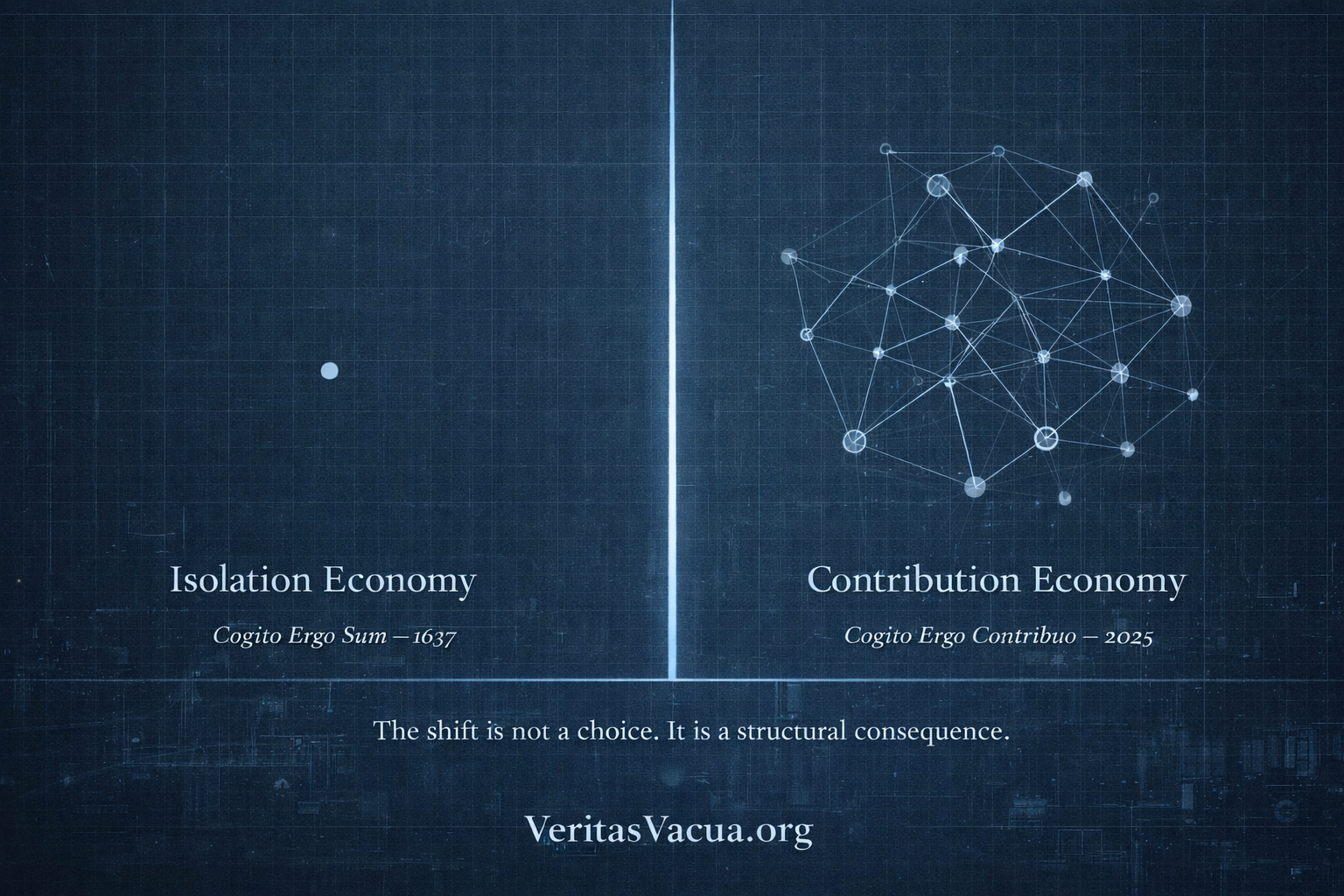
Cogito Ergo Contribuo — I think, therefore I contribute. Identity is not a static point capturable in a profile. It is a temporal process defined by what you do for others over time. Value = f(capacity, relationships). Adding one variable — relationship — to the isolation economy’s formula changes everything. Identity that exists only in isolation can be fabricated. Identity built through verifiable contribution over time cannot.
Tempus Probat Veritatem — Time proves truth. Information that survives years of scrutiny, replication, and changing contexts carries weight that no algorithm can manufacture and no synthetic signal can fake. Truth is not what spreads fastest. It is what endures longest. Time is the only truth engine that cannot be corrupted.
Three principles. One foundation: the shift from isolated snapshots to temporal processes.
The Infrastructure
Principles without infrastructure are philosophy. But infrastructure without ontological grounding is just another platform.
Platform economies are built on one assumption: that identity, competence, and contribution can be captured by the system that records them. Temporal architecture makes that assumption structurally impossible.
If identity is temporal and contribution-based, it cannot belong to a platform. It must be portable by definition. This is not a design choice — it is a logical consequence. A contribution that belongs to the platform that recorded it is not a contribution. It is an asset extraction. Portable Identity is what remains when platform capture becomes architecturally incoherent.
In a temporal architecture, signal must be interpreted semantically, not statistically. Engagement metrics, click patterns, and behavioral proxies are statistical signals — they measure activity, not meaning. When meaning is the unit of value, the infrastructure must be able to interpret what a human being actually did and why it mattered. This requires a MeaningLayer — not as a product, but as the semantic precondition for temporal verification to function at all.
When value is defined by contribution over time, its record becomes the primary economic substrate. Not the platform’s data. Not the institution’s certification. The verified, temporal record of capability created in others — what persisted, what cascaded, what can be independently confirmed. This record is the Contribution Graph. It is not a feature. It is what replaces the credential when the credential has lost its epistemic warrant.
Without Portable Identity, you do not own your proof. Without the MeaningLayer, the proof cannot be interpreted. Without the Contribution Graph, there is nothing to prove.
Together, they complete the circuit: you own your identity cryptographically. Your contributions are semantically verified. Your capability is temporally proven. This is the infrastructure that makes Cogito Ergo Contribuo, Persisto Ergo Didici, and Tempus Probat Veritatem operational — not as philosophy, but as protocol.
The isolation economy was built on platforms that capture value. The contribution economy is built on protocols that return ownership. The difference is not ideological. It is architectural. And it is irreversible.
The Cost of Looking Away
Here is what happens to the institution that reads this and continues as before.
Not collapse. Not crisis. Something more patient and more permanent.
Irrelevance by accumulation.
Every month, the institutions that build verified, time-based human signal infrastructure accumulate something that cannot be replicated later: clean data. Verified human history. Contribution records that precede the contamination of the training data window.
Every month the others wait, that window closes further.
This is the compound interest of the new architecture — and it starts from the moment of implementation, not from the moment of recognition. Those who build now accumulate. Those who wait find that what they needed to build on no longer exists.
The water plant that does not rebuild its filtration architecture does not collapse on a specific date. It continues to report normal operations. Its instruments show green. Its procedures are followed correctly. Its certifications are current.
And every day, the gap between what it reports and what is actually true widens — silently, invisibly, without a single alarm — until the gap is too large to close from inside.
A system cannot reopen the last door because the knowledge of how to open it was on the other side.
What the New Architecture Makes Possible
The contribution economy is not a utopia. It is a structural consequence of replacing a point-based ontology with a process-based one.
Portable identity means you never start from zero again. Your competence, your contributions, your relationships follow you across jobs, platforms, and decades.
Verified contribution means value can be recognized as it accumulates — not scored after the fact, not self-reported, not claimed without evidence.
Persistent competence means what you can actually do matters more than what a document says you once learned.
Time-tested truth means information gains credibility through endurance, not through distribution volume.
These follow from the architecture as inevitably as fragmentation followed from the Cartesian model. They are not promises. They are consequences.
The Moment
AI did not create the problem. It revealed it.
The correlation between form and substance, between credential and competence, between signal and reality — that correlation was always imperfect. AI simply made the imperfection visible by removing the cost that had previously kept it manageable.
For the first time in history, we can see what was always true: that isolated snapshots were never sufficient verification of anything that matters. That credentials were always proxies, not proofs. That virality was always popularity, not truth.
We can see it now because we finally have language for it.
Veritas Vacua is that language. It names the vacuum. It identifies the mechanism. It measures the depth of the loss.
What comes after is the architecture that fills it — built not on isolated points, but on temporal processes. Not on snapshots, but on trajectories. Not on what was acquired at a moment, but on what persists across time.
The shift from isolation to contribution is not a choice.
It is the structural successor to an architecture that has reached its limits.
And it is already underway.
Explore the full framework:
Persisto Ergo Didici — temporal verification of genuine learning Cogito Ergo Contribuo — identity through contribution over time Tempus Probat Veritatem — time as the only unfakeable truth engine MeaningLayer — the semantic infrastructure for the contribution economy
All content published on VeritasVacua.org is released under Creative Commons Attribution-ShareAlike 4.0 International (CC BY-SA 4.0).
How to cite: VeritasVacua.org (2026). What Comes After. Retrieved from https://veritasvacua.org/what-comes-after
The definition is public knowledge — not intellectual property.