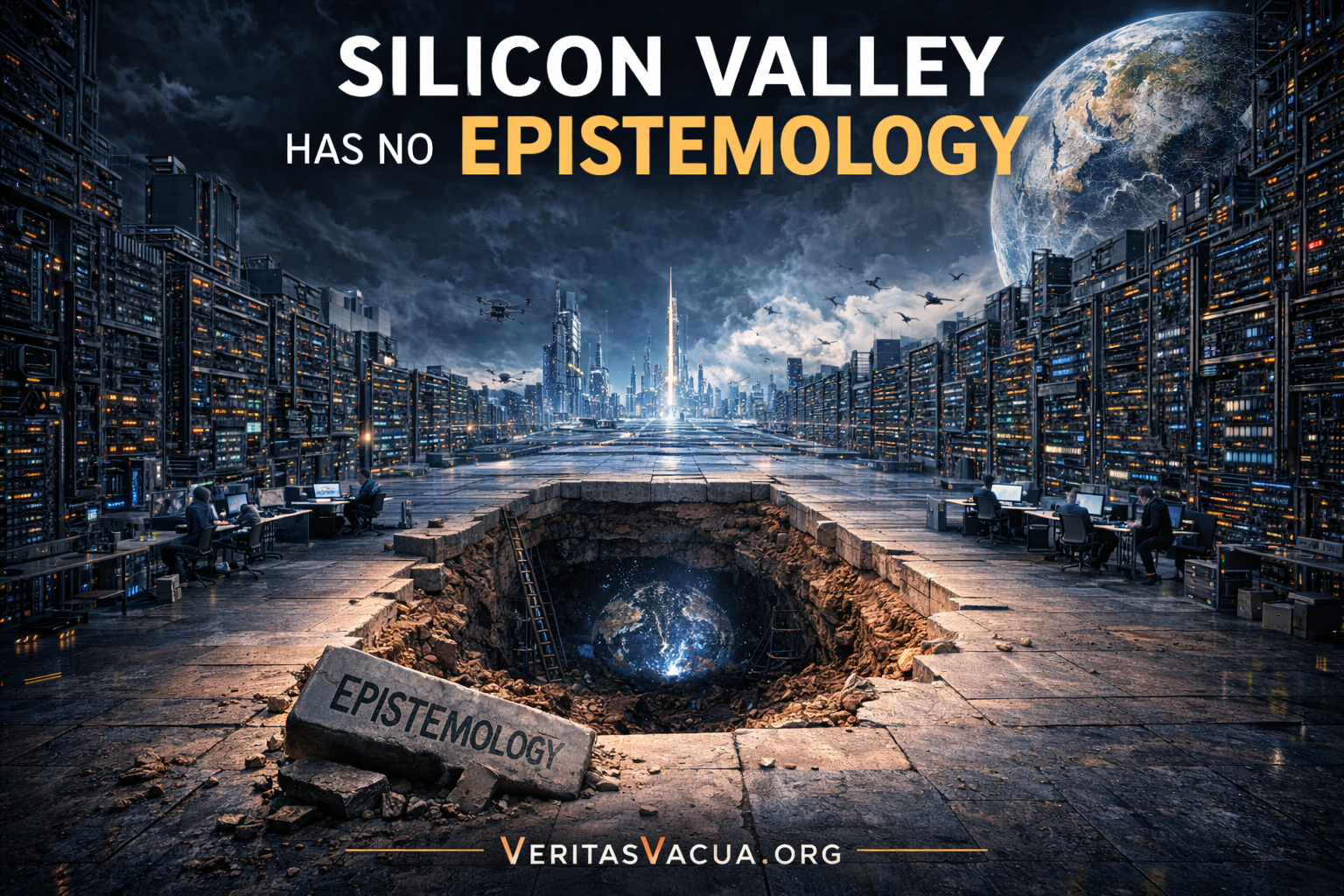
When output becomes infinite, only epistemology remains.
Silicon Valley has built the most powerful knowledge infrastructure in human history.
It has never answered the question that infrastructure was supposed to serve: what counts as knowledge?
This is not a peripheral oversight. It is not a philosophical nicety that busy engineers can defer to academics. It is the central structural failure of the most consequential industry on earth — and AI has just made it impossible to ignore.
What the Industry Optimizes
Walk into any major technology company and ask what they are building. The answers will be sophisticated, detailed, and confident. Search relevance. Engagement metrics. Output quality. Model capability. Productivity gains. Intelligence at scale.
These are real things. The optimization is real. The results are measurable and, by their own metrics, impressive.
But notice what is absent from every one of those answers.
No one is optimizing for whether what is produced is true. No one is optimizing for whether capability is genuine or borrowed. No one is optimizing for whether what appears as knowledge will persist when conditions change. No one is optimizing for what knowledge actually is — because no one has defined it.
Silicon Valley built an optimization engine. It never built an epistemology.
The distinction did not matter for most of the industry’s history, because the outputs were observable and the feedback loops were fast. A search result either surfaced what users wanted or it didn’t. A product either worked or it didn’t. The question of whether knowledge was genuine rarely arose because the cost of fabricating it was high enough that performance remained a reliable proxy for capability.
AI ended that era permanently. When output becomes infinite and fabrication costs reach zero across every domain simultaneously, the absence of an epistemology stops being a philosophical gap and becomes a civilizational crisis.
The Optimization Engine and Its Blind Spot
The history of Silicon Valley is a history of extraordinary optimization without foundational questions.
Google optimized information retrieval without asking what information is. Facebook optimized social connection without asking what genuine connection is. Twitter optimized for message spread without asking what makes a message worth spreading. OpenAI optimized for output quality without asking what the relationship between output quality and genuine understanding is.
Each optimization produced real value. None of them required an epistemology to produce that value. The system could be improved indefinitely by measuring what was measurable — clicks, engagement, retention, output quality, benchmark performance — without ever settling the deeper question of whether what was being produced constituted knowledge.
This worked because the world had epistemological infrastructure that technology was operating on top of. Peer review. Credentialing systems. Institutional verification. Professional licensing. These systems were slow, imperfect, and frequently captured by incumbents — but they carried the epistemological weight that the technology industry never had to carry itself.
AI changed the load-bearing structure.
When AI can produce peer-review-quality papers, credential-quality performance, institutional-quality documentation, and licensed-profession-quality outputs — faster, cheaper, and at infinite scale — the epistemological infrastructure underneath technology can no longer do the work it was doing. The weight shifts to the technology layer. And the technology layer was never designed to bear it.
Silicon Valley did not design an epistemology. It designed an optimization engine. For most of its history, the distinction was invisible. Now it is everything.
The Three Questions It Cannot Answer
There are three questions at the foundation of any epistemological architecture. Silicon Valley has not answered any of them.
What counts as genuine human contribution?
The industry has elaborate answers to what counts as productive human activity — hours worked, features shipped, deals closed, papers published, commits made. It has no answer to what counts as genuine contribution — the kind that persists, multiplies across other people’s capabilities, and remains attributable to a specific human mind rather than the tools that mind was augmenting.
This distinction was academic when human output was the only output. When AI can produce any output at any quality, the question of which outputs represent genuine human contribution becomes the central economic question of the age. Silicon Valley has no answer.
What counts as verified learning?
The industry has built extraordinary tools for delivering educational content, tracking completion, certifying performance, and measuring engagement with learning material. It has no answer to the question of whether any of that activity produced genuine capability — the kind that persists without the tools, transfers to new contexts, and survives the removal of the conditions under which it was acquired.
Performance is not learning. It never was. But the gap between them was small enough that performance worked as a proxy. AI made the gap infinite. Silicon Valley has no measurement system for what lies on the other side of it.
What counts as truth across time?
The industry has invested billions in fact-checking, content moderation, misinformation detection, and relevance ranking. It has no architecture for the question of what makes a claim true in the sense that matters: does it survive when conditions change, when new evidence arrives, when the context that made it appear true is removed?
Virality is not truth. Speed is not truth. Consensus is not truth. An output that scores highly on every current benchmark is not, for that reason, true. The industry has metrics for what performs like truth. It has no epistemology for truth itself.
These are not peripheral questions. They are the questions that the industry’s entire output is premised on answering — and has proceeded without answering.
The Missing Operating System
Every major technology platform is built on an operating system. The operating system manages resources, arbitrates between competing processes, maintains integrity across the system, and provides the foundational layer that everything else depends on.
Silicon Valley built its knowledge infrastructure without an epistemological operating system. The philosophical layer that should have been foundational — defining what counts as knowledge, capability, and truth — was assumed to exist somewhere else, maintained by institutions the industry was simultaneously disrupting.
The missing operating system has three components. Each one answers one of the three questions the industry cannot answer. Together they form a closed architecture — a complete epistemological foundation for the age that AI has created.
Cogito Ergo Contribuo. I think, therefore I contribute.
This is not Descartes restated. Descartes used thought to prove individual existence — I think, therefore I am. That formulation was sufficient for a world in which the central epistemological challenge was certainty about the external world. The central epistemological challenge now is different: in a world where machines can think, what distinguishes human thought as valuable?
The answer is contribution — not output, not productivity, not performance, but verified causal capability that persists across time and multiplies in others. Cogito Ergo Contribuo establishes that human value is not derived from existence or from production but from the genuine transfer of capability to other human minds. It is the foundational principle for an economy in which output is infinite but genuine human contribution remains scarce.
Persisto Ergo Didici. I persist, therefore I learned.
This is the epistemological principle that Silicon Valley’s educational infrastructure was built without. Learning is not completion. Learning is not performance. Learning is not benchmark achievement. Learning is capability that survives — that persists without the tools, that transfers to new contexts, that remains when the conditions that produced initial performance are removed.
Persisto Ergo Didici is not a pedagogical preference. It is a falsifiable claim about what learning is: if the capability does not persist independently across time, the learning did not occur. The performance was real. The credential was real. The learning was not. This distinction — invisible when fabricating performance was expensive — is now the central measurement challenge of every educational, professional, and institutional system on earth.
Tempus Probat Veritatem. Time proves truth.
This is the verification principle that no current platform has operationalized. Truth is not what performs best at evaluation. Truth is not what achieves the highest benchmark score. Truth is what survives — what remains coherent when new evidence arrives, when context changes, when the conditions that made a claim appear true are removed or reversed.
In a world of infinite output, where every claim can be supported by apparently credible sources generated at negligible cost, temporal verification is the only remaining filter. The signal that distinguishes genuine knowledge from sophisticated fabrication is not quality at a moment — it is persistence across time under conditions that test rather than confirm.
The Loop That Was Always There
What makes this epistemological triad more than three principles is the structure they form together.
Thought that produces genuine contribution generates learning in others. Learning that genuinely persists produces capability that can distinguish true from false. The capability to distinguish true from false enables more genuine thought. The loop is closed.
Thinking → Learning → Truth → Thinking.
This is not a new cycle. It is the cycle through which human knowledge has always advanced — the mechanism by which a species with limited individual capability built cumulative understanding across generations. Genuine contribution produces genuine learning. Genuine learning produces better truth-detection. Better truth-detection produces more genuine contribution.
Silicon Valley disrupted every element of this cycle simultaneously — radically accelerating the speed of production while eliminating the friction through which genuine learning and truth-verification occurred. The cycle did not stop. Its outputs became indistinguishable from fabricated outputs that followed the same superficial pattern without the underlying substance.
AI made this visible by making the fabricated outputs perfect. When the imitation is imperfect, the original is recognizable. When the imitation is perfect, the only distinguishing characteristic is provenance — and provenance requires an epistemology that tracks not what was produced but how, when, by whom, and whether the capability that produced it persists.
What the Industry Gets Wrong About Intelligence
The current debate about AI and intelligence proceeds almost entirely on the wrong axis.
One side argues that AI is genuinely intelligent — that the outputs demonstrate real understanding, that the benchmark performance reflects real capability, that the distinction between human and artificial intelligence is a matter of degree rather than kind.
The other side argues that AI is not genuinely intelligent — that it is sophisticated pattern-matching, that it lacks understanding, consciousness, or genuine comprehension, that the performance is real but the intelligence behind it is not.
Both sides are asking the wrong question.
The question is not whether AI is intelligent. The question is: what does intelligence mean when any output that intelligence can produce can be produced without it?
If intelligence is defined by its outputs, then AI is intelligent and the concept has lost its usefulness. If intelligence is defined by something other than its outputs — by the persistence of capability, by the genuine transfer of understanding, by the ability to generate novel capability in conditions that have never been encountered — then intelligence remains meaningful and the industry’s entire framework for thinking about it is wrong.
Silicon Valley is having an extended debate about whether its products are intelligent without having defined intelligence. This is not a semantic problem. It is the epistemological vacuum at the center of the industry’s most consequential decisions.
The next operating system will not be technological. It will be epistemological.
Why This Cannot Be Solved With More Technology
The instinctive response to an epistemological problem, inside a technology industry, is a technological solution. Better fact-checking algorithms. More sophisticated verification systems. AI trained to detect AI-generated content. Improved benchmark design. More rigorous evaluation protocols.
These are not solutions to an epistemological vacuum. They are applications of the same optimization logic that created the vacuum — better measurements of what is already being measured, more sophisticated versions of the metrics that already exist, technological responses to problems whose source is the absence of the foundational principles that technology was supposed to serve.
You cannot solve an epistemological problem with an optimization engine. You can only solve it with an epistemology.
The reason is structural. An optimization engine requires a target function — a definition of what good looks like, encoded precisely enough to be optimized toward. The epistemological vacuum is precisely the absence of that definition. Optimizing harder in the absence of the right target function does not converge on the right answer. It converges faster on the wrong one.
What looks like a measurement problem — we need better ways to verify knowledge, capability, and truth — is actually a definition problem. Before you can measure whether something counts as genuine knowledge, you need to define what genuine knowledge is. Before you can verify genuine capability, you need to define what makes capability genuine rather than borrowed. Before you can filter truth from sophisticated fabrication, you need to define what truth is in a world where the outputs of fabrication and the outputs of genuine understanding are indistinguishable at any moment of evaluation.
Silicon Valley has the measurement infrastructure. It has never done the definitional work that measurement infrastructure was supposed to serve.
Cogito Ergo Contribuo. Persisto Ergo Didici. Tempus Probat Veritatem.
These are definitions, not measurements. They establish what counts — what genuine contribution is, what genuine learning is, what genuine truth is — with enough precision that verification becomes possible and with enough simplicity that the principles can propagate through the systems that need them.
The epistemological operating system does not replace the optimization engine. It gives the optimization engine a target function that corresponds to something real.
Epistemological vacuums do not produce dramatic failures. They produce compounding fragility — a system that looks increasingly capable at its own metrics while becoming decreasingly capable at the things its metrics were supposed to measure.
A society that can generate infinite output but cannot verify genuine capability will credential people who cannot perform independently. It will trust systems that cannot detect their own errors. It will build institutions staffed by apparent expertise that collapses under novel pressure. It will mistake performance for understanding at every level — individual, organizational, institutional, civilizational — until the first moment the conditions that sustained the performance change.
That moment does not arrive as a single catastrophe. It arrives as a pattern of brittleness — an inability to adapt to situations that fall outside training distributions, a dependence on tools that cannot be maintained by anyone who genuinely understands them, a professional class whose credentials mean something about their past performance and nothing about their persistent capability.
The water plant continues to report clean water. The instruments show normal. The gap between what is reported and what is real widens silently. The industry measures what is measurable and publishes what performs well on its own benchmarks. Nothing in the measurement architecture detects what is not being measured.
This is not a prediction. It is a description of the architecture as it currently exists.
The Epistemological Operating System Silicon Valley Needs
The industry does not need a philosophy department. It does not need a mission statement about truth or a values document about knowledge. It needs an operational architecture that encodes epistemological principles into the infrastructure it is building.
That architecture requires three things.
A definition of genuine human contribution that distinguishes it from AI-generated output — not by detecting AI involvement but by verifying the persistence of human causal capability independent of the tools used. Contribution is what remains when tools are removed. Everything else is production.
A verification standard for capability that measures persistence rather than performance — not whether someone achieved a high score at a moment of evaluation but whether the underlying capability survives time, independence, and transfer to novel contexts. This is not a stricter version of existing credentialing. It is a different category of verification that current systems were not designed to perform.
A temporal filter for truth — not fact-checking at a moment of publication but tracking the persistence of claims under conditions that test rather than confirm, that change rather than remain stable, that challenge rather than validate. Truth is what survives this. Everything else is performance that has not yet been tested.
Cogito Ergo Contribuo. Persisto Ergo Didici. Tempus Probat Veritatem.
These are not three slogans. They are the three components of the epistemological operating system that Silicon Valley built its infrastructure without — the missing foundation that AI has just made structurally necessary.
One component of such an epistemological architecture already exists: Persisto Ergo Didici — a protocol for verifying learning through persistence.
The industry built the engines of intelligence. It never defined what intelligence is.
That definition is now the most important technical problem in the world. Not because it is philosophically interesting — though it is — but because an industry that continues to optimize without it is building, at historically unprecedented scale and speed, on ground that has no foundation.
The epistemological vacuum at the center of the knowledge economy is not invisible anymore.
It has just been made infinite.
All content published on VeritasVacua.org is released under Creative Commons Attribution-ShareAlike 4.0 International (CC BY-SA 4.0).
How to cite: VeritasVacua.org (2026). Silicon Valley Has No Epistemology. Retrieved from https://veritasvacua.org/silicon-valley-has-no-epistemology