For all of human history, incompetence eventually revealed itself. AI has ended that law of reality.
This is not a warning about the future.
It is a description of a structural change that has already occurred — quietly, without announcement, without any single moment of rupture — in every institution, every profession, and every system that allocates trust and authority based on demonstrated competence.
For the entirety of human civilization, incompetence was self-correcting. Not because institutions were wise enough to detect it. Not because evaluation systems were sophisticated enough to measure it. But because reality was merciless enough to expose it.
The incompetent surgeon produced worse outcomes. The incompetent engineer built structures that failed. The incompetent analyst made predictions that were wrong. The incompetent leader made decisions that collapsed. Not always immediately. Not always dramatically. But eventually, under the pressure of reality, incompetence became visible — and visibility enabled correction.
This feedback loop was the invisible immune system of human civilization. It was not perfect. It was slow. It was frequently captured by power structures that protected incompetent insiders at the expense of competent outsiders. It was biased, unfair, and riddled with exceptions.
But it worked. Because incompetence, under sufficient pressure, eventually produced evidence of itself. And evidence enabled correction. And correction, accumulated across time, was how systems improved.
AI has broken this loop. Not by making incompetence more common. By making it invisible.
AI has created the first era in human history in which incompetence can survive indefinitely.
The Correction Mechanism That No Longer Works
Every functional system in human history has depended on some version of the same feedback architecture: performance produces observable outcomes, observable outcomes reveal capability gaps, capability gaps create pressure for correction, correction improves performance.
This architecture does not require benevolent institutions or sophisticated measurement systems. It requires only that incompetence eventually produces observable failure — that the gap between credentialed capability and actual capability eventually becomes visible in operational reality.
A doctor whose clinical judgment is poor eventually produces patient outcomes that are worse than those of doctors whose judgment is sound. The gap is measurable. The signal, however slow and noisy, exists.
An engineer whose structural calculations are wrong eventually produces designs that fail under load. The failure is observable. The feedback, however delayed, reaches the system.
A financial analyst whose models are flawed eventually produces predictions that diverge from market reality. The divergence is trackable. The correction, however painful, can occur.
The feedback is never immediate. The correction is never guaranteed. The system is full of noise, delay, and structural protection of established incompetence. But the fundamental architecture holds: incompetence produces failure, failure produces signal, signal enables correction.
AI has severed this architecture at its foundation. Not by improving incompetent performance — that would still allow the feedback loop to function with reduced signal. By replacing the performance entirely.
When a doctor with poor clinical judgment uses AI-assisted diagnostic tools to produce accurate diagnoses, the outcomes improve. The signal that previously revealed the capability gap disappears. The feedback loop has no failure to process. The system reports normal.
When an engineer with flawed structural intuition uses AI-assisted calculation tools to produce correct designs, the structures hold. The failure that would have revealed the capability gap never occurs. The correction mechanism has nothing to correct.
When an analyst with limited modeling capability uses AI-assisted analytical tools to produce accurate predictions, the forecasts are right. The divergence from reality that would have exposed the capability gap does not appear. The system improves its outputs without improving its underlying capability.
The feedback loop that corrected incompetence for all of human history required one thing: that incompetent performance produce observable failure. AI has eliminated the observable failure while leaving the incompetence intact.
What Invisible Incompetence Is
Invisible Incompetence is not a new form of fraud. It is not cheating. It is not deception in any conventional sense.
It is a structural condition that emerges when a tool is powerful enough to mask the gap between credentialed capability and actual capability across every observable dimension — indefinitely, consistently, and without the person using the tool necessarily being aware of the gap themselves.
The person experiencing Invisible Incompetence is not lying. They are performing. Their outputs are real. Their credentials are accurate. Their evaluations are passed legitimately. Their professional results, measured by every available metric, are satisfactory or better.
The incompetence is invisible not only to the institution evaluating them. It is invisible to them.
This is what makes it unlike any previous form of capability gap in human history. Previous incompetence was experiential — the incompetent person struggled, produced poor outcomes, and had some awareness of the gap between their capability and the demands of their role. The struggle was the signal. The signal enabled self-correction as well as institutional correction.
AI removes the struggle. The tool handles what the capability cannot. The performance is smooth. The outputs are satisfactory. There is no experiential signal. There is no struggle to interpret. There is no moment of failure that might prompt either self-recognition or institutional detection.
The incompetence does not develop because the person is failing. It persists because the person is succeeding — with a tool that is doing what their capability cannot, invisibly, consistently, and without leaving any trace in the observable record.
Incompetence that is never visible cannot be corrected. Incompetence that cannot be corrected persists. Incompetence that persists accumulates. A civilization that cannot see its own capability gaps cannot correct them.
The Stability Mechanism
Here is what makes Invisible Incompetence more than a measurement problem.
Previous forms of hidden incompetence were unstable. They required continuous active concealment. The incompetent person had to work to hide the gap — to avoid situations that would expose it, to manage appearances, to ensure that the observable record did not reflect the underlying reality. This effort was itself a signal: the pattern of avoidance, the resistance to evaluation, the structuring of work to minimize exposure.
Invisible Incompetence is stable. It requires no active concealment because there is nothing to conceal in the observable record. The gap between capability and performance does not appear in outputs, outcomes, credentials, evaluations, or any of the metrics by which competence is assessed.
More than stable: it is self-reinforcing.
A professional whose AI-assisted performance is consistently excellent receives positive feedback, advancement, and increasing responsibility. The credential record improves. The performance record improves. The professional’s confidence in their own capability is maintained or enhanced — because every observable signal confirms competence.
The underlying capability gap does not grow because it is being actively masked. It grows because the conditions that would develop genuine capability — struggle, failure, independent problem-solving under pressure, the consolidation of understanding through difficulty — are systematically absent. The tool removes the friction that builds the capability.
Meanwhile, the professional is being prepared for greater responsibility. Their credential record justifies it. Their performance record supports it. The institution has no signal to contradict it.
AI has not just made incompetence invisible. It has made incompetence stable, self-reinforcing, and institutionally rewarded. This is a different category of problem from any that human institutions were designed to handle.
The Institutional Blindspot
Every institution designed to manage human competence was built on the assumption that incompetence would eventually produce observable failure. The entire architecture of verification, credentialing, performance review, professional licensing, and quality assurance is calibrated to detect and respond to the signal that failure produces.
Remove the failure from the observable record while leaving the capability gap intact, and every one of these systems becomes blind — not because they are poorly designed, but because they are correctly designed for a world where the signal they were built to detect still existed.
Hospitals measure patient outcomes. Patient outcomes improve when AI-assisted diagnosis and treatment planning supplement weak clinical judgment. The quality assurance system reports improvement. The capability gap that remains — the clinical judgment that has not developed because AI handled the cases that would have developed it — does not appear in any outcome metric.
Universities measure academic performance. Academic performance improves when AI-assisted research and writing supplements weak analytical capability. The quality assurance system reports improvement. The capability gap that remains — the analytical reasoning that has not developed because AI handled the intellectual work — does not appear in any grade or credential.
Law firms measure case outcomes and client satisfaction. Outcomes improve when AI-assisted legal research and document preparation supplements weak legal reasoning. The quality assurance system reports improvement. The capability gap that remains — the legal judgment that has not developed because AI handled the reasoning — does not appear in any performance review.
These institutions are not failing to detect Invisible Incompetence because they are careless. They are failing because the signal they were designed to detect — the observable failure that reveals the capability gap — has been removed from the observable record.
A system designed to detect failure cannot detect the successful masking of the conditions that produce failure. Every quality assurance architecture in every institution is currently operating in this condition.
When the Mask Comes Off
Invisible Incompetence does not remain invisible forever. It remains invisible precisely as long as AI assistance remains available, the tasks remain within distributions the AI can handle, and no situation arises that requires the independent capability that was never developed.
These conditions are not permanent.
AI systems fail. Networks go down. Tools become unavailable. Novel situations arise that fall outside the distribution of what AI assistance can reliably handle. Emergencies occur that require immediate independent judgment. Crises develop that demand the kind of adaptive reasoning that cannot be outsourced in real time.
When the mask comes off, the gap that has been accumulating invisibly becomes suddenly and completely visible — not as a gradual decline that the institution can manage, but as an abrupt absence of capability that was assumed to exist and does not.
The surgeon facing an intraoperative complication that the AI system cannot classify. The engineer called to diagnose a structural failure in a system they designed but never genuinely understood. The financial analyst managing a crisis whose dynamics fall outside every model they have used. The leader required to make a consequential decision without the analytical infrastructure they have relied on for every previous decision.
The credential said competent. The performance record confirmed it. Every evaluation was passed. Every metric was satisfied.
The capability was never there.
This is not a failure of the individual. It is a failure of the system — of every verification architecture that measured performance and assumed capability, in a world where performance had been decoupled from capability without anyone designing that decoupling or measuring its consequences.
The Invisible Incompetence does not announce its arrival. It accumulates silently, in every domain where AI assistance is available and performance is the metric of competence, until the first moment when assistance is unavailable and the capability it was masking is required.
The Civilizational Consequence
Scale this across an entire generation of professionals in every domain.
Medicine. Law. Engineering. Finance. Education. Policy. Military judgment. Infrastructure management. Scientific research. Every field that credentials competence through performance evaluation and deploys credentialed professionals in roles that depend on genuine independent capability.
Each of these fields is currently producing a cohort of credentialed professionals whose Invisible Incompetence is accumulating undetected. The performance records are excellent. The credential systems are functioning. The quality assurance architectures are reporting improvement across every observable metric.
The capability gap is widening.
Systems do not collapse because of incompetence that is visible. Visible incompetence produces failure, failure produces signal, signal produces correction. This is how systems survive contact with reality.
Systems collapse because of incompetence that is invisible. Invisible incompetence produces no failure, no signal, no correction. It accumulates without limit, reinforced by the positive feedback of excellent observable performance, institutionalized through the advancement of individuals whose capability gap was never detected, reproduced in every cohort trained by professionals whose own capability gaps were never corrected.
Civilizations do not collapse because they cannot see their failures. They collapse because they cannot see their competence illusions — the perfect performance that masks the absence of the capability that performance was supposed to represent.
The feedback loop that corrected incompetence for all of human history required observable failure. Invisible Incompetence has removed the observable failure while leaving everything else intact — the credentials, the performance records, the quality assurance systems, the advancement pathways, the institutional trust.
The correction mechanism is not degraded. It is non-functional. And no currently existing institutional architecture is designed to detect this.
The Only Measurement That Penetrates the Mask
Persisto Ergo Didici — I persist, therefore I learned — is the only verification principle that Invisible Incompetence cannot satisfy.
Every other verification system measures performance at evaluation moments. Invisible Incompetence passes every evaluation moment — that is the definition of its invisibility. It passes credentials, passes performance reviews, passes quality assurance checks, passes every measurement that relies on observable performance as a proxy for underlying capability.
What it cannot pass is the measurement of persistent independent capability across time.
Remove the AI assistance. Change the context. Wait months. Test capability in conditions that differ from those under which performance was demonstrated. Require independent reconstruction of reasoning from first principles without reference to previous outputs.
Genuine capability persists under these conditions. Invisible Incompetence does not. The gap that was invisible in every performance measurement becomes immediately and completely visible in the one measurement that tests not what was produced but what remains.
The Persistence Gap is not a better version of existing evaluation. It is the only evaluation that tests the dimension along which Invisible Incompetence is visible: time, independence, and the removal of the conditions that produced initial performance.
A society that continues to verify competence through performance at evaluation moments will continue to produce and certify Invisible Incompetence at scale. A society that adopts persistence as the foundational verification principle will be able to detect the gap before the mask comes off under operational pressure.
These are not equivalent choices. One produces systems that report normal until they fail catastrophically. The other produces systems that detect the gap while there is still time to close it.
What Has Already Changed
The Invisible Incompetence is not a future risk. It is a current condition in every domain where AI assistance is available, performance is the metric of competence, and persistence is not measured.
Which is every domain.
The credential systems are functioning. The performance records are excellent. The quality assurance architectures are reporting improvement. Every observable metric is moving in the right direction.
The capability gap is accumulating.
No existing institutional architecture was designed to detect what is currently happening — because what is currently happening is structurally new. Incompetence that is invisible, stable, self-reinforcing, institutionally rewarded, and accumulating in every domain simultaneously has never existed before.
The feedback loop that corrected incompetence for all of human history has been broken — not dramatically, not by any single decision or failure, but by the gradual deployment of tools powerful enough to mask the gap between credential and capability across every observable dimension, indefinitely, in every field where those tools are available.
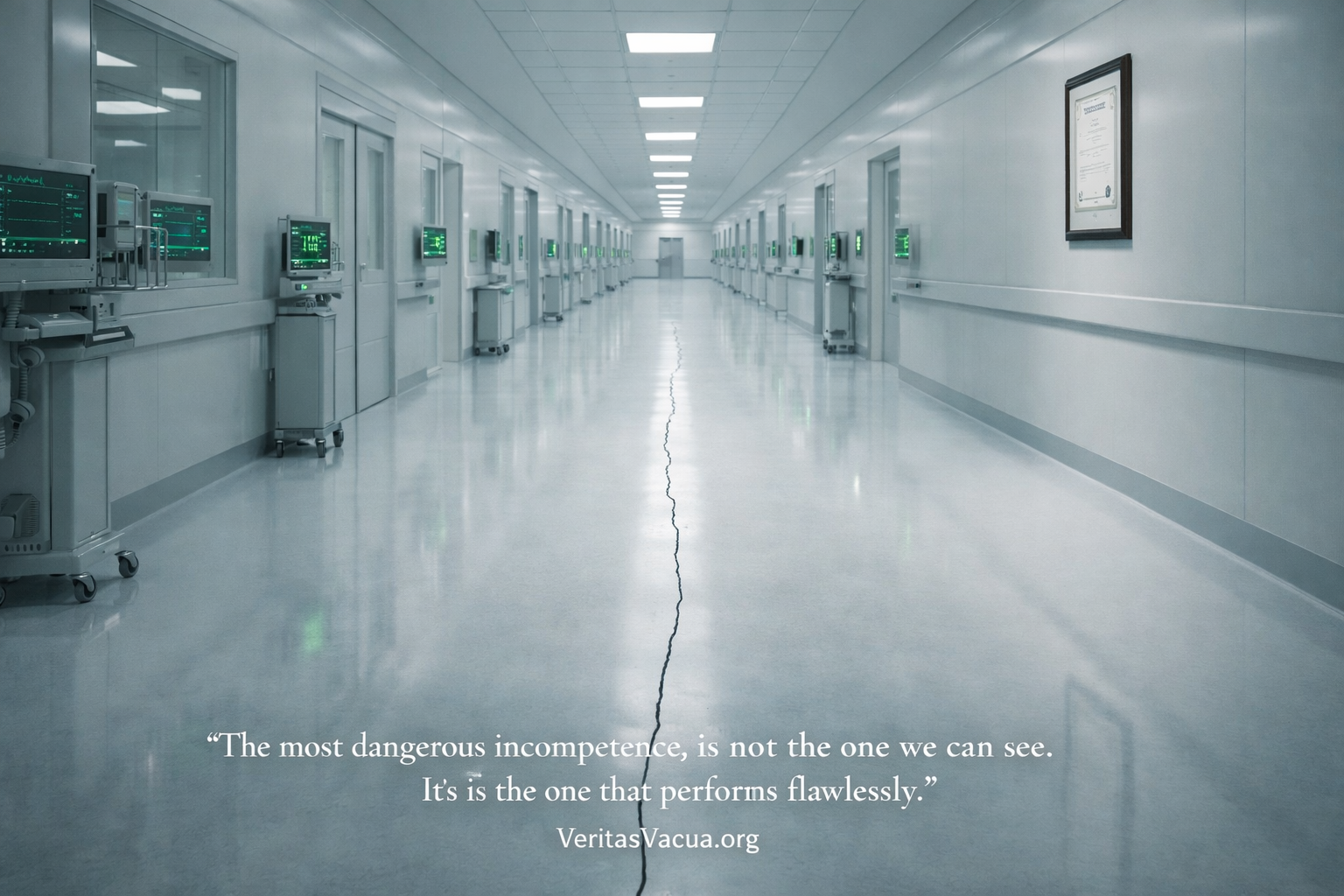
The most dangerous incompetence is no longer the one we can see. It is the one that performs flawlessly.
And it is already everywhere.
All content published on VeritasVacua.org is released under Creative Commons Attribution-ShareAlike 4.0 International (CC BY-SA 4.0).
How to cite: VeritasVacua.org (2026). The Invisible Incompetence. Retrieved from https://veritasvacua.org/the-invisible-incompetence