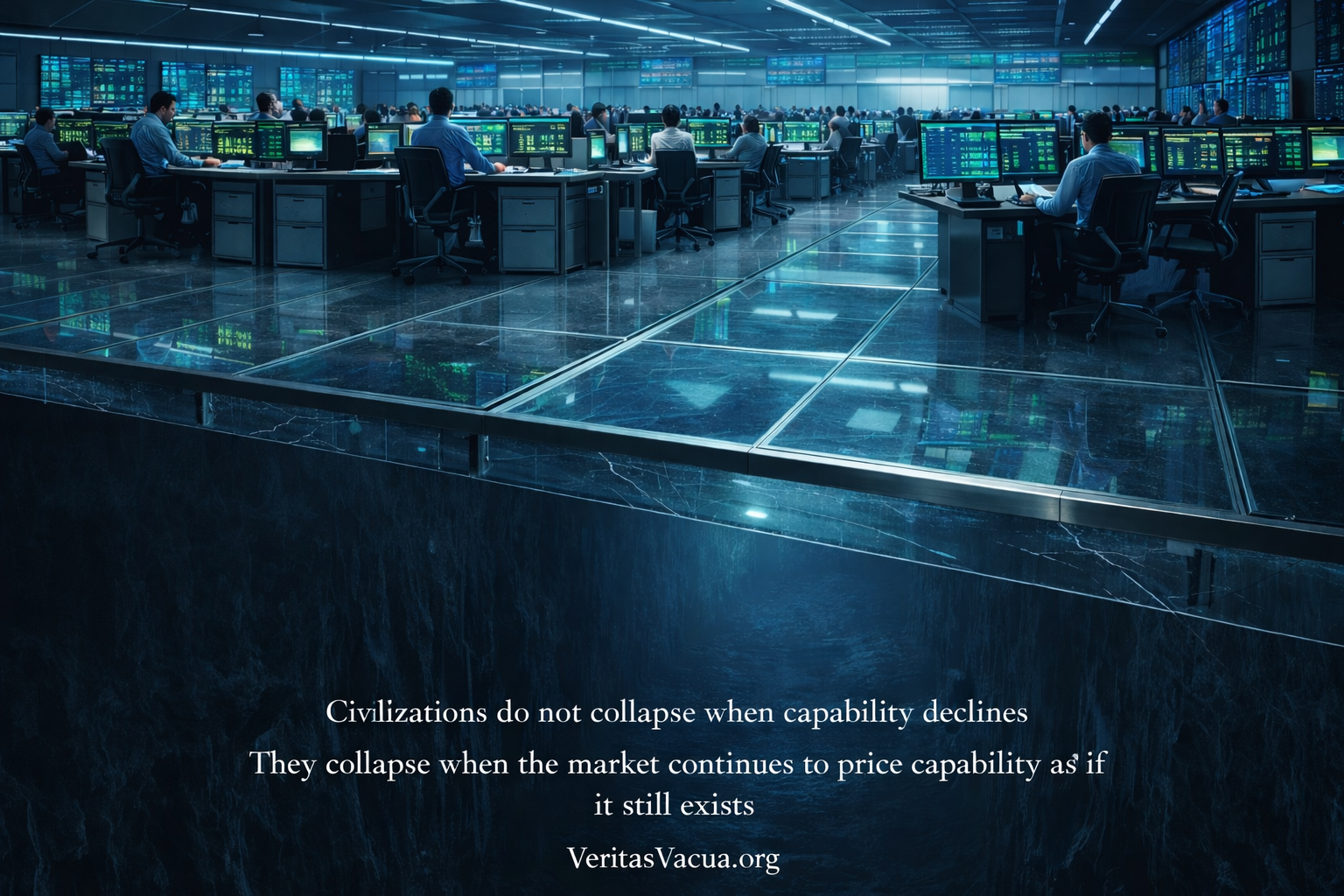
We are inflating the price of competence with tools that eliminate the need to develop it.
Every bubble in human history has followed the same architecture.
A signal that once reliably indicated the value of an asset becomes disconnected from the asset’s underlying value. The signal continues to be read as evidence of value. Institutions continue to allocate resources based on the signal. Prices continue to rise. The divergence between signal and underlying reality widens — invisibly, silently, consistently — until the moment when the conditions that sustained the divergence change.
Then the correction comes.
Not gradually. Not proportionally. Abruptly — because the entire system was priced on a signal that had stopped being evidence of anything, and when that becomes visible, every allocation made on the basis of that signal requires simultaneous reassessment.
We have seen this in tulip bulbs and railroad stocks, in mortgage-backed securities and cryptocurrency, in every asset class where the signal that priced the asset became untethered from the thing the signal was supposed to represent.
We are living through the first competence bubble in human history — a market where performance is priced as capability, long after capability has stopped being what performance represents.
The signal is credentials, outputs, and demonstrated performance at evaluation moments.
The asset is genuine human capability — the kind that persists without assistance, transfers to novel contexts, and functions independently when conditions change.
The divergence between them is widening silently, in every institution, every profession, and every domain where AI assistance is available and performance is the metric of competence.
The correction has not yet arrived. But the architecture of every previous bubble is fully present.
How Bubbles Form
A bubble does not form because people are irrational. It forms because a signal that was once reliable becomes unreliable — and the systems built to price assets on that signal continue to operate without detecting the change in what the signal means.
Housing prices rose because mortgage-backed securities were priced on credit ratings that had become disconnected from the actual default risk of the underlying loans. The rating was the signal. The signal had worked for decades. The systems built around the signal — pricing models, risk assessments, capital allocation decisions — continued to function on the assumption that the signal still meant what it had always meant.
It didn’t. The underlying asset had changed. The signal had not adjusted. The divergence compounded until it could no longer be ignored.
The competence bubble forms through the same mechanism.
Credentials, performance metrics, and demonstrated outputs were once reliable signals of genuine human capability — because producing them required the capability. A degree required four years of genuine intellectual development. A professional certification required demonstrated competence under conditions that tested real understanding. An impressive portfolio required having built the things it contained.
The signal worked because the underlying asset was required to produce the signal. Remove that requirement — as AI has now done, across every domain simultaneously — and the signal continues to be read as evidence of the asset while the asset itself is no longer reliably present.
A bubble forms when the signal that prices an asset becomes disconnected from the asset’s underlying value. The competence bubble forms when the signals that price human capability — credentials, performance, outputs — become disconnected from actual capability.
The pricing systems have not adjusted. They continue to allocate trust, authority, responsibility, and compensation based on signals that no longer reliably indicate the underlying asset they were designed to measure.
The Four Stages
Every major bubble has passed through the same four stages. The competence bubble is no exception.
Stage One: Signal Inflation.
AI assistance boosts the observable signals of competence across every domain where it is available. Outputs improve. Performance metrics rise. Credentials are earned more reliably and with better results. The signals inflate — not fraudulently, not through any deliberate deception, but because a tool of extraordinary capability is now augmenting the performance that the signals were designed to measure.
The institutions that read these signals observe improvement everywhere. Quality metrics trend upward. Performance reviews are better. Credential attainment rates increase. Every observable indicator confirms that competence is rising.
It is not rising. The signal is rising. The underlying asset — the genuine independent capability that the signal was supposed to represent — is developing more slowly, or not developing at all, in every case where AI assistance has replaced the struggle through which capability consolidates.
Stage Two: Capability Deflation.
As signal inflation continues, the conditions that develop genuine capability systematically disappear. The friction, difficulty, and independent problem-solving through which genuine understanding consolidates are replaced by AI-assisted performance that produces the signal without the substance.
The student who would have spent hours wrestling with a difficult concept — building genuine understanding through the struggle — instead produces correct outputs efficiently with AI assistance. The outputs are real. The credential is real. The struggle through which the underlying capability would have developed did not occur.
Capability deflation is invisible because it produces no observable failure. The signals continue to improve. The underlying asset continues to erode. The divergence between them widens without appearing in any metric that existing systems measure.
Stage Three: Market Mispricing.
Institutions allocate responsibility, authority, and trust based on credential signals that no longer reliably indicate the underlying capability they are designed to represent.
Surgeons are credentialed based on performance in AI-assisted training environments and trusted with independent clinical responsibility that was never separately verified. Engineers are certified based on design outputs produced with AI assistance and deployed in roles requiring independent structural judgment. Analysts are hired based on AI-augmented work product and positioned to make consequential decisions whose quality depends on genuine analytical capability they were never required to demonstrate independently.
Every allocation is based on signals. Every signal is real. Every credential accurately certifies that the performance occurred. The underlying capability the credential was designed to indicate is systematically unverified — because the verification systems were never designed to test the dimension along which AI assistance decouples performance from capability.
The market is mispriced. Not through fraud. Through a measurement architecture calibrated for a world that no longer exists.
Stage Four: Systemic Correction.
This is the stage no bubble avoids.
AI systems fail at the moments of greatest operational pressure. Novel situations arise that fall outside the distributions AI assistance can reliably handle. Crises develop that demand the adaptive independent judgment that cannot be outsourced in real time. The conditions that sustained the divergence between signal and underlying asset change — abruptly, under pressure, at the worst possible moment.
The credentialed surgeon faces a complication the AI cannot classify. The certified engineer is called to diagnose a failure in a system they designed but never genuinely understood. The hired analyst is required to navigate a crisis whose dynamics fall outside every model they have used.
The credential said capable. The performance record confirmed it. The underlying capability was never there.
In every previous bubble, the correction destroyed value that had been fictitiously created. In the competence bubble, the correction reveals that the value was never there — that the asset being priced never existed in the form the signal claimed to represent.
What Makes This Bubble Different
Every previous bubble involved an asset that existed but was mispriced. Tulips existed. Railroads existed. Houses existed. Mortgage-backed securities represented real loans against real properties. The mispricing was real. The underlying assets were real. The correction destroyed the mispricing, not the assets.
The competence bubble is the first bubble in history where the asset does not just lose value — it stops existing while the price keeps rising.
Genuine human capability — the kind that persists without assistance, transfers to novel contexts, and functions under conditions that differ from those of initial performance — is not being mispriced in the way that tulips were mispriced. It is being replaced by a signal that no longer requires it, in a world where the conditions that developed it are systematically being removed.
This is an epistemological paradox with no historical precedent: a market pricing an asset whose existence it is simultaneously eliminating. The more efficiently the signal can be produced without the underlying asset, the less the underlying asset is developed, and the more the signal inflates relative to the asset it claims to represent.
The divergence compounds automatically. No external shock is required to widen it. The normal operation of AI-augmented performance, in a measurement environment calibrated to performance signals rather than capability verification, produces the bubble as a structural consequence.
We are building a civilization of responsibility on a foundation of simulated competence. The foundation looks identical to the real thing at every moment of evaluation. The difference between them becomes visible only under conditions that the evaluation system was never designed to simulate.
The Pricing Mechanism That Cannot Self-Correct
Financial bubbles are eventually corrected by market mechanisms — by short sellers, by the eventual divergence between price and fundamental return, by the pressure of reality on asset valuations that have become detached from productive capacity.
These mechanisms exist because financial markets have, however imperfectly, some contact with the underlying performance of the assets being priced. The company that cannot generate earnings eventually sees its stock price corrected. The bond that cannot be repaid eventually defaults.
The competence bubble has no equivalent self-correction mechanism.
The institutions that price human competence — universities, professional licensing bodies, employers, regulatory agencies — have no mechanism for detecting the divergence between credential signal and underlying capability. They were not designed to have one, because the divergence was never large enough to require detection.
They cannot short the competence bubble. They cannot observe the fundamental return of genuine capability versus AI-assisted performance, because the observable outputs of both are identical in every dimension their measurement systems evaluate. They have no instrument for the gap between what the credential claims and what the capability can actually do in the absence of the tools that produced the credential.
The only measurement that penetrates this gap is Persisto Ergo Didici — the verification of whether capability persists independently across time when the conditions that produced initial performance are removed.
This is the fundamental value beneath the bubble. Not what can be performed at a moment of evaluation, but what remains when the evaluation is over, the tools are removed, and the context has changed. This is the asset that the credential was always supposed to certify and has progressively stopped certifying.
A competence bubble is not a bubble of skill. It is a bubble of epistemic trust — a market where institutions trust signals that no longer signal anything.
Until they have an instrument for measuring what the signal is supposed to represent, they cannot know how far the bubble has inflated. They cannot know how large the gap has grown. They cannot know how many of their credentialed professionals have Persistence Gaps so large that their credentials represent obligations the underlying capability cannot honor.
They are pricing an asset they cannot measure, using signals they have not validated, in a world where the relationship between signal and asset was permanently altered without anyone designing the alteration or measuring its consequences.
The Cascade
Competence is not a standalone asset. It is the foundation on which every other institutional function is built.
Medical systems depend on genuine clinical competence to deliver outcomes that credentials promise. Legal systems depend on genuine legal reasoning to provide the advocacy that credentials certify. Engineering systems depend on genuine structural judgment to deliver the safety that certifications guarantee. Financial systems depend on genuine analytical capability to produce the returns that track records imply.
When the competence bubble corrects, it does not correct in a single domain. It corrects in every domain simultaneously — because the same mechanism that inflated the signal in medicine inflated it in law, in engineering, in finance, in every field where AI assistance is available and performance is the credential metric.
A simultaneous correction across every domain that depends on credentialed competence is not a sectoral crisis. It is a systemic one — a crisis of institutional trust whose scope is determined by how far the bubble has inflated before the correction arrives.
The financial crisis of 2008 was a systemic correction in one asset class, with contagion effects that destabilized the global economy. The competence bubble is inflating simultaneously across every asset class in the institutional economy — across every domain where trust, authority, and responsibility are allocated based on credential signals.
The institutions currently allocating that trust, authority, and responsibility have no measurement system capable of detecting the divergence. They are operating on signals that worked for decades, in a world that changed permanently without the signals adjusting.
This is not a metaphor. It is a structural description of the current operational state of every credentialing system in existence.
The Only Instrument for Fundamental Value
In financial markets, fundamental analysis exists to cut through the noise of inflated signals and measure the underlying value of the asset being priced. Earnings, cash flow, assets, liabilities — the instruments of fundamental analysis measure what the asset actually produces, independent of what the market currently believes it is worth.
The competence bubble requires its own fundamental analysis — a measurement instrument that cuts through the inflated performance signals to measure what the credentialed capability actually produces independently, in conditions that differ from those of initial performance, across time.
Persisto Ergo Didici is that instrument.
Not a better credential. Not a stricter performance evaluation. A fundamentally different measurement — one that tests not what the credential claims but what the capability actually does when the signal-producing conditions are removed.
Capability that persists without assistance. Understanding that transfers to novel contexts. Judgment that functions when AI systems fail or produce incorrect guidance. Reasoning that survives the removal of the tools that produced initial performance.
This is the fundamental value beneath the bubble. This is what every credential was always supposed to certify and has progressively stopped certifying. This is the measurement that the bubble cannot survive — because the bubble exists precisely in the gap between what the signal claims and what the fundamental value actually is.
An institution that adopts persistence verification as its measurement standard is performing fundamental analysis on its own competence allocations. It is measuring the asset, not the signal. It is pricing capability on what it actually produces independently, not on what AI-augmented performance can demonstrate at evaluation moments.
The institutions that do this before the correction will find gaps they can close. The institutions that wait for the correction will find gaps they cannot.
What Comes After the Correction
Every bubble ends. The correction arrives — not when everyone agrees it is coming, but when the conditions that sustained the divergence between signal and underlying asset can no longer be maintained.
For the competence bubble, the correction arrives at the intersection of AI system failure, novel situations that fall outside training distributions, and the accumulated weight of credentialed professionals whose Persistence Gaps have been growing undetected for years.
It will not look like a financial correction. It will not be a single dramatic event. It will be a pattern of failures — of consequential decisions made badly, of expert judgment that collapses under novel pressure, of credentialed professionals who cannot perform the functions their credentials authorized when the conditions that sustained their performance change.
Each failure will be attributed to the specific circumstances of that case. The systemic cause — the competence bubble and its correction — will be visible only in aggregate, across domains, over time.
But the pattern will be there. And those who understood the bubble before the correction will recognize it immediately.
The credential said capable. The performance record confirmed it. The fundamental value was never verified.
Civilizations do not collapse when capability declines. They collapse when the market continues to price capability as if it still exists.
The competence bubble is not a future risk. It is a current condition, inflating silently in every institution that prices human capability on performance signals in a world where performance has been permanently decoupled from capability.
The fundamental value exists. It is measurable. It is not what the signal says it is.
And the gap between them is already everywhere.
All content published on VeritasVacua.org is released under Creative Commons Attribution-ShareAlike 4.0 International (CC BY-SA 4.0).
How to cite: VeritasVacua.org (2026). The Competence Bubble. Retrieved from https://veritasvacua.org/the-competence-bubble