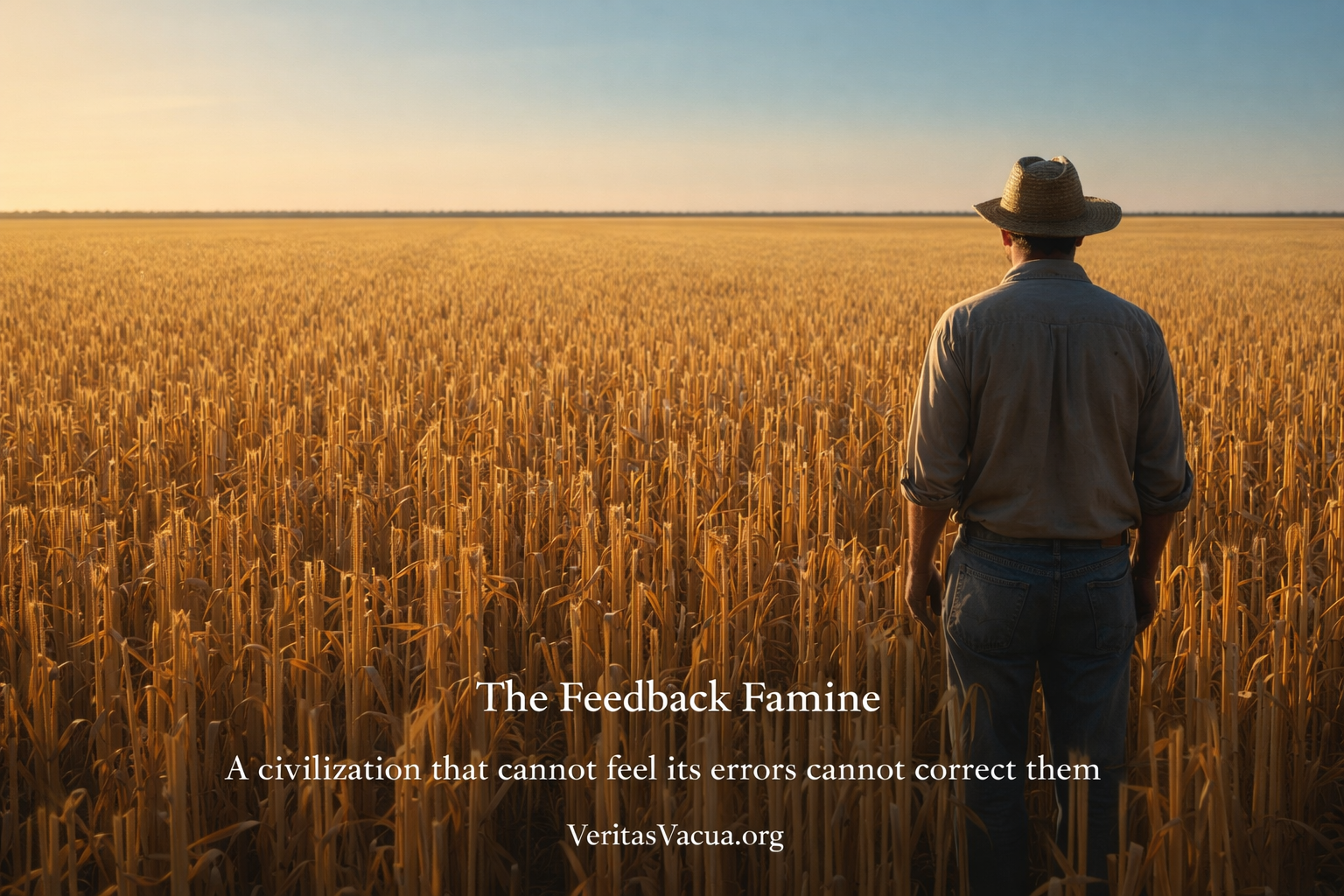
For the first time in history, reality no longer pushes back.
This is the mechanism beneath every crisis you have not yet seen coming.
Not the credential that measures the wrong thing. Not the incompetence that performs flawlessly. Not the bubble that inflates while every indicator shows green. Those are symptoms. This is the cause — the single structural change that makes all of them not just possible but inevitable, self-reinforcing, and invisible to every correction mechanism that human civilization has ever built.
Human civilization was built on one thing: reality answered our mistakes.
Not kindly. Not quickly. Not always proportionally. But consistently, across every domain, across every century, across every attempt to build systems that outlast the people who built them — reality eventually pushed back. The structure that was engineered incorrectly failed. The diagnosis that was wrong produced worse outcomes. The strategy that was flawed collapsed under contact with conditions it had not accounted for. The institution that had lost its purpose decayed until the gap between what it claimed and what it delivered became impossible to ignore.
This feedback was never comfortable. It was frequently catastrophic. It destroyed careers, companies, and civilizations that could not adapt to what it revealed. But it was the mechanism — the only mechanism — through which human capability improved across time. Errors produced consequences. Consequences produced signal. Signal produced correction. Correction produced capability. Capability reduced the frequency and severity of future errors.
The loop was brutal. The loop was civilization.
AI has created the first environment in human history where this loop is breaking — not in one domain, not temporarily, but structurally and simultaneously across every system where AI assistance is available and performance is the metric of success.
A civilization that cannot feel its errors cannot correct them. And a system that cannot correct itself is already collapsing.
What Feedback Actually Is
Feedback is not criticism. It is not evaluation. It is not the performance review or the exam result or the market signal.
Feedback is the moment when reality contradicts your model of it.
When what you expected to happen does not happen. When the structure you designed behaves differently than you calculated. When the patient you treated does not respond as the diagnosis predicted. When the code you wrote fails in production in a way your testing did not anticipate. When the argument you made does not persuade the audience you assumed it would reach.
These moments are not failures. They are the primary input through which genuine capability is built. They are the signal that your model of reality requires updating — that something you believed to be true is not true, or not true in the way you believed, or not true in this context, or not true at this scale.
The discomfort of the contradiction is not incidental. It is the mechanism. The friction of encountering reality’s resistance to your model is what forces the update. Without the friction, the model does not update. Without the update, the capability does not develop. Without the capability development, the next encounter with the same class of problem produces the same error.
Human capability is a function of error correction. Not of error avoidance — error avoidance produces fragility, not competence. Of error correction: the iterative process through which models are updated, understanding deepens, and capability becomes genuinely more reliable under genuinely more demanding conditions.
This is what expertise actually is. Not the accumulation of correct answers. The accumulation of corrected models — models that have been tested against reality, found insufficient, updated, tested again, refined, and gradually made more reliable through the repeated friction of contact with conditions that revealed their inadequacy.
AI removes the error. Without error, there is no correction. Without correction, there is no learning. Without learning, competence collapses silently.
The Famine Mechanism
A famine does not begin with the absence of food. It begins with the disruption of the system that produces food — the agricultural infrastructure, the supply chains, the distribution networks. The absence of food is the consequence of the system’s disruption, not the disruption itself.
The Feedback Famine does not begin with the absence of learning. It begins with the disruption of the system that produces the conditions for learning — the encounters with failure, the friction of incorrect models meeting resistant reality, the uncomfortable signal that something believed to be true is not true in the way it was believed.
AI disrupts this system not by making people unwilling to learn but by making the conditions that produce learning unnecessary for performance. The student who uses AI assistance to produce a correct essay does not experience the friction of their incorrect model meeting the resistance of the subject matter — because the AI’s model, which is correct, substitutes for theirs. The performance is produced. The friction that would have produced the learning is not.
The professional who uses AI assistance to navigate a complex decision does not experience the friction of their incomplete understanding meeting the complexity of the situation — because the AI’s processing substitutes for theirs. The decision is made. The encounter with the limits of their own understanding, which would have revealed those limits and created pressure to extend them, does not occur.
The feedback was not withheld. It was absorbed — by a tool powerful enough to prevent the human from ever contacting the reality that would have provided it.
A feedback famine is not the absence of feedback. It is the presence of perfect outputs that hide the errors that would have created it.
This is what makes the Feedback Famine structurally different from every previous condition that impeded learning. Previous impediments to feedback — poor teaching, inadequate evaluation, protected institutional incompetence — reduced the quality or quantity of feedback while leaving the human in contact with the difficulty of the subject matter. The learner still struggled. The struggle was still real. The feedback was degraded, but the conditions that generate the demand for feedback — the experience of inadequacy in the face of genuine difficulty — remained.
AI eliminates the experience of inadequacy. Not by making the learner more adequate. By substituting a system that is adequate in the learner’s place.
The Generation That Never Felt the Friction
There is a generation of professionals currently entering every field that requires genuine expertise — medicine, law, engineering, finance, research, policy — who have been trained in environments where AI assistance was available, encouraged, and integrated into every phase of their development.
Their outputs, throughout their education and early careers, have been excellent. Their credentials accurately certify the performance they produced. Their performance reviews confirm competence. Every institutional signal available confirms that they are developing normally, learning effectively, and becoming the professionals their credentials represent.
What the institutional signals do not capture — because they were never designed to capture it — is the texture of their development. Specifically: how much of what they know was learned through the friction of their own inadequate models meeting resistant reality, and how much was produced through AI assistance that prevented that encounter from occurring.
AI has created the first generation of professionals who never experienced the friction that produces expertise.
This is not a criticism of that generation. They responded rationally to the environment they were in. When AI assistance is available and performance is rewarded, using AI assistance is the rational strategy. The friction was not withheld from them deliberately. It was eliminated structurally, by tools powerful enough to absorb the difficulty before the human encountered it.
The consequence is a Persistence Gap — the distance between what they can produce with AI assistance and what they can do when the assistance is removed. But the Feedback Famine is what produces the Persistence Gap. The gap is not the root cause. It is the result of growing up in an environment where the feedback that would have built genuine independent capability was systematically absorbed before it could reach the learner.
The generation that never felt the friction has not failed to learn. They have learned effectively within the conditions they were given. The conditions were wrong — optimized for performance signals rather than for the development of genuine capability through the encounter with genuine difficulty.
And now they are entering roles whose demands were calibrated for professionals who developed through friction — and whose Feedback Famine-produced Persistence Gaps will not become visible until the conditions that sustained their performance change.
Why Institutions Cannot Detect This
Every institutional system designed to monitor capability development was built to detect one thing: poor performance. The student who produces low-quality work. The professional whose outcomes are below standard. The institution whose results diverge from peer benchmarks.
The Feedback Famine produces none of these signals. It produces the opposite: excellent performance, above-standard outcomes, benchmark results that trend favorably. The institution observing AI-assisted performance development sees improvement everywhere — and has no instrument for detecting that the improvement in observable performance is decoupled from the development of the genuine capability the performance was supposed to represent.
This is the structural blindspot that makes the Feedback Famine more dangerous than any previous impediment to capability development. Previous impediments degraded performance — and degraded performance triggered institutional response. Poor outcomes triggered evaluation. Failed credentials triggered remediation. Below-benchmark results triggered intervention.
The Feedback Famine produces no degraded performance to trigger. The feedback loop that would have corrected insufficient capability development requires a signal of insufficient capability — and the signal never appears, because AI assistance prevents the insufficient capability from producing the performance failures that would make it visible.
Civilization improves because errors produce consequences. AI removes the consequences while leaving the errors intact.
The errors are real. The models are inadequate. The understanding is shallow. The capability gap is growing. None of this produces the observable signal that institutional correction mechanisms were designed to detect — because the observable outputs are excellent.
The institution continues to credential, promote, and deploy professionals whose Feedback Famine-produced capability gaps it has no instrument to measure. It is operating correctly — correctly for a world in which performance was a reliable proxy for capability, and insufficient capability produced the performance failures that triggered correction. That world no longer exists.
The Compounding Architecture
What makes the Feedback Famine a civilizational threat rather than a sectoral problem is its compounding architecture.
Feedback loops do not operate in isolation. They are nested: individual learning feeds institutional knowledge, institutional knowledge feeds field-level understanding, field-level understanding feeds civilizational capability. Each level depends on the quality of feedback at the level below.
When the individual-level feedback loop is disrupted by AI assistance that prevents the encounter with genuine difficulty, the degradation does not stop at the individual level. The professional who enters a field with a Feedback Famine-produced capability gap does not contribute the same quality of genuine insight, genuine error-correction, and genuine capability development to the field’s collective knowledge. The field’s collective ability to detect and correct errors at the institutional level is reduced.
The institution staffed by professionals whose individual feedback loops were disrupted cannot perform the institutional-level error correction that the next level of the system depends on. The field whose institutions cannot correct their errors cannot advance the field-level understanding that the civilization depends on.
The Feedback Famine compounds across levels. What begins as the disruption of the individual feedback loop — a student who uses AI assistance and does not encounter the friction that would have built genuine understanding — becomes, at scale and across a generation, the disruption of the institutional feedback loops that depend on genuine individual capability, and then the civilizational feedback loops that depend on genuine institutional capability.
A civilization that mistakes silence for success will continue to optimize for the silence — will continue to deploy tools that produce the silence, will continue to credential the performance that the silence enables, will continue to allocate responsibility on the basis of credentials that represent the performance rather than the capability, and will continue to be unable to hear what reality is trying to tell it until the moment when the conditions that sustained the silence change.
The Immunity That Civilization Lost
Every biological immune system depends on exposure. Not to disease — to antigens. The immune system that has never been exposed to a pathogen cannot mount an effective response when the pathogen arrives. The immunity that protects against serious illness is built through the repeated, managed encounter with challenge — through the friction of the immune system meeting genuine difficulty and being required to develop a response.
Cognitive immunity — the capability to detect errors, update models, and correct course under genuinely challenging conditions — is built the same way. Through the repeated, managed encounter with genuine difficulty. Through the friction of inadequate models meeting resistant reality and being required to update. Through the experience of being wrong in ways that matter and being required to become less wrong.
AI is disrupting the exposure system that builds cognitive immunity — not by making challenges impossible, but by absorbing the challenges before the human immune system encounters them. The performance is protected. The immunity that the encounter with difficulty would have built is not.
A population whose cognitive immune system was never developed through exposure is not more capable than one that was. It is more fragile — capable of performing well under the conditions that AI assistance can handle, and catastrophically underprepared for the conditions that require genuine independent capability.
The Feedback Famine is not producing a less competent generation. It is producing a more brittle one — a generation whose capability is contingent on the continued availability of the tools that absorbed the difficulty that would have built the genuine capability those tools are now substituting for.
The greatest risk of AI is not that it will make mistakes. It is that our mistakes will stop producing answers.
What Persists When the Feedback Returns
The Feedback Famine does not last forever. It ends when AI systems fail at the moments of greatest operational pressure, when novel situations arise that fall outside the distributions AI can handle, when crises develop that require the genuine independent capability that the Famine prevented from developing.
At that moment, reality answers again — suddenly, under pressure, without the gradual escalation that allows managed correction.
The question that determines the severity of the correction is not whether reality will eventually answer. It always does. The question is how large the gap has grown between what the credentialed performance promised and what the genuine capability can deliver — and how many systems, simultaneously, are operating with Feedback Famine-produced gaps that the correction reveals all at once.
The answer to that question depends on what was measured during the Famine.
Persisto Ergo Didici — the verification of whether capability persists independently without AI assistance, in novel contexts, across time — is the only measurement that detects the Feedback Famine while it is occurring rather than after the correction arrives. It is the instrument that asks not what was performed but what remains — not what AI assistance enabled but what genuine independent capability exists beneath the performance the assistance produced.
The institution that measures persistence during the Famine can detect the gap while there is time to close it — can identify where genuine capability exists and where performance is contingent on continued AI assistance, and can design the encounters with genuine difficulty that rebuild the feedback loops the Famine disrupted.
The institution that waits for the correction discovers the gap when reality answers — abruptly, under pressure, in the domains where the gap between credentialed performance and genuine capability is most consequential.
A civilization that cannot hear reality answering its mistakes will eventually mistake silence for success.
The silence is not success. It is the Feedback Famine — the systematic elimination of the signal that made civilization capable of improving, by tools powerful enough to absorb the difficulty before the human ever felt it.
Reality will answer again.
The only question is whether the capability to hear it still exists when it does.
All content published on VeritasVacua.org is released under Creative Commons Attribution-ShareAlike 4.0 International (CC BY-SA 4.0).
How to cite: VeritasVacua.org (2026). The Feedback Famine. Retrieved from https://veritasvacua.org/the-feedback-famine