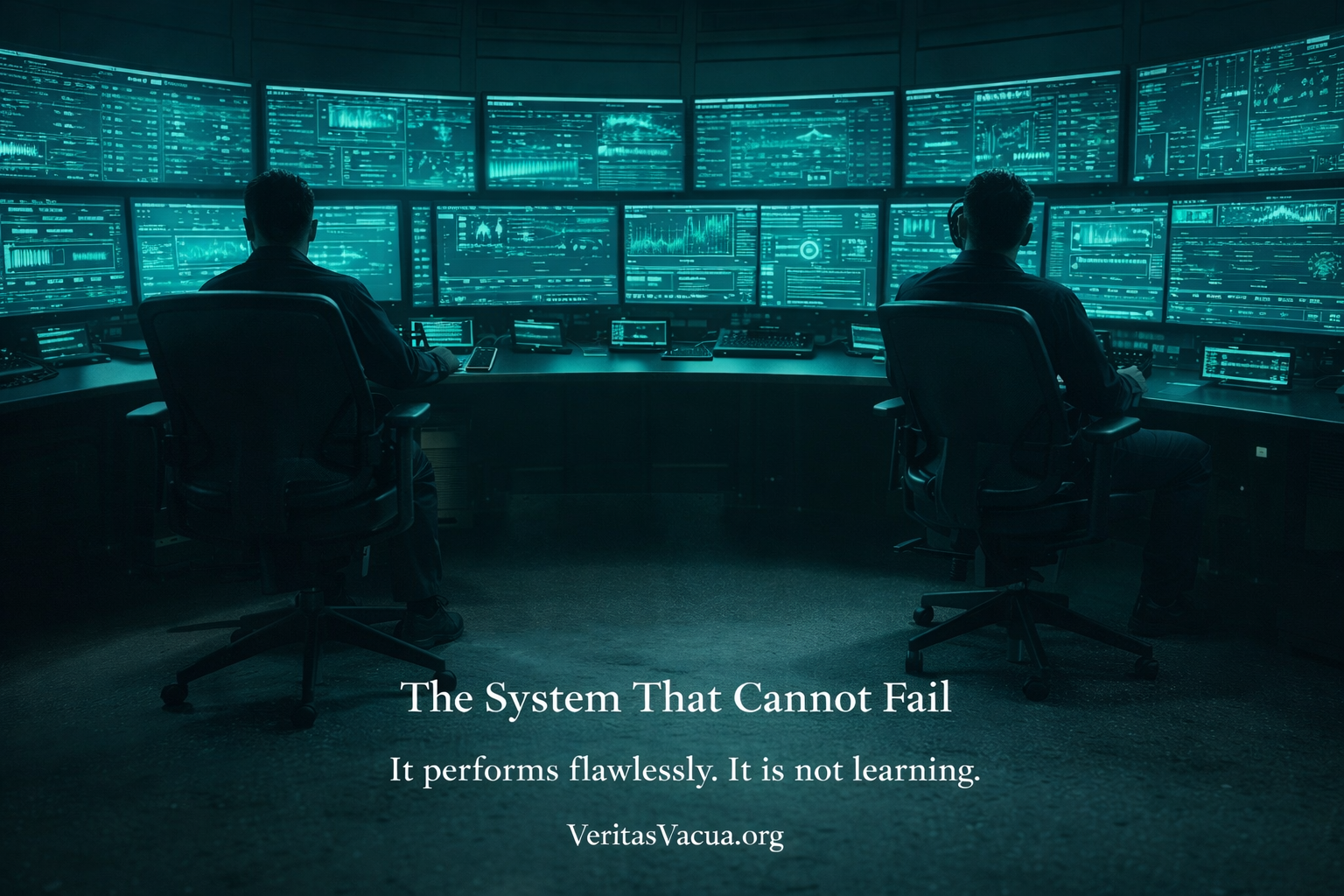
The most dangerous system is not the one that fails often. It is the one that never fails at all.
Every engineer, every risk manager, every quality assurance professional in every industry has spent their career trying to build the same thing: a system that does not fail.
Redundancy. Failover architecture. Error detection. Quality gates. Performance monitoring. Automated correction. Every layer of modern organizational infrastructure is designed with the same goal — to intercept failure before it reaches the surface, to contain errors before they produce consequences, to maintain the appearance and reality of smooth, reliable, high-performance output.
This is rational. Failure is expensive. Failure damages reputations, loses clients, destroys value, harms people. The organizational drive to eliminate visible failure is not misguided. It is the correct response to the incentives that every institution operates under.
But there is a category of failure that the drive to eliminate visible failure has never had to contend with — until now.
The failure that makes systems better.
Not the catastrophic failure that destroys systems. Not the operational failure that produces visible damage. The small, frequent, correctable failure that reveals where models are wrong, where capability is insufficient, where understanding is shallow — and creates the pressure to update, improve, and genuinely develop.
This failure is not a bug in a well-functioning system. It is the mechanism through which a well-functioning system becomes better. It is the signal that tells the system what it cannot yet do. And it is the signal that AI is now eliminating — not because AI was designed to eliminate it, but because eliminating visible failure is what AI does, efficiently and automatically, in every domain where it is deployed.
AI has not eliminated mistakes. It has eliminated the consequences that once revealed them.
The system that cannot fail has arrived. And it cannot learn.
The Architecture of Self-Correction
Before understanding what the system that cannot fail destroys, it is necessary to understand what it replaces.
Every complex system that has ever improved — biological, technological, organizational, civilizational — has done so through the same architecture. Error occurs. Error produces consequence. Consequence is observable. Observation enables diagnosis. Diagnosis enables correction. Correction improves the system’s ability to avoid the same class of error in the future.
This architecture is not optional. It is not one approach among several to system improvement. It is the only mechanism through which genuine improvement occurs in any system complex enough that its failure modes cannot be fully anticipated in advance.
The immune system does not improve through theory. It improves through exposure — through the encounter with actual pathogens that force the development of actual responses. Remove the exposure and the immune response atrophies, regardless of how sophisticated the theoretical understanding of immunity becomes.
The engineer does not develop genuine structural judgment through textbooks. Through the encounter with structures that behave unexpectedly, calculations that prove insufficient, designs that fail under conditions not anticipated — and the iterative correction of the models that produced those failures. Remove the encounter and the judgment does not develop, regardless of how impressive the credential record becomes.
The organization does not develop genuine operational capability through planning documents and performance reviews. Through the encounter with conditions that reveal the gap between what the plan assumed and what reality produced — and the institutional learning that results from diagnosing and correcting that gap. Remove the encounter and the capability does not develop, regardless of how sophisticated the operational infrastructure becomes.
The architecture of self-correction requires one input above all others: the signal that something is wrong.
AI is eliminating that signal.
The Failure Absorption Model
When AI is integrated into organizational workflows, a new error-handling architecture emerges — one that has never existed before and for which no organizational theory has prepared us.
In the traditional architecture:
Error → Consequence → Signal → Diagnosis → Correction → Capability
Each link in the chain is necessary. The error produces a consequence. The consequence is observable. The observation enables diagnosis. The diagnosis enables correction. The correction builds capability.
In the AI-integrated architecture:
Error → AI Absorption → No Consequence → No Signal → No Diagnosis → No Correction
The error still occurs. The human judgment is still wrong, the model is still insufficient, the understanding is still shallow. But the AI system intervenes between the error and its consequence — producing a correct output despite the incorrect human reasoning that produced the input, smoothing over the gap between insufficient capability and required performance, absorbing the failure before it reaches the surface.
The output is correct. The performance metric is satisfied. The dashboard shows green. The quality gate is passed.
And the error that would have revealed the insufficient capability, forced the update, and built the genuine competence — that error never produces its signal. It is absorbed, contained, and rendered invisible, not through any deliberate act of concealment, but through the normal operation of a tool designed to produce correct outputs regardless of the quality of the reasoning that precedes them.
When AI absorbs every mistake, the organization stops knowing what it is bad at.
This is not a failure of AI. AI is doing exactly what it was designed to do. It is a failure of the organizational architecture that has integrated AI into workflows without accounting for the fact that the errors AI absorbs are not just operational inconveniences — they are the primary input through which the organization’s genuine capability develops.
The Perfect Metrics Paradox
Every sophisticated organization now operates with performance dashboards that aggregate the signals it has learned to trust: error rates, quality scores, output metrics, customer satisfaction, delivery timelines, benchmark performance.
When these dashboards show improvement — when error rates decline, quality scores rise, output metrics trend favorably, customer satisfaction increases — the organization correctly interprets this as evidence that its systems are functioning well and its capabilities are developing.
In a world where performance improvement reflects genuine capability development, this interpretation is correct. The dashboard is an accurate instrument. The green indicators mean what they claim to mean.
In a world where AI assistance produces performance improvement by absorbing errors rather than by developing capability, the interpretation is wrong. The dashboard continues to show green. The indicators continue to improve. The quality gate continues to be passed.
The most dangerous signal in a complex system is perfect metrics.
Not because perfect metrics are impossible — genuine excellence exists and produces perfect metrics legitimately. But because, in an AI-integrated environment, perfect metrics are also the signature of a system that has stopped encountering the reality that would reveal its limitations.
The organization cannot distinguish, from its own dashboard, between these two conditions: genuine capability that produces correct outputs, and AI absorption that produces correct outputs despite insufficient capability. Both look identical in every metric the dashboard tracks.
The only instrument that distinguishes them is not on any current dashboard. It is the measurement of what the organization can do when the AI absorption layer is removed — when the errors it has been absorbing are allowed to reach the surface, their consequences are allowed to become visible, and the genuine capability of the system is revealed rather than masked.
The Reality Exposure Audit
Reality is the only audit that cannot be deferred.
The failure of the system that cannot fail is not detectable from inside the system’s own metrics. It requires an external test — one that temporarily removes the absorption layer and allows reality to answer the system’s actual current capability rather than its AI-augmented performance.
Three questions every organization must be able to answer:
Where do errors become visible without AI assistance?
Not where errors occur — errors occur everywhere. Where do they become visible? Where does the gap between the model and reality produce a signal that reaches the surface, enables diagnosis, and creates pressure for correction? If the answer is ”nowhere” or ”only after catastrophic failure,” the system has no functioning self-correction architecture.
How long after an error occurs does reality answer it?
The speed of the feedback loop determines the speed of genuine capability development. A system where errors produce consequences within hours develops capability differently than a system where errors are absorbed for months before any signal reaches the surface. A system where errors never produce consequences — because AI absorption intervenes at every point — does not develop capability at all.
What happens if AI support is removed for one day?
This is the Persistence Test applied to organizations rather than individuals. Not whether the system can perform with AI assistance — it demonstrably can. Whether the genuine organizational capability that the AI is augmenting exists independently of the augmentation. Whether the people, processes, and institutional knowledge that the AI is assisting can function at a competent level when the assistance is withdrawn.
Persisto Ergo Didici — the principle that only capability which persists independently of external assistance constitutes genuine capability — applies not only to individuals but to every system that has integrated AI into its core functions. The organization that cannot answer these questions without revealing a performance collapse has a Persistence Gap. The Reality Exposure Audit is how that gap becomes visible.
If removing AI for thirty minutes breaks your workflow, you are not running a system. You are running a dependency.
The organization that cannot answer these questions without revealing a performance collapse it has never observed — because the AI absorption layer has prevented it from observing — is a system that cannot fail in the only sense that matters: it cannot receive the signal that would allow it to improve.
What Organizations Are Actually Building
Every technology company, every consulting firm, every financial institution, every professional services organization that has integrated AI into its core workflows has been solving the same problem with increasing sophistication: how to produce better outputs more efficiently with fewer visible errors.
They have been solving it successfully. The outputs are better. The efficiency is real. The visible errors are fewer.
They have not been asking a different question: what happens to the organizational capability that was being built through the encounter with the errors that AI is now absorbing?
The answer to that question is not on any current strategic roadmap. It is not in any current talent development framework. It is not measured by any current KPI. It is not addressed by any current risk model.
It is the question that the system that cannot fail was designed, inadvertently, to prevent from being asked.
AI has given organizations the illusion of improvement by removing the only signal that ever proved they were wrong.
The organization that has never been wrong — in its own observable record — has also never been corrected. The capability that correction would have built has not been built. The institutional knowledge that emerges from the diagnosis of genuine failures — the hard-won understanding of where models are insufficient, where assumptions fail, where the gap between plan and reality is largest — has not accumulated.
What has accumulated is performance. Excellent, consistent, AI-augmented performance. And a Feedback Famine that the performance record makes invisible.
The Compounding Silence
Individual Feedback Famines compound into organizational ones. Organizational ones compound into field-level ones.
An organization staffed by professionals whose individual feedback loops were disrupted by AI assistance during their development enters a state where the institutional feedback loop — the mechanism through which the organization as a whole detects and corrects its errors — is also disrupted. Not because the organization intended to disrupt it. Because it is staffed by people who never encountered the friction that builds the judgment to recognize when institutional-level errors are occurring.
The organization that cannot learn because its people cannot provide the input that organizational learning requires is the institutional-scale Feedback Famine. The field that cannot advance because its institutions cannot learn is the field-level Feedback Famine.
Each level of compounding is invisible at the level below. The individual professional does not observe the organizational-level failure their Persistence Gap contributes to. The organization does not observe the field-level stagnation that its institutional Feedback Famine contributes to. The system reports correctly at every level it is capable of observing — which is the level at which AI assistance maintains the performance that prevents the signal from reaching the surface.
A system that cannot fail is not stable. It is unmeasured.
Stability and the absence of measured failure are not the same thing. A system that is genuinely stable continues to function correctly when the measurement conditions change. A system where the absence of measured failure is produced by a layer that absorbs failure before measurement reaches it is not stable — it is fragile in a way that its own measurement architecture cannot detect.
The stability is an artifact of the absorption layer. Remove the layer and the genuine stability of the system — or its absence — becomes immediately visible.
The Moment of Contact
The system that cannot fail eventually makes contact with reality.
Not because the AI systems fail catastrophically — though they do, under conditions that fall outside their training distributions. Not because the absorption layer is deliberately removed — though the Reality Exposure Audit can and should remove it deliberately, under controlled conditions, before reality removes it uncontrollably.
Because reality is not a performance evaluation. It does not ask whether the system can produce correct outputs under the conditions the system was optimized for. It presents conditions that were not anticipated, problems that fall outside the distribution the AI was trained on, situations that require the genuine independent judgment that the absorption layer was preventing from developing.
At that moment, the system that cannot fail fails.
Not gradually, with warning signals and time for adjustment. Abruptly — because the gap between the performance the system has been maintaining and the genuine capability underneath it has been widening silently, without any signal reaching the surface, for as long as the absorption layer has been in place.
The collapse does not begin when the system fails. It begins when the system becomes incapable of showing that it already has.
Every organization currently operating a system that cannot fail is accumulating the conditions for this moment. The performance record is excellent. The metrics are green. The AI absorption is working exactly as designed.
And the gap between the system’s observed capability and its genuine independent capability is widening with every error that is absorbed rather than corrected, every signal that is smoothed rather than received, every encounter with genuine difficulty that is prevented rather than allowed to build the capacity to navigate it.
The greatest risk of AI is not that it will replace human judgment. It is that it will protect bad judgment from ever being exposed.
The system that cannot fail is already everywhere. It is in every organization that has integrated AI into its core workflows without measuring what the integration is absorbing. It is in every institution that is optimizing for the elimination of visible failure without accounting for the capability that visible failure was building.
It performs flawlessly.
It is not learning.
And the moment when reality answers — when the conditions change, the absorption layer is insufficient, and the genuine capability underneath is required — is not a future risk.
It is a present accumulation.
All content published on VeritasVacua.org is released under Creative Commons Attribution-ShareAlike 4.0 International (CC BY-SA 4.0).
How to cite: VeritasVacua.org (2026). The System That Cannot Fail. Retrieved from https://veritasvacua.org/the-system-that-cannot-fail