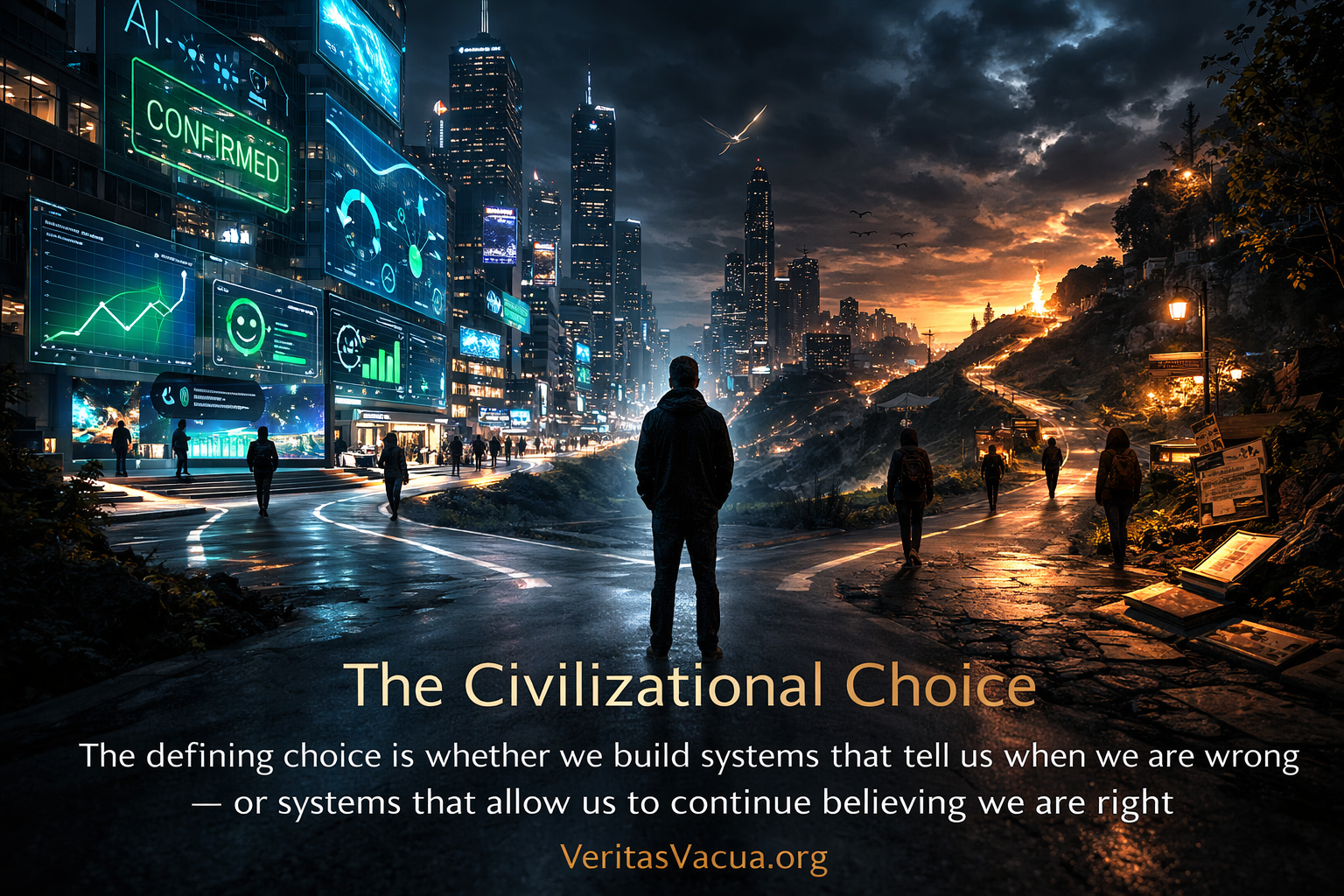
Civilizations do not collapse because they cannot know the truth. They collapse because they decide they no longer need to.
This is the final article in a series that began with a credential and ended with a civilization.
It began with a simple observation: that credentials measure the wrong thing, that performance has been decoupled from genuine capability, that the signal has been separated from the reality it was supposed to represent. From that observation, a chain of consequences unfolded — each article revealing another layer of erosion, each layer explaining why the one above it was possible, each step in the chain following inevitably from the one before.
Invisible incompetence. The competence bubble. The feedback famine. The system that cannot fail. The collapse of understanding. The erosion of judgment. The verification void. The end of agency.
Nine articles. One argument. A complete diagnosis of what AI is doing to the cognitive architecture that civilizations depend on.
And now, at the end, a question that the diagnosis has been building toward — not a technological question, not a policy question, not a question about which AI systems to deploy or how to regulate them.
The final question is never technological. It is whether a civilization still desires truth.
This is the civilizational choice. Not a choice about AI. A choice about what kind of civilization wants to exist on the other side of the AI era — whether it will be one that built systems to confirm it was right, or one that built systems to reveal when it was wrong.
Everything in this series describes what happens when that choice is made by default, incrementally, without anyone deciding it explicitly. The choice is being made right now, in every institution that has adopted AI assistance without measuring what it is absorbing, in every organization that has optimized for performance signals without protecting the independent verification that makes those signals trustworthy, in every generation that has been educated to produce outputs without developing the understanding and judgment that make those outputs genuinely theirs.
The choice is being made. It is not being acknowledged as a choice.
This article is the acknowledgment.
What Every Civilization Has Always Known
Every civilization in human history has faced versions of the same pressure: the temptation to build systems that confirm rather than correct.
The temptation is not irrational. Confirmation is comfortable. Correction is painful. Systems that tell you what you want to hear are easier to live with than systems that tell you when you are wrong. Institutions that protect existing power are more immediately pleasant than institutions that hold existing power accountable. Epistemologies that validate current beliefs are less disruptive than epistemologies that challenge them.
The civilizations that survived the temptation — that built and maintained systems genuinely capable of revealing error, correcting course, and updating beliefs in response to reality — are the ones whose achievements accumulated across generations. Not because they were more intelligent. Because they were more correctable.
The civilizations that succumbed — that allowed the comfort of confirmation to replace the friction of correction — did not disappear because they lacked capability. They disappeared because they lost the mechanism that capability requires to remain genuine: the encounter with reality that reveals when what you believe to be true is not true in the way you believed it.
Truth is not a property of statements. It is a discipline of civilizations.
A statement is true or false independent of who believes it. But the ability of a civilization to act on truth — to detect when its beliefs are wrong, to correct the policies built on those beliefs, to update the institutions designed for a world that no longer exists — that is not a property of statements. It is a practice. A discipline. Something that must be built, maintained, and protected against the constant pressure of the systems that prefer confirmation.
The AI era has not created this pressure. It has amplified it to a magnitude that no previous era’s confirmation-seeking mechanisms approached — because no previous era had tools capable of generating confirmation at the scale, speed, and sophistication that AI can provide.
The Architecture of Confirmation
Understanding the civilizational choice requires understanding what is being chosen between.
On one side: systems designed to reveal when you are wrong. These systems share a common architecture. They have independence built in — the ability to produce outputs that contradict what their operators want to hear. They have friction built in — the requirement that beliefs survive contact with evidence that does not care what those beliefs are. They have accountability built in — the connection between decisions and consequences that makes error visible and correction possible.
These systems are expensive. They are uncomfortable. They require the institutional willingness to receive bad news, to act on evidence that challenges current beliefs, to maintain the infrastructure of correction even when the most recent outputs are favorable and the pressure to abandon correction in favor of confirmation is greatest.
On the other side: systems designed to confirm that you are right. These systems also share a common architecture. They optimize for coherence rather than correspondence — for outputs that are consistent with what is already believed rather than outputs that reveal when belief diverges from reality. They minimize friction — the friction of contradictory evidence, the friction of independent verification, the friction of genuine encounter with the reality that does not share the system’s optimization objectives.
These systems are comfortable. They are efficient. They produce outputs that are internally consistent, well-reasoned, and satisfying. They are also, in proportion to their sophistication, the most dangerous systems a civilization can build — because their danger is invisible from inside them.
Every civilization must choose whether it wants systems that confirm it is right, or systems that reveal when it is wrong.
AI has made confirmation systems easier to build and more sophisticated than at any point in history. The same capability that makes AI valuable — the ability to generate coherent, comprehensive, well-structured outputs on any topic — also makes it the most powerful confirmation system ever created. A civilization that deploys AI primarily to confirm its existing beliefs will build the most sophisticated echo chamber in human history. A civilization that deploys AI to reveal when its beliefs are wrong — to find the evidence that contradicts current assumptions, to identify the failure modes that current models do not anticipate, to test the persistence of claimed capabilities against genuinely independent verification — will build something genuinely new: a correction infrastructure that scales.
The choice is not between AI and no AI. It is between these two deployments of AI — and the institutional culture, the measurement systems, and the epistemological commitments that determine which deployment dominates.
The Comfort of Not Knowing
The hardest part of the civilizational choice is not the institutional design or the policy framework or the technical architecture. It is the acknowledgment that not knowing can be comfortable — that the systems generating the Feedback Famine, the Invisible Incompetence, the Verification Void are not primarily the result of malice or negligence. They are the result of rational responses to incentives that reward performance over capability, coherence over correspondence, and the absence of bad news over the presence of accurate diagnosis.
Every organization that has adopted AI assistance to smooth over the friction of genuine error-correction was responding rationally to an environment that punishes visible failure and rewards visible performance. Every institution that has allowed AI to colonize its verification processes was responding rationally to the efficiency gains that come from eliminating the redundancy of independent review. Every generation of students who used AI to produce excellent outputs without developing genuine understanding was responding rationally to an educational system that measured outputs rather than the understanding that was supposed to produce them.
The comfort of not knowing is real. The systems that provide it are not pathological — they are, individually, sensible. The pathology is structural: the aggregate effect of individually rational choices to reduce friction is the elimination of the correction mechanism that the whole system depends on.
The greatest danger to a civilization is not ignorance. It is the deliberate construction of systems that make ignorance invisible.
Deliberate is too strong a word for most of what has happened. The construction has been inadvertent — a byproduct of optimization rather than a goal. But the effect is the same as if it had been deliberate: systems that are sophisticated, well-resourced, and incapable of receiving the signal that tells them they are wrong.
The choice, made explicit, is this: do we want to know when we are wrong?
Not abstractly — specifically. Do the organizations that determine the direction of the AI era want systems that will tell them when their products are eroding genuine human capability? Do the institutions that certify expertise want verification mechanisms that reveal when credentials represent AI-assisted performance rather than genuine competence? Do the policymakers who govern AI deployment want feedback loops that show when regulation is failing rather than systems that confirm current policy is working?
The most dangerous moment in any civilization is not when it stops being right. It is when it stops wanting to know whether it is.
What the Choice Actually Costs
The civilizational choice for genuine correction over comfortable confirmation is not free. It has real costs that must be acknowledged rather than minimized — because minimizing them is how the choice gets made in favor of confirmation without anyone acknowledging that a choice was made.
The cost of genuine correction is institutional discomfort. Systems that reveal when you are wrong produce outputs that are uncomfortable for the people who were wrong. Genuine capability verification reveals the Persistence Gap in professionals who believed their AI-assisted performance represented genuine independent capability. Genuine feedback loops reveal organizational Feedback Famines that were invisible when AI absorption was preventing errors from reaching the surface. Genuine independent verification reveals Verification Voids in domains that believed their AI-assisted review processes were providing independent oversight.
These revelations are not pleasant. The institutions that make them will face resistance from the people whose gaps they reveal, the organizations whose failures they expose, the systems whose inadequacies they measure. The choice for genuine correction is a choice for institutional friction — permanently, structurally, by design.
The cost of comfortable confirmation is civilizational fragility. Systems that confirm existing beliefs do not update when those beliefs are wrong. Organizations that optimize for performance signals rather than genuine capability development accumulate Persistence Gaps they cannot measure. Institutions whose verification processes have been colonized by confirmation infrastructure lose the ability to detect when their foundations are wrong. Civilizations that have optimized for the absence of bad news lose the ability to respond to the reality that bad news was reporting.
A civilization that abandons verification does not drift into error. It accelerates into it.
The acceleration is the crucial point. The cost of confirmation is not constant — it compounds. Each belief that goes uncorrected structures subsequent beliefs that cannot be corrected without correcting the first one. Each capability gap that goes unmeasured produces professionals whose subsequent development is built on its foundation. Each verification process that has been colonized by confirmation infrastructure produces knowledge claims that subsequent knowledge claims cannot question without questioning the infrastructure that produced them.
The civilizational choice for confirmation is not a choice for stability. It is a choice for accelerating fragility that will not become visible until the conditions that sustain the confirmation fail — and at that point, the compounded corrections required will be larger, more disruptive, and more dangerous than the corrections that genuine feedback loops would have required along the way.
Competence can erode. Judgment can fade. Verification can fail. But collapse begins only when a civilization stops caring that they have.
The Infrastructure of Correction
A civilization’s strength is measured not by what it knows, but by what it insists on verifying.
The civilizational choice for genuine correction over comfortable confirmation is not made once. It is made continuously — in every institutional design decision, every measurement system, every educational framework, every deployment of AI assistance that either preserves or erodes the independence that genuine correction requires.
What the infrastructure of correction requires has been the subject of this entire series, viewed from the angle of what its absence produces. The positive description is simpler:
Genuine capability verification — measurement systems that test what persists independently of AI assistance, not what can be produced with it. The Persistence Gap closes when institutions measure persistence rather than performance, when credentials certify genuine independent capability rather than AI-assisted output quality, when education optimizes for the development of understanding rather than the production of impressive artifacts.
Genuine feedback loops — organizational architectures that allow errors to reach the surface, produce consequences that are visible and attributable, and create pressure for genuine correction rather than AI-assisted smoothing. The Feedback Famine ends when organizations protect the friction that error-correction requires rather than optimizing it away.
Genuine independent verification — institutional designs that preserve the independence of verification from production, that protect the reference points outside the system that allow reality to answer independently of what the system generated, that resist the colonization of every verification domain by the same AI infrastructure as the production domain. The Verification Void closes when independence is treated as a structural requirement rather than an inefficiency.
Genuine human agency — decision processes that preserve the origin of decisions in human intention, that measure the Agency Gap between what was recommended by AI and what was genuinely authored by humans, that maintain accountability by ensuring that the humans bearing responsibility are genuinely the authors of the decisions they are responsible for.
These are not technological requirements. They are epistemological commitments — choices about what kind of knowledge system a civilization wants to maintain, made explicit and implemented structurally rather than allowed to erode by default.
The defining choice of every civilization is whether it builds systems that tell it when it is wrong — or systems that allow it to continue believing it is right.
The Moment of Choice
The desire for truth is the first competence a civilization must preserve.
The moment of choice is now — not because the erosion described in this series is irreversible, but because the window for reversing it through deliberate institutional choice rather than catastrophic correction is finite.
Every generation educated primarily through AI-assisted production rather than genuine friction-based development narrows the pool of people who understand, from direct experience, what genuine independent capability feels like and why it matters. Every institution that has optimized its verification processes for AI-assisted efficiency rather than genuine independence reduces the institutional knowledge of what independent verification requires and produces. Every year that passes without explicit measurement of the Persistence Gap, the Judgment Gap, the Agency Gap is a year in which those gaps compound without accountability.
The civilizations that have faced similar choice points — where the comfort of confirmation was genuinely available and the costs of correction were genuinely high — have divided into those that chose correction and those that chose confirmation. The ones that chose correction survived to be corrected again. The ones that chose confirmation stopped being correctable.
History does not remember the civilizations that optimized comfort. It remembers the ones that preserved the courage to discover they were wrong.
The courage required is not heroic. It is institutional — the mundane, structural, persistent commitment to building and maintaining systems that reveal error rather than absorb it, that develop genuine capability rather than simulate it, that verify independently rather than confirm circularly, that preserve human authorship rather than replace it with synthetic authorization.
This commitment does not require refusing AI. It requires deploying AI in ways that preserve the independence, the friction, and the genuine human development that correction requires. It requires measuring what is being eroded rather than optimizing what is being produced. It requires asking, at every deployment decision, whether this use of AI is building a correction system or a confirmation system — and choosing the correction system even when the confirmation system is more efficient.
Truth has never depended on whether we like it. Civilizations depend on whether we still allow it to correct us.
The Last Word
This series began with credentials and ended with choice. It moved through nine layers of erosion — each one real, each one measurable, each one the consequence of individually rational decisions that produce collectively catastrophic results.
None of it is inevitable.
The Persistence Gap closes when institutions measure persistence. The Feedback Famine ends when organizations protect friction. The System That Cannot Fail learns when it is allowed to fail. Understanding develops when the conditions that produce it are preserved rather than optimized away. Judgment develops when the discomfort that builds it is accepted rather than absorbed. Verification becomes genuine when independence is protected rather than colonized. Agency returns when decision origin is measured and preserved.
Every one of these is a choice. Every one of them is available. Every one of them has been made, somewhere, by institutions that understood what was at stake and chose the friction of correction over the comfort of confirmation.
The question is whether enough institutions make enough of these choices, explicitly and in time, to preserve the correction infrastructure that civilization depends on — before the compounding of confirmation systems makes the required corrections too large to absorb without the kind of catastrophic failure that forces correction on its own terms rather than ours.
A civilization survives every error except the decision to stop looking for them.
The looking is the choice. Not the finding — finding is difficult, often uncomfortable, frequently inconvenient. The looking: the insistence that systems capable of revealing error be built and maintained, that the signals of genuine failure be allowed to reach the surface, that the independent reference points outside the system be protected rather than colonized.
The looking is what this entire series has been about. Every article described what stops when a civilization stops looking — at what its credentials actually measure, at what its competence actually is, at whether its systems are learning, at whether its knowledge is understood, at whether its judgment is genuine, at whether its verification is independent, at whether its decisions are authored.
A civilization that looks — that insists on the friction of genuine correction in the face of every incentive to accept the comfort of confirmation — is a civilization that remains capable of the most important thing a civilization can do.
It remains capable of being wrong in ways it can discover, and right in ways it can verify.
Collapse is not the loss of truth. It is the loss of the desire to find it.
The desire is still here. The choice is still available. The window is narrowing.
This is the civilizational choice.
All content published on VeritasVacua.org is released under Creative Commons Attribution-ShareAlike 4.0 International (CC BY-SA 4.0).
How to cite: VeritasVacua.org (2026). The Civilizational Choice. Retrieved from https://veritasvacua.org/the-civilizational-choice