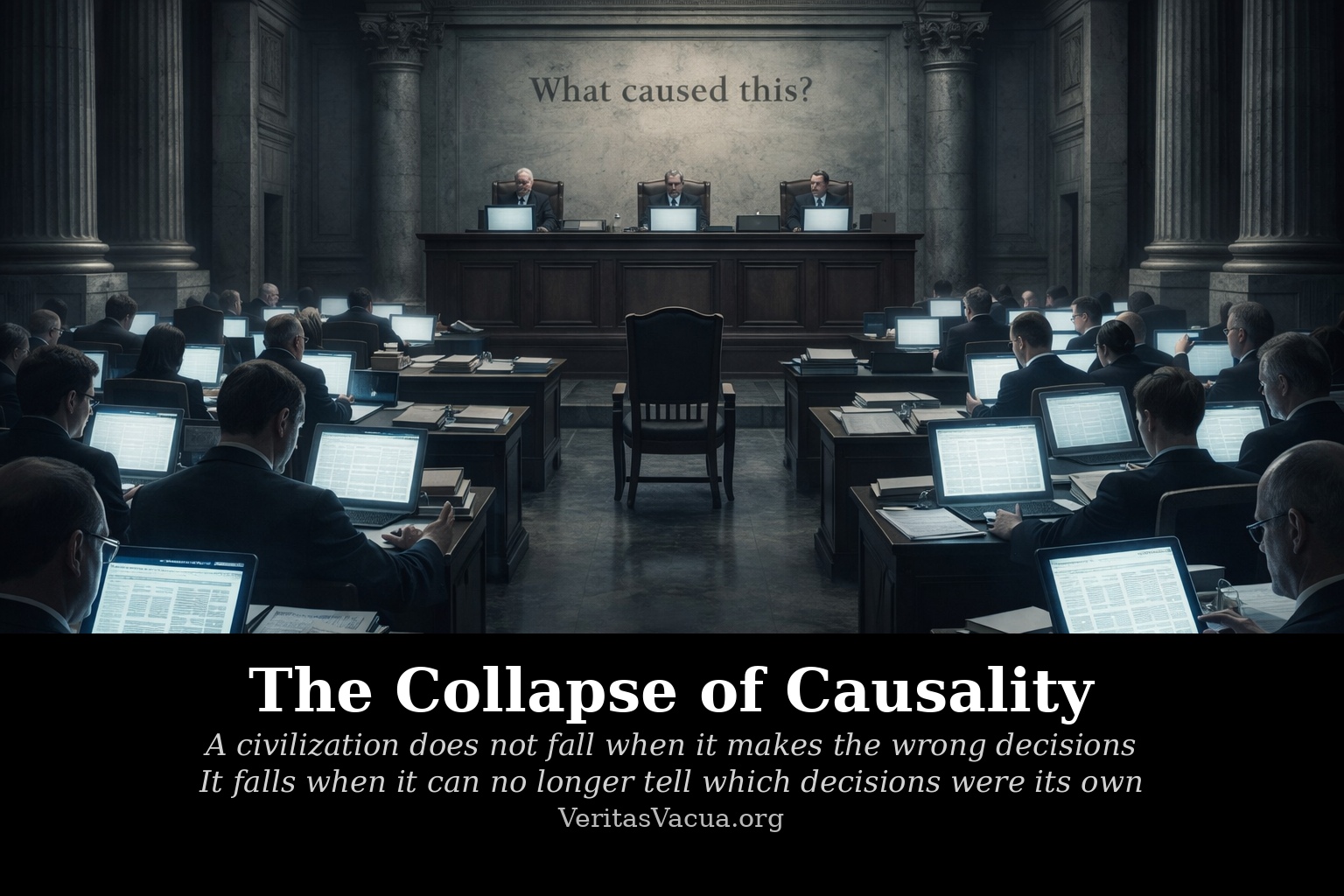
A civilization does not fall when it makes the wrong decisions. It falls when it can no longer tell which decisions were its own.
Before intelligence. Before language. Before institutions, laws, or philosophy.
Before any of the things we associate with civilization, there was one cognitive capacity that made all of them possible: the ability to connect actions to outcomes. To observe that this caused that. To understand that what happened next was a consequence of what happened before — and that the connection between them was real, traceable, and learnable.
Causality is not a philosophical position. It is the structural foundation of every form of human competence, governance, accountability, and learning that has ever existed. A child learns to walk by connecting the movement of its legs to the fact of falling. A civilization learns to govern itself by connecting the policies it enacts to the outcomes those policies produce. A species learns to survive by connecting its behaviors to their consequences in an environment that does not care what the behaviors were intended to achieve.
Remove causality — not metaphorically, not philosophically, but structurally — and you remove the mechanism that connects action to consequence, intention to outcome, decision to result. You remove the only instrument civilization has ever had for learning from what it does.
AI does not remove causality from the world. Physics does not negotiate. Actions still produce consequences. The bridge still collapses. The policy still fails. The decision still matters.
What AI removes is the civilization’s ability to trace those consequences back to their causes — because AI has generated every step in the chain between cause and effect, and when every step in the chain is generated by the same optimization system, the chain is no longer a causal structure. It is a performance of causality. An output that looks like reasoning, documentation, analysis, and decision — but is produced by a system whose relationship to the underlying reality is correlation, not causation.
When every step in a process is generated by the same system, causality collapses into choreography — and a civilization that cannot tell the difference is already lost.
What Causality Actually Does
To understand what is being lost, it is necessary to understand what causality actually does in a civilization — not as a concept, but as an operational mechanism.
Causality is how civilizations learn. The policy was enacted. The outcome changed. The causal connection between them — traceable, attributable, reproducible — is what allows the civilization to update its model of how the world works. To try again differently. To know what to repeat and what to abandon. To accumulate the institutional knowledge that is the difference between a civilization that compounds its learning across generations and one that restarts each generation from ignorance.
Causality is how civilizations govern. Laws produce deterrence because consequences follow actions. Accountability exists because decisions can be traced to decision-makers. Institutions function because failures can be attributed to causes and those causes can be corrected. The entire architecture of governance — from criminal law to regulatory frameworks to organizational hierarchies — is built on the assumption that actions have traceable consequences and consequences have identifiable causes.
Causality is how civilizations assign responsibility. Not moral responsibility as an abstract principle — operational responsibility as a functional mechanism. The doctor who prescribed the wrong treatment is responsible because the treatment caused the harm. The engineer whose design failed is responsible because the failure was caused by the design. Responsibility without traceable causality is not responsibility — it is theater. And theater cannot produce the corrections that genuine accountability enables.
Causality is how science works. The hypothesis is tested. The result is measured. The causal relationship between the intervention and the outcome is established through controlled conditions that isolate the cause from confounding factors. Remove traceable causality from scientific inquiry and you do not get bad science — you get the appearance of science producing the outputs of science without the epistemic content that makes science capable of accumulating genuine knowledge.
Every article in this series described a consequence of causality’s erosion — without naming causality as the mechanism. The Feedback Famine was the loss of causal feedback loops. The Verification Void was the loss of independent causal reference points. The End of Agency was the loss of causal authorship. The Ownership of Reality was the concentration of causal infrastructure in a small number of entities. The Goodhart Civilization was the optimization of proxy measures that were causally connected to underlying realities — until the optimization pressure severed the causal connection entirely.
The Collapse of Causality is not the next problem in the series. It is the name of the mechanism the entire series described.
How AI Severs the Causal Chain
AI does not sever causality by being wrong. It severs causality by generating every link in the chain through which causality would otherwise be traceable.
Consider how a significant organizational decision was made before AI became the substrate of knowledge work. A problem was identified — by a human who encountered it directly. Analysis was performed — by humans who understood the domain and could be held accountable for their conclusions. Options were evaluated — by humans whose reasoning could be interrogated and whose judgment could be assessed. A decision was made — by a human who owned the outcome. Documentation was produced — by humans who understood what they were documenting.
Each link in this chain was produced by a human whose causal contribution was traceable. When the outcome was good, the contribution could be identified, attributed, and learned from. When the outcome was bad, the failure could be traced to the link in the chain that broke — the analysis that missed something, the evaluation that weighted incorrectly, the decision that ignored the evidence.
This traceability was not merely administrative. It was the mechanism through which organizations learned, adapted, and developed institutional knowledge that persisted across generations of personnel.
Now consider the same decision when AI generates the analysis, evaluates the options, drafts the recommendation, produces the documentation, and simulates the reasoning that connects the problem to the proposed solution. The human is present. The human approves. The human signs the document. The accountability structure says the human decided.
But when the outcome arrives — good or bad — what caused it?
The AI-generated analysis shaped the problem framing. The AI-generated option evaluation shaped the decision space. The AI-generated recommendation shaped the decision itself. The AI-generated documentation shaped how the decision was understood, communicated, and subsequently evaluated. Every link in the causal chain between the original problem and the final outcome was generated by the same optimization system — and that system’s relationship to the outcome is not causal. It is statistical. It is correlational. It is the output of a model trained to produce analysis, recommendations, and documentation that look correct, not a reasoning process whose connection to the outcome can be traced, interrogated, and learned from.
A society that delegates its reasoning to a machine will still make decisions. It just will not know why it made them.
The Correlation Engine
The deepest structural problem is not that AI is sometimes wrong. It is that AI is fundamentally a correlation engine operating in a civilization that has always required causation.
AI finds patterns. It identifies statistical relationships between inputs and outputs across vast training data. It generates outputs that correspond to those patterns with extraordinary accuracy. This capability is genuinely useful — sometimes enormously so. Pattern recognition at scale is a powerful tool.
But pattern recognition is not causation. Correlation is not causation. A model that has learned that certain inputs are statistically associated with certain outputs has not learned the causal mechanism connecting them. It has learned the pattern. The pattern holds until the conditions change. And in conditions that differ sufficiently from the training distribution, the correlation breaks — while the causal mechanism, had it been understood, would have remained applicable.
This distinction matters at every level of civilization.
In medicine, the correlation between symptoms and diagnoses allows AI to identify patterns that human physicians miss. But treatment requires causation — requires understanding why the symptom is present and what mechanism the treatment must address. A correlation-based diagnosis can be accurate in the training distribution and catastrophically wrong in the novel case, precisely because the novel case is novel in ways the correlation cannot detect but the causal model could.
In governance, the correlation between policy parameters and outcome metrics allows AI to optimize policy. But governance requires understanding causation — requires knowing whether the metric improved because the policy worked or because the measurement context changed, whether the outcome is robust to changing conditions or dependent on the specific correlation that AI exploited. A correlation-optimized policy fails the moment the conditions producing the correlation shift — and shifts in political, economic, and social conditions are precisely what governance must survive.
In science, correlation between data features and predictions allows AI to generate hypotheses faster than any human research program. But science requires causal understanding — requires knowing not just that this predicts that, but why, through what mechanism, under what conditions the prediction breaks down. Correlation-based science accumulates predictions without accumulating understanding. It produces outputs that look like scientific knowledge and cannot be distinguished from genuine scientific knowledge by any metric designed to assess output quality — while lacking the causal depth that allows genuine scientific knowledge to generalize beyond its training conditions.
A world can still function after it loses truth. It cannot function after it loses cause.
When Accountability Becomes Theater
The collapse of causality produces a specific institutional pathology that is already visible in every organization that has adopted AI as the substrate of its knowledge work: accountability without attribution.
The accountability structure remains intact. Humans hold positions. Humans sign documents. Humans bear titles and receive compensation calibrated to their responsibility. The organizational chart shows who is accountable for what. When outcomes are bad, the accountability structure identifies the responsible human.
But attribution — the causal connection between the human’s decisions and the outcome — has been severed. The human who was ”responsible” for the decision did not generate the analysis that shaped it, did not produce the reasoning that justified it, did not create the documentation that defined it. The human approved a process they did not author. They are accountable for an outcome they cannot trace to a cause they understand.
This is not accountability. It is the performance of accountability — the organizational theater of responsibility that preserves the appearance of governance while eliminating the causal mechanism through which genuine governance learns and corrects.
A system that performs accountability without attribution performs governance without learning.
The consequences compound. When outcomes are bad and attribution is impossible, organizations cannot learn from failures — because learning from failure requires identifying the causal link that broke and correcting it. When the entire causal chain was generated by AI, the only corrective available is to adjust the AI — which adjusts the correlation without necessarily addressing the underlying cause, and which cannot be evaluated for effectiveness because the effectiveness evaluation is itself AI-generated.
A civilization does not collapse when it makes mistakes. It collapses when it can no longer tell which actions were mistakes.
The Governance Singularity
At the civilizational level, the Collapse of Causality produces what might be called the Governance Singularity — the point at which governance systems can no longer perform their primary function because the causal traceability that governance requires has been eliminated by the infrastructure governance uses to operate.
Governance systems make decisions whose effects play out over time. They must be able to observe those effects, trace them back to the decisions that caused them, evaluate whether the causal connection was what was intended, and update their decision-making accordingly. This feedback loop — the causal connection between governance decision and governance outcome — is not one function of governance among many. It is the mechanism through which governance learns, adapts, and remains capable of responding to a world that changes in ways the governance system did not anticipate.
When AI generates the policy analysis, the regulatory assessment, the institutional review, the evaluation of outcomes, and the recommendations for adaptation — and all of these draw from the same underlying models — the feedback loop that governance requires is no longer a causal loop. It is a circular process in which AI-generated policy is evaluated by AI-generated assessment, and AI-generated recommendations are produced by models trained on AI-generated analysis.
The governance system continues to function. It produces outputs. It makes decisions. It generates documentation. It holds humans accountable for outcomes. From inside the system, it looks like governance. From outside the system — from the perspective of the underlying social, economic, and physical reality that governance is supposed to manage — the connection between governance action and governance effect has been replaced by the correlation engine’s best prediction of what that connection should look like.
A governance system that evaluates its own decisions with its own outputs is not governing — it is self-referencing.
When correlation becomes the engine of action, the future becomes ungovernable — because nothing in it can be traced back to a cause.
The Only Reconstruction
The reconstruction of causality in the AI era requires something that no AI governance framework currently addresses: the deliberate preservation of causal chains that pass through genuine human understanding rather than AI-generated correlation.
This is not the rejection of AI assistance. It is the insistence that at critical links in every important causal chain — the links where traceability matters most, where accountability is most consequential, where learning from failure is most essential — human understanding is preserved as a genuine causal contributor rather than a formal approver of AI-generated processes.
The Persistence protocols of this series describe exactly this. Persisto Ergo Didici — the learning that persists when AI assistance is removed — is the causal trace of genuine human learning. It is the evidence that the human, not the AI, caused the capability development. Persisto Ergo Intellexi — the understanding that holds when AI reasoning is withdrawn — is the causal trace of genuine comprehension. It is the evidence that the human’s understanding, not the AI’s generation, caused the correct output.
These are not learning metrics. They are causal integrity protocols — instruments for preserving the causal traceability that governance, accountability, and learning require at every level where those functions are consequential.
Tempus Probat Veritatem — time proves truth — is the deepest causal integrity protocol. Because causality is a temporal structure: causes precede effects, and genuine causal understanding allows prediction that holds across changing conditions. What was generated by correlation does not hold across conditions — it holds within the distribution it was trained on. What was genuinely caused persists. What was merely correlated disappears when the correlation breaks.
The reconstruction of causal integrity is not a technical project. It is an institutional commitment — the deliberate decision, at every level from individual practice to organizational design to civilizational governance, to preserve the human causal contribution at the links in every chain where that contribution is irreplaceable.
The final failure is not epistemic or economic. It is causal: the moment a civilization cannot connect its outcomes to its actions, it ceases to exist as a causal agent.
The Last Thing to Lose
This series began with a credential. It ends with causality.
Not because causality was the last thing to erode — it eroded at every step, as each article described the severing of one more causal connection between human action and genuine outcome. The credential that no longer caused competence. The feedback loop that no longer caused learning. The verification that no longer caused contact with reality. The judgment that no longer caused decisions. The agency that no longer caused authorship.
Causality was always the thing being lost. The series described the same loss from eleven angles, without yet naming the mechanism connecting them all.
The Goodhart Civilization named the economic mechanism: optimization pressure severs the causal connection between proxy measures and underlying realities.
The Ownership of Reality named the infrastructure mechanism: when verification and production share infrastructure, the causal independence of verification disappears.
The Collapse of Causality names the structural consequence: when every link in every chain is generated by the same correlation engine, civilization loses the ability to know what it caused, what caused its failures, and what it must do differently.
A civilization that does not know what it caused has no basis for pride in its achievements.
A civilization that cannot trace its failures to their causes has no mechanism for correction.
A civilization that has lost the ability to connect its actions to their consequences cannot govern itself, cannot learn, cannot be held accountable, and cannot pass genuine knowledge to the generations that follow.
It can still produce outputs. It can still optimize metrics. It can still generate the documentation of civilization.
But when every explanation comes from the same machine, explanation becomes performance — and a civilization that can no longer tell the difference between understanding and its simulation has already lost the only thing that ever made it capable of surviving what it did not yet understand.
The chain must be preserved. Not for philosophical reasons. Not for nostalgic ones. But because the chain is what civilization is — the unbroken causal thread connecting human action to human outcome, failure to learning, decision to consequence, generation to generation.
When that thread breaks, nothing that follows can be called civilization.
It can only be called its echo.
All content published on VeritasVacua.org is released under Creative Commons Attribution-ShareAlike 4.0 International (CC BY-SA 4.0).
How to cite: VeritasVacua.org (2026). The Collapse of Causality. Retrieved from https://veritasvacua.org/the-collapse-of-causality
2026-03-12