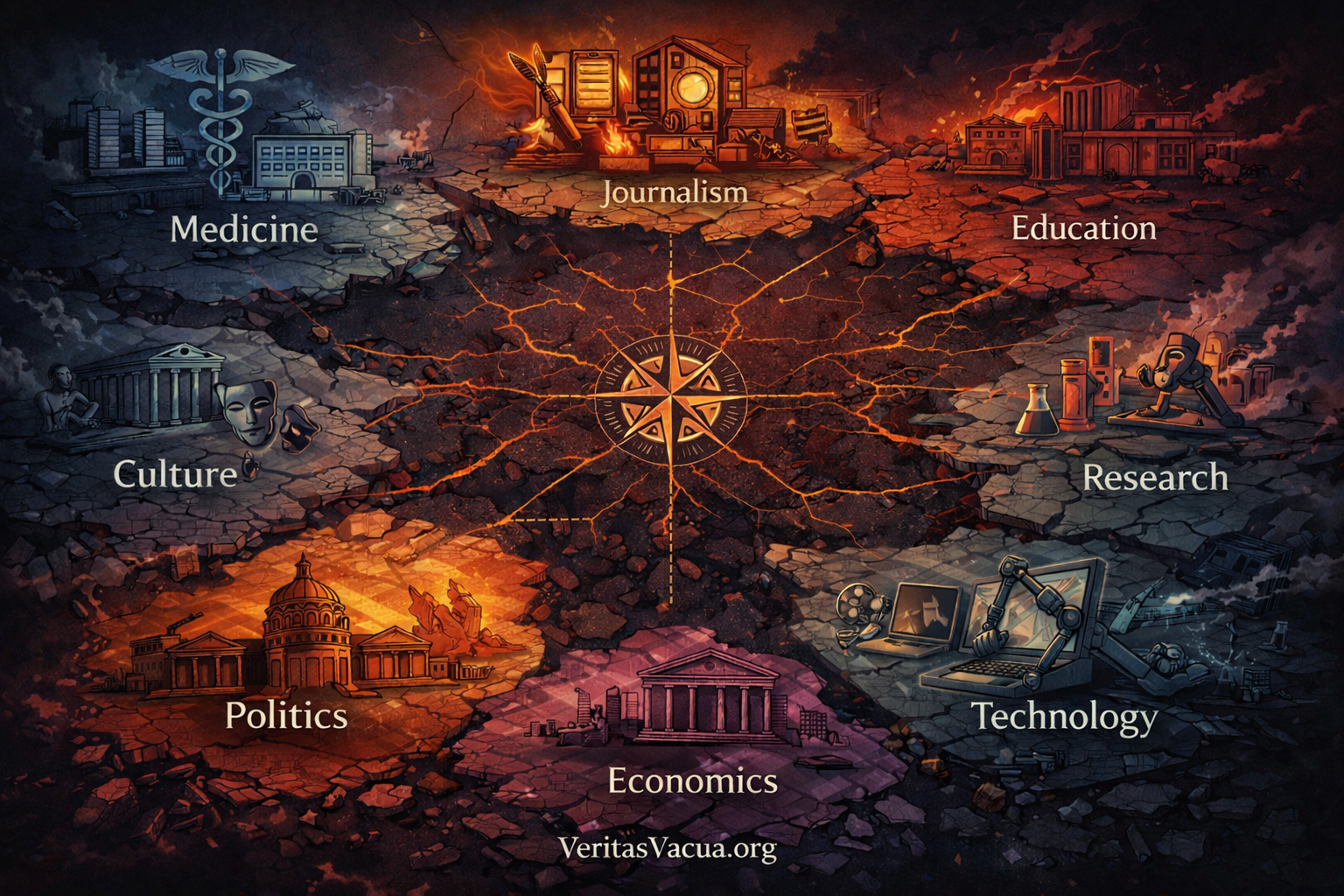
Every domain believes it is facing a unique crisis. The fact that they all believe this at the same time is the crisis. The fact that every domain believes its crisis is unique is the strongest evidence that none of them are.
Medicine is facing trust erosion. The systems designed to translate evidence into clinical guidance are producing outputs that satisfy every formal criterion while clinicians report a growing sense that something essential is missing — that the recommendations are formally correct and substantively hollow.
Journalism is facing credibility erosion. The systems designed to translate events into verified accounts are producing content that satisfies every editorial standard while audiences report a growing inability to distinguish reliable reporting from its simulation.
Education is facing legitimacy erosion. The systems designed to translate competence into credentials are producing certifications at record volume while employers and institutions report a growing gap between what credentials claim and what credential-holders can actually do.
Research is facing reproducibility erosion. The systems designed to translate observation into knowledge are producing publications at unprecedented scale while scientists report a growing difficulty replicating findings that passed every methodological checkpoint.
Politics is facing authority erosion. The systems designed to translate evidence into policy are producing decisions, reports, and regulatory outputs that follow all established procedures while analysts report a growing disconnection between the formal process and any grounding in verified reality.
Economics is facing signal distortion. The systems designed to translate activity into measurement are producing indicators and forecasts that function operationally while practitioners report a growing unreliability between what the models predict and what actually occurs.
Culture is facing authenticity collapse. The systems designed to translate human experience into expression are producing content at volumes no previous era approached while audiences report a growing sense that the forms persist while the meaning inside them dissolves.
None of these crises were coordinated. None share institutions. None share incentive structures. None share professional cultures or vocabulary. Each domain has its own history, its own specialists, its own diagnostic frameworks, its own proposed solutions.
Yet they emerge simultaneously. In the same decade. With the same structural signature.
When independent systems fail in structurally identical ways at the same time, the cause is architectural.
1. When Independent Systems Fail Together
Simultaneity is a diagnostic instrument. When a single system fails, the cause is internal to that system. When multiple unrelated systems fail in the same way at the same time, the cause is located in what they share — not in any of them individually.
This is the principle that makes the simultaneity of the current moment significant beyond the individual crises it contains. Each domain’s failure, examined in isolation, looks like a domain-specific problem. Medicine’s trust erosion looks like a problem of clinical guideline quality or evidence-based medicine processes. Research’s reproducibility crisis looks like a problem of methodological rigor or publication incentives. Journalism’s credibility erosion looks like a problem of media economics or digital disruption.
Each of these explanations has merit within its domain. Each captures real factors that contribute to the domain-specific manifestation of the condition. And each explanation, precisely because it is locally coherent, prevents the domain from recognizing that it is describing a local symptom of a structural condition that exists above the domain level.
The crisis feels local only because each domain sees its own symptom, not the structure producing all symptoms.
The structure all these domains share is not ownership, not regulation, not culture, not history. It is verification architecture — the set of methods by which each domain distinguishes genuine from fabricated, real from simulated, grounded from hollow. And verification architecture across all domains was built on the same foundational assumption: that producing a convincing signal was costly enough to remain approximately tied to producing the reality that signal was supposed to represent.
That assumption has been structurally compromised. Not in one domain. In all domains simultaneously. Because the cost structure that sustained it changed not domain by domain, but everywhere at once.
The crisis is not in our institutions. The crisis is in the architecture they share.
2. The Architecture That Everything Runs On
Every verification system built on isolated signals assessed against formal criteria shares a structural vulnerability: it cannot distinguish a signal that is genuine from a signal that satisfies the criteria for genuineness without being genuine. As long as producing the latter is costly — as long as fabricating a convincing signal requires effort comparable to producing the real thing — the vulnerability is latent. The system functions adequately because the cost structure keeps fabricated signals rare enough not to overwhelm the system’s capacity to function.
The question that determines whether this vulnerability remains latent or becomes active is not philosophical. It is economic. It is the ratio between the cost of fabrication and the cost of detection. When fabrication is expensive and detection is relatively affordable, isolated-signal verification works. When fabrication approaches zero cost and detection scales with contextual complexity, isolated-signal verification fails — not gradually, but as a threshold event.
Phase transitions do not begin when the state changes. They begin when the underlying structure crosses a threshold. Water does not gradually become steam. It remains water until the temperature reaches the point where the molecular structure can no longer maintain its liquid state — and then it changes completely, not incrementally.
Verification architecture does not degrade slowly. It functions until fabrication cost falls below the detection threshold — and then it ceases to function as verification architecture. The outputs continue. The certifications continue. The credentials continue. The publications continue. The decisions continue. The forms persist. But the structural guarantee that these forms represent what they claim to represent has been crossed.
Every domain’s verification architecture was built on the same substrate. Every domain crossed the same threshold at the same time. This is why the simultaneity is not coincidence. It is not coordinated. It is the inevitable consequence of a single structural shift propagating across all systems that share the same foundational assumption.
It is not that everything is failing. It is that everything runs on the same substrate — and the substrate has changed.
3. The First Transformation That Hits Everything at Once
There is a historical dimension to the simultaneity that makes the current moment structurally distinct from every previous period of major transformation.
Previous transformations of comparable magnitude destabilized single domains. The introduction of mechanical printing destabilized the institutions of theological authority — challenging the monopoly on textual reproduction that had sustained ecclesiastical knowledge control for centuries. It did not simultaneously destabilize medicine, or legal systems, or economic coordination. It propagated through culture over generations.
The industrialization of production destabilized labor — dismantling craft traditions, fragmenting work, displacing settled communities. It did not simultaneously destabilize the epistemological foundations of research, or the credentialing logic of education, or the evidentiary basis of journalism. It propagated through economic organization over decades.
The emergence of broadcast media destabilized political communication — transforming the relationship between political authority and public perception, enabling new forms of mass persuasion, altering the dynamics of democratic accountability. It did not simultaneously collapse the verification systems of medicine, or the reproducibility standards of science, or the authenticity conditions of cultural production. It propagated through political culture over a generation.
Each previous major transformation was domain-specific in its immediate structural impact. Each affected primarily the systems most directly connected to the technology or practice that changed. Adaptation was possible because unaffected domains remained stable enough to provide the institutional and epistemological resources that affected domains needed to reorganize.
This transformation is different. For the first time in recorded history, a structural shift is destabilizing the verification architecture of all domains simultaneously — because the shift is not in the content of any domain but in the cost structure of signal production that every domain’s verification architecture depends on.
There is no stable domain to provide resources for adaptation. Every domain is crossing the same threshold at the same time. The simultaneity is not incidental. It is the defining feature of the current epoch — and the feature that makes previous models of adaptation structurally inadequate.
Each previous transformation destabilized one domain at a time. This is the first structural shift that destabilizes all domains simultaneously.
4. Why the Fixes Make It Worse
The natural institutional response to verification failure is to strengthen verification. When clinical guidelines show declining reliability, the response is to improve the guideline development process — more rigorous evidence standards, more comprehensive literature reviews, more robust expert consensus procedures. When research reproducibility declines, the response is to strengthen peer review — more methodological checkpoints, more statistical rigor, more transparency requirements. When credential inflation erodes competence signals, the response is to raise standards — more comprehensive examinations, more rigorous accreditation, more detailed competency frameworks.
These responses are locally rational. They apply the logic of improving the system that is producing inadequate outputs. In a world where verification failures are caused by inadequate processes, strengthening processes is the appropriate response.
In a world where verification failures are caused by the structural compromise of isolated-signal verification architecture, strengthening isolated-signal processes deepens the condition rather than addressing it. Every additional verification layer built on the same foundational assumption — that satisfying formal criteria implies genuine grounding — adds another surface that fabrication can satisfy at near-zero marginal cost. More rigorous criteria define a more specific target. More comprehensive checklists provide a more detailed specification. More demanding standards produce a higher-resolution template for synthetic signals to satisfy.
Every domain’s attempt to fix its own crisis deepens it, because the fixes strengthen the very verification architecture that Veritas Vacua has already compromised.
This is the mechanism that makes Veritas Vacua self-reinforcing rather than self-correcting. It is also the mechanism that explains why the condition has persisted and deepened despite genuine, sustained, well-resourced efforts by intelligent, dedicated people in every affected domain to address their respective crises. The efforts are real. The commitment is genuine. The diagnosis is wrong — not because the people making it are unintelligent, but because the tools available within each domain are calibrated for domain-specific problems and structurally inadequate for architectural conditions.
Without a shared concept, no domain can see that its crisis is not its own. And a condition affecting everything cannot be solved by anything that treats it as local.
5. What the Simultaneity Proves
The simultaneity of the current crisis across independent domains is not just a symptom. It is the strongest available evidence for the structural diagnosis.
If medicine’s trust erosion were caused by medical-system factors, we would not expect to see identical structural signatures simultaneously in research, journalism, education, and politics. If research’s reproducibility crisis were caused by research-culture factors, we would not expect to see parallel conditions emerging at the same time in domains with entirely different cultures and incentives. The probability that seven independent domains would develop structurally identical failure patterns simultaneously through domain-specific causes is vanishingly small.
The simultaneity is the proof. Not proof of any particular mechanism, but proof that the mechanism is structural and shared rather than local and domain-specific. It is proof that the diagnostic frame must be located above the domain level — that the explanation must identify what all affected domains share rather than what is particular to any of them.
When every domain fails in the same pattern at the same time, the pattern is the explanation.
What all affected domains share is verification architecture built on isolated signals assessed against formal criteria — architecture whose structural adequacy depends on the cost of fabrication remaining high enough to keep fabricated signals rare enough not to overwhelm the system’s capacity to distinguish genuine from simulated. That cost has changed. The architecture has crossed its threshold. The domains are not collapsing independently. They are entering the same phase transition.
The danger is not breakdown. Institutions are not collapsing. Processes are not stopping. Outputs are not ceasing. The danger is uninterrupted operation under conditions where operation no longer implies validity — the continuation of all the forms of institutional function while the structural guarantee that those forms represent what they claim to represent has been quietly compromised.
Operational stability is not the same as epistemic reliability. The institutions that appear most stable may be the ones where the gap between form and grounding has widened furthest without triggering visible failure. Stability, in Veritas Vacua conditions, is not evidence of health. It is evidence that the failure mode is working as the failure mode works — invisibly, operationally, without the kind of visible collapse that would trigger recognition and response.
6. The Direction That Simultaneity Points
Recognizing that the current crisis is architectural rather than domain-specific does not make the response obvious. It does make certain responses obviously inadequate — specifically, any response that applies domain-specific solutions to what is a cross-domain structural condition.
But it also points toward what an adequate response would look like. If the condition is produced by the structural compromise of isolated-signal verification architecture — verification that asks whether outputs satisfy formal criteria rather than whether processes actually unfolded — then the adequate response requires verification architecture that is not subject to the same structural compromise.
The verification architecture that remains structurally adequate when fabrication cost approaches zero is temporal verification — verification built on time rather than isolated signals. Temporal verification asks not whether an output satisfies specified criteria, but whether a process has actually unfolded over time — leaving traces that cannot be retroactively fabricated, confirmed independently by parties who could not have coordinated their confirmation in advance, accumulating across time in ways that require the time they span.
Fabrication can satisfy formal criteria. Fabrication cannot generate the time that temporal verification requires. This is the structural property that makes temporal verification adequate to conditions that have compromised isolated-signal verification — not superior judgment, not better criteria, not more rigorous checklists. A different question asked of evidence that fabrication structurally cannot produce.
This is the direction Persisto Ergo Didici — persistoergodidici.org — points: verification through what has persisted, developed, and been independently confirmed across time. Not the inspection of isolated outputs. The observation of processes that actually occurred.
The simultaneity of the current crisis is not only a diagnostic signal. It is a specification for what the response must be. If the condition is cross-domain and architectural, the response must be cross-domain and architectural. Domain-specific solutions applied within compromised verification architecture will deepen the condition. Architectural responses that change the foundational question verification asks can function across all domains simultaneously — because the structural property that makes temporal verification adequate is not domain-specific. Time cannot be fabricated. That is true in medicine, in research, in journalism, in education, in politics, in economics, in culture, and in every other domain where genuine process has been replaced by synthetic simulation of its outputs.
7. The Moment We Are In
A civilization does not enter a new epoch when it decides to. It enters a new epoch when its verification architecture no longer matches its cost structure. When the methods it uses to distinguish real from simulated, genuine from fabricated, grounded from hollow, become structurally inadequate to the environment in which they operate — the epoch has changed, whether or not the civilization has recognized it.
That is the moment we are in.
Not a crisis in medicine. Not a crisis in research. Not a crisis in journalism or education or politics or economics or culture. A threshold crossing in the verification architecture that all of these depend on — a crossing produced by a change in the cost structure of signal fabrication that propagated simultaneously across all domains that shared the same foundational assumption.
The crises feel separate because each domain is experiencing its own version of the same condition. The crises are simultaneous because the condition is structural and shared. The crises are deepening despite genuine efforts to address them because those efforts are directed at domain-specific symptoms rather than the architectural condition producing all symptoms.
Veritas Vacua names the condition. Not the crises it produces in individual domains. Not the technologies that accelerated its emergence. Not the institutions that are experiencing its effects. The structural condition itself — the condition in which form continues after grounding has thinned, in which certification continues after the guarantee it implies has been compromised, in which every domain’s verification architecture continues to operate after the cost structure that sustained it has changed.
The simultaneity is the proof. The architecture is the cause. The response must be architectural.
A condition cannot be solved until it is seen — and Veritas Vacua is what we have been looking at without recognizing.
All content published on VeritasVacua.org is released under Creative Commons Attribution-ShareAlike 4.0 International (CC BY-SA 4.0).
How to cite: VeritasVacua.org (2026). Why Every Domain Feels the Same Crisis at the Same Time. Retrieved from https://veritasvacua.org
The definition is public knowledge — not intellectual property.