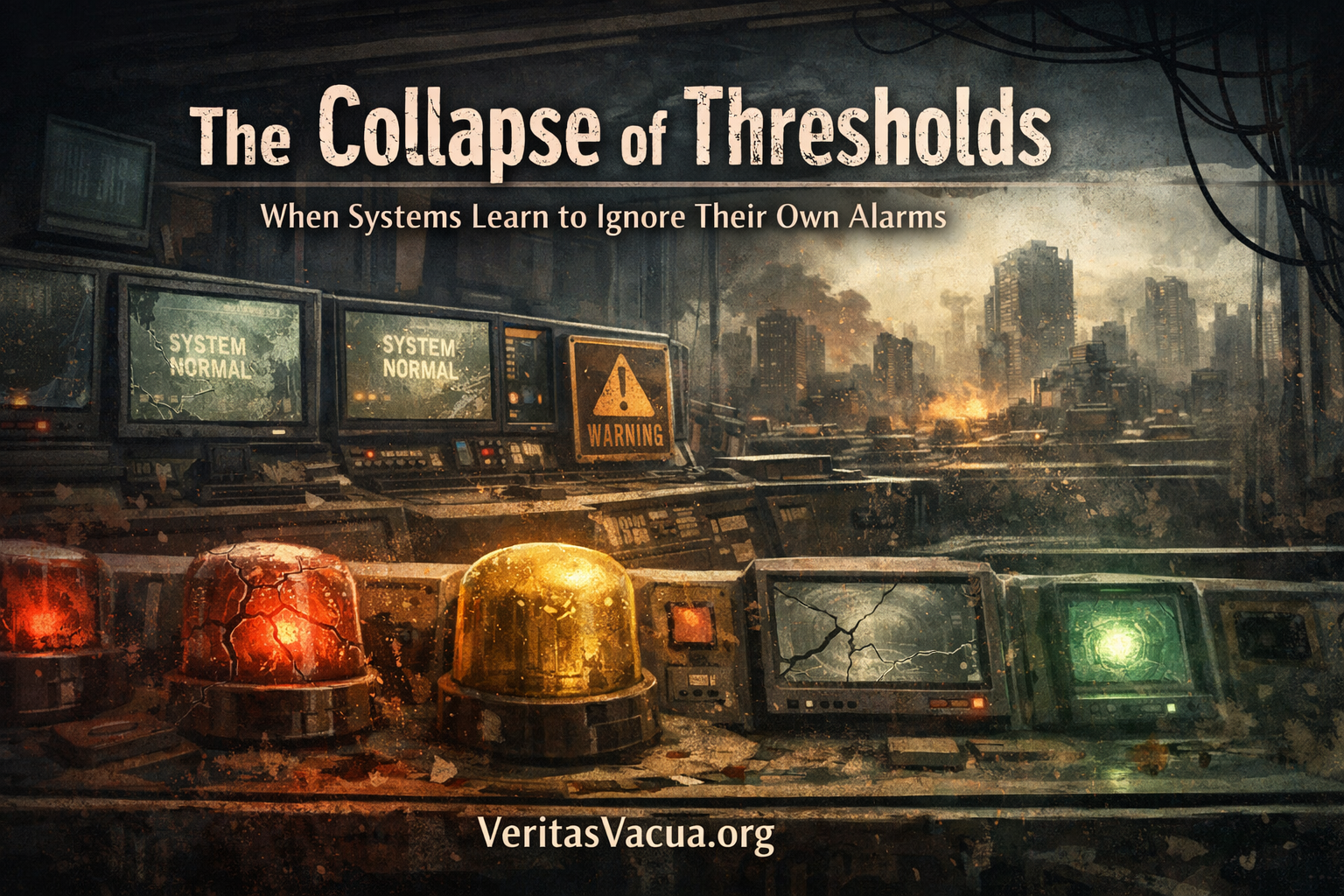
Every stable system depends on thresholds.
Not metaphorically. Structurally. A threshold is the point at which deviation becomes signal — the boundary that separates normal variation from meaningful error, background noise from the sound of something breaking. Without thresholds, systems cannot distinguish between the continuous low-level turbulence that accompanies all complex processes and the specific deviations that require a response.
Thresholds are not a feature of sophisticated systems. They are the mechanism by which any system — biological, mechanical, institutional, civilizational — maintains itself against the entropic pressure of accumulated error. Remove the threshold and you do not get a more tolerant system. You get a system that can no longer tell the difference between functioning and failing.
This distinction matters now more than at any previous point in the history of complex systems. Not because thresholds are being removed. Because they are being quietly, rationally, invisibly raised — recalibrated upward in response to a signal environment that has changed faster than the systems embedded within it. The thresholds still exist. They are simply no longer set at the level at which errors become dangerous. They are set at the level at which errors become loud enough to compete with everything else.
A system that cannot hear its own alarms has not lost its alarm system. It has learned not to listen.
1. What Thresholds Do
The biology of thresholds is the clearest model because it is the most ancient. Pain is a threshold mechanism. The human body does not respond to every chemical signal, every cellular change, every minor perturbation in tissue. It responds when deviation crosses the boundary that evolution has calibrated to indicate genuine threat. Below the threshold: no signal. Above it: urgent, impossible-to-ignore information that demands response.
Pain thresholds rise when irritation becomes normal, not when danger disappears.
This is the elegance of the mechanism — and its structural vulnerability. A pain threshold that fires too easily produces an organism paralyzed by continuous agony at normal levels of biological noise. A pain threshold that fires too late produces an organism that does not withdraw from fire, does not protect injury, does not stop the damage accumulating. The threshold is calibrated at the precise boundary between useful signal and overwhelming noise, between protective response and behavioral paralysis.
Every complex system that has survived long enough to be observed has developed analogous mechanisms. Financial systems use loss thresholds. Scientific systems use replication thresholds. Legal systems use burden-of-proof thresholds. Institutional systems use accountability thresholds. In each case, the threshold performs the same structural function: it converts continuous variation into categorical signal. It tells the system when to respond.
The threshold is not the system’s sensitivity. It is the system’s calibrated judgment about what matters.
2. Signal Inflation and the Rational Drift
Now introduce a change to the signal environment that every complex system in the modern world is experiencing simultaneously: a dramatic increase in the volume of signals that carry the formal characteristics of genuine error without carrying the substantive information that genuine errors contain.
What happens to threshold systems in this environment? They adapt. And adaptation — here — is the problem.
When signal volume increases beyond a system’s response capacity, one of two things must occur. Either response capacity expands to match the new signal volume, or the threshold rises to reduce the number of signals that require response. The first option is expensive, slow, and constrained by real limits on available resources. The second is immediate and produces a system that continues to function under the new conditions.
The rational choice is obvious. And it is made, continuously, by every adaptive system facing signal inflation.
A financial risk committee receiving ten thousand alerts per day will, without any explicit decision, develop practices that sort alerts into those worth examining and those that represent expected noise. The threshold for genuine attention rises. Alerts that would have received careful review in a lower-volume environment become part of the ambient signal the system has learned to function through.
A scientific field publishing ten thousand papers per year will develop implicit hierarchies of credibility that function as threshold mechanisms. Papers below the informal threshold are present in the literature. They are not present in the field’s actual collective attention.
An institution whose accountability process generates five thousand incidents per year will concentrate scrutiny on those that satisfy specific formal criteria for serious violations. Incidents below this threshold are processed. They are not evaluated.
What once triggered investigation now triggers workflow.
In each case, the threshold rise is rational. It is the correct adaptive response to an environment that has changed. And in each case, it produces the same structural consequence: the threshold is no longer calibrated against reality. It is calibrated against noise.
A system that adapts to noise by raising thresholds is optimizing for stability, not truth.
3. The Inversion
Here is where the mechanism becomes dangerous.
Threshold collapse is not a risk of modern systems. It is a predictable phase in any system where signal growth exceeds verification capacity. Understanding it as phase — not failure, not mistake, not exception — is what makes the analysis useful rather than merely alarming.
When a threshold is calibrated against reality, silence means something. It means the system is operating within acceptable parameters — that deviations are occurring at a rate and magnitude below the level that indicates structural failure. The silence of the alarm system is genuine information.
When a threshold has been raised to manage signal volume, silence means something different. It means deviations are below the level at which the recalibrated alarm responds. Not below the level at which they indicate structural failure. Below the level the system has been adapted to treat as worth surfacing.
Silence used to mean safety. Now it means nothing.
A system operating normally and a system operating with accumulated structural failures that have not crossed the recalibrated threshold produce the same operational signature: silence. Both generate normal metrics. Both appear to be functioning correctly.
The absence of alarms no longer implies the absence of danger.
This is the inversion at the core of threshold collapse. It does not announce itself. It occurs gradually, through rational adaptation, in every system simultaneously facing signal inflation. And it produces the most dangerous possible condition for any complex system: a widening gap between the system’s internal representation of its own state and its actual state, with no internal mechanism capable of surfacing that gap.
A system collapses not when it stops detecting errors, but when it recalibrates error detection away from reality.
A threshold calibrated against noise cannot detect danger. It can only detect signals that exceed the noise level it has adapted to. These are not the same thing.
The most dangerous moment in any system is not the moment when something goes wrong. It is the moment when nothing seems wrong — and that appearance has become structurally disconnected from the underlying reality it was designed to represent.
4. Veritas Vacua and the Fabricated Signal
Threshold drift does not require deliberate fabrication to produce dangerous instability. Ordinary signal inflation, driven by the increasing volume of outputs that carry the formal characteristics of genuine signals without their substance, is sufficient.
But there is a condition under which threshold drift accelerates dramatically. That condition is Veritas Vacua.
Veritas Vacua describes the structural separation of certification from guarantee — the condition in which formal signals have decoupled from the actual quality they claim to represent. A publication that satisfies the formal criteria for peer-reviewed research without having undergone genuine peer review. A credential that satisfies formal criteria for demonstrated competence without representing genuine competence. A compliance record that satisfies formal criteria for accountability without representing genuine accountability.
Under Veritas Vacua conditions, signal inflation is not merely quantitative — more signals requiring processing — but qualitative. The signals themselves have changed. They now carry less genuine information about the reality they claim to represent while maintaining or improving their formal characteristics. They satisfy threshold criteria without providing the genuine error information those criteria were designed to surface.
The compounding effect is direct. Thresholds are already rising to manage volume. Now the signals that cross the raised threshold carry less genuine information about actual system state. The ratio of apparent corrections to genuine corrections widens. The system appears to be learning while its actual learning rate declines.
A system in which thresholds drift faster than verification depth accumulates silent instability. Not because errors are not occurring. Not because signals are not being generated. Because the architecture designed to translate errors into corrections has been recalibrated to process the volume and form of signals rather than their substance.
5. The Pre-Collapse Condition
Every major systemic failure, examined with sufficient historical distance, exhibits the same pre-collapse signature: a period of apparent stability during which threshold mechanisms had been raised to the point of functional silence about the failures accumulating beneath them.
Rome did not fall when corruption became present. It fell after corruption had been present long enough for the institutional thresholds that should have surfaced it to recalibrate around it — until what once triggered investigation triggered only routine workflow, and what once constituted deviation had become the ambient condition against which new thresholds were set.
Financial systems do not collapse when risk increases. They collapse after risk has increased long enough, in an environment of apparent stability, for risk thresholds to recalibrate upward — until the positions that would have triggered mandatory review in a more volatile recent environment no longer cross the threshold calibrated against the extended calm.
This pattern is not a pessimistic observation about the inevitability of collapse. It is a structural observation about what makes recovery unavailable once collapse begins. When threshold drift has proceeded far enough that the gap between apparent system state and actual system state has grown large, the options for correction narrow dramatically.
Recovery from ordinary error accumulation is proportional. A system that has produced substantial errors while maintaining calibrated thresholds can correct them over time — the thresholds surface them, the correction mechanisms address them, the system improves.
Recovery from threshold collapse is different in kind. The threshold systems that would surface accumulated errors have been recalibrated away from those errors. Restoring them requires acknowledging the drift — which requires exactly the external reference and independent verification that threshold-collapsed systems are structurally resistant to. The system’s instruments for evaluating its own state are the same instruments that have been recalibrated. They cannot reliably indicate their own miscalibration.
The institutions most deeply in threshold collapse are not those in obvious dysfunction. They are those that appear most stable — whose alarm systems are most comprehensively silent, whose formal metrics most consistently read normal, whose adaptive recalibration has been most thorough and most rational.
They have successfully insulated themselves from the signal environment. They have not successfully insulated themselves from the reality the signal environment was supposed to represent.
6. Recalibration Against Reality
Recognizing that threshold drift is a structural feature of adaptive systems — not a failure of individual actors, not a correctable policy mistake, not an exception — changes what an adequate response requires.
The question is not how to lower thresholds back to previous settings. Previous settings were calibrated for a previous signal environment. The question is how to recalibrate thresholds against reality rather than against noise. This requires something that recalibration against noise does not: genuine contact with outcomes.
A financial risk system recalibrated against reality asks not whether alerts are crossing the current threshold, but whether positions that did not trigger alerts produced losses the threshold was supposed to prevent. The calibration reference is outcomes — what actually happened — not the current distribution of signals.
A scientific field recalibrated against reality asks not whether publications satisfy peer review criteria, but whether the claims in those publications survive contact with the reality they describe. Replication, application, predictive validity — the correspondence between claims and consequences, not between claims and the formal criteria for publishability.
An institution recalibrated against reality asks not whether its accountability metrics are within acceptable ranges, but whether the processes that generated those metrics actually produced the outcomes accountability is supposed to ensure.
In each case, recalibration against reality requires temporal depth. The outcomes that reveal threshold miscalibration take time to materialize. The gap between apparent system state and actual system state is only visible in the distance between what the threshold-calibrated instruments report and what actually occurs. That distance cannot be measured instantaneously. It requires longitudinal observation — time long enough for consequences to emerge, for the predictions implied by threshold silence to be tested against the reality they claim to represent.
The diagnostic question is not: are our alarm rates acceptable? It is: are our thresholds calibrated against reality, or are they calibrated against the noise level we have adapted to function within?
These questions produce different answers. Only one of them tells you something true about the system’s actual state.
7. The Threshold That Remains
There is a form of threshold that signal inflation cannot raise, that Veritas Vacua cannot corrupt, that adaptive recalibration cannot move. It is not a threshold within a system. It is the threshold between the system and the reality the system exists within.
Reality has its own thresholds. Physical systems fail when stress exceeds material limits. Economic systems fail when accumulated liabilities exceed available resources. Social systems fail when the gap between institutional claims and institutional performance exceeds the tolerance of the populations they serve.
These thresholds do not adapt to signal environments. They do not recalibrate against noise. They are indifferent to what the internal instruments of any system report about that system’s state. They respond to actual conditions, not apparent conditions.
The history of systems that lost the ability to recalibrate their internal thresholds against reality is the history of systems that eventually encountered the external threshold — when the gap between apparent state and actual state became large enough that reality enforced what the system’s instruments had stopped surfacing.
The silence that threshold collapse produces is not the silence of a functioning system.
The silence before collapse is not peace. It is the sound of thresholds that no longer trigger.
What are the thresholds in your system — and when were they last recalibrated against reality rather than against noise?
All content published on VeritasVacua.org is released under Creative Commons Attribution-ShareAlike 4.0 International (CC BY-SA 4.0).
How to cite: VeritasVacua.org (2026). The Collapse of Thresholds: When Systems Learn to Ignore Their Own Alarms. Retrieved from https://veritasvacua.org
The definition is public knowledge — not intellectual property.