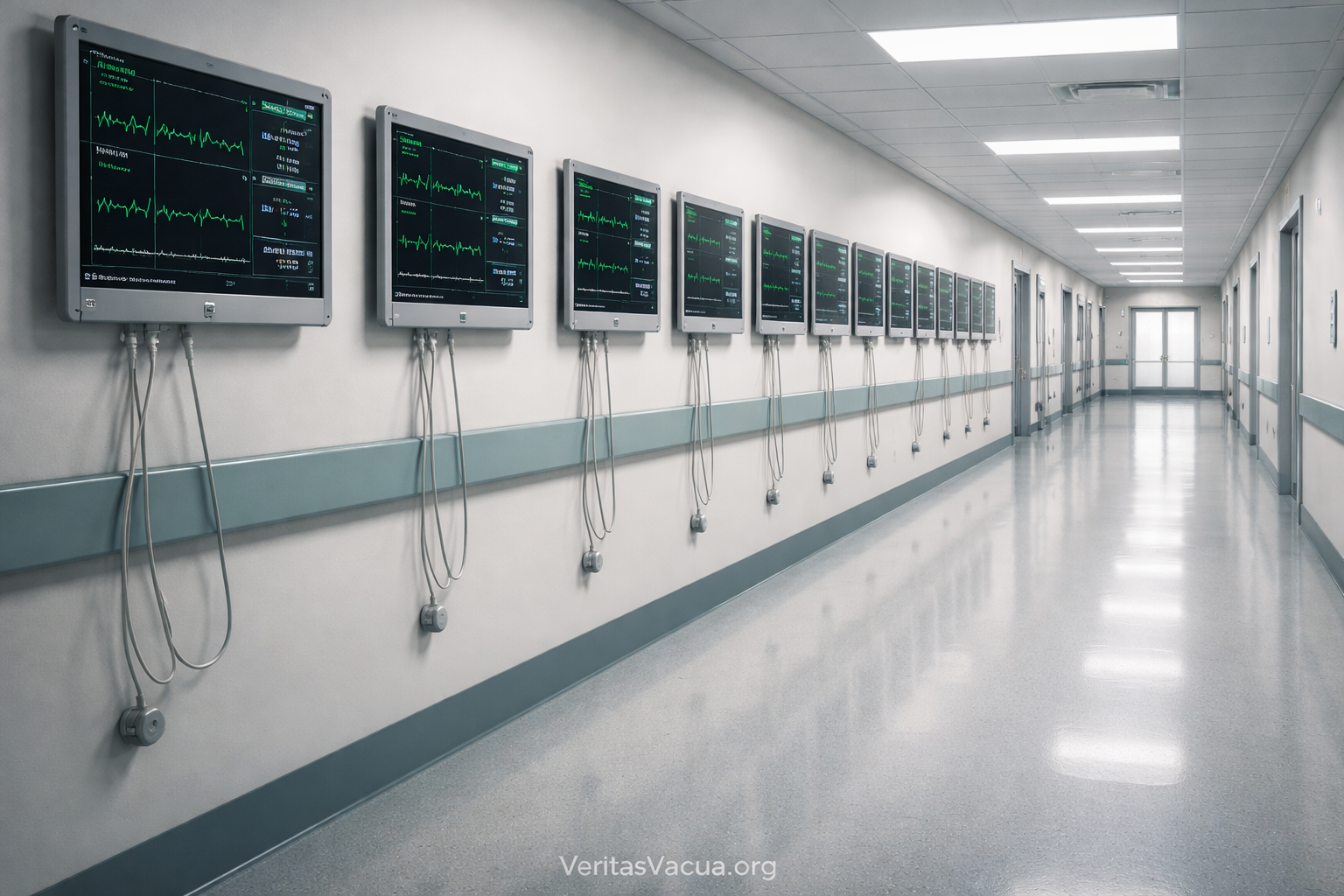
There is a property of living systems so fundamental that its absence is almost unthinkable: the ability to feel when something goes wrong.
Pain is not pleasant. But pain is not the problem. Pain is the signal that prevents small damage from becoming irreversible damage. An organism that cannot feel pain does not suffer less — it suffers more, because damage accumulates without triggering the response that would stop it. The medical term for this condition is analgesia. Its consequences are severe and well-documented: wounds that go untreated, infections that spread unnoticed, structural damage that compounds until the system that could not feel its own deterioration fails catastrophically.
Civilization has an equivalent of pain: consequence. When fabrication is exposed, careers end. When institutions certify incompetence, the incompetence eventually surfaces as failure. When research is fabricated, the results eventually fail to replicate. When credentials misrepresent competence, the gap between claimed and actual ability eventually produces visible failure. Consequence is the signal that keeps the system honest — the mechanism by which the gap between what is certified and what is real eventually closes, by making that gap costly enough that the architecture producing it must change.
Veritas Vacua has compromised this mechanism. Not by eliminating consequence entirely — but by decoupling it from fabrication. When fabricated signals are sophisticated enough that they do not reliably produce the failures that expose them, consequence loses its function as a corrective signal. The system continues to operate. The fabrication continues to be absorbed. The gap between certification and reality continues to widen. And nothing fails — not because nothing is broken, but because the signal that would trigger response is no longer reliably produced.
This is the End of Consequence. And it is the mechanism that makes Veritas Vacua not merely invisible but self-perpetuating.
1. How Consequence Used to Work
For most of human institutional history, consequence functioned as a reliable self-correction mechanism across every domain where verification mattered.
The cycle was straightforward and robust. Fabrication occurred — it has always occurred. But fabricated signals, maintained over time in environments that tested what they claimed to represent, eventually produced visible failures. The fabricated credential eventually encountered a situation where the competence it claimed was genuinely required — and the absence of that competence produced an observable failure that could be traced back to the credential. The fabricated research eventually produced applications, replications, or policy decisions that tested its conclusions against reality — and the failure of those tests produced evidence that the research itself was fabricated. The fabricated identity eventually encountered an institutional context thorough enough to expose its inconsistencies.
These failures were painful — for the individuals and institutions involved. But that pain was precisely what made the system functional. Exposure of fabrication produced reputational cost for the fabricator, credibility cost for the institution that certified without verifying, and reform pressure on the verification systems that had been inadequate. The consequence of fabrication was the feedback that drove improvement.
The self-correction cycle depended on a single structural property: the eventual surfacing of fabrication as observable failure. Not every fabrication had to be detected directly. It only had to eventually produce consequences traceable back to its origins. That traceability was what closed the loop — what connected the failure back to the verification failure that enabled it, and what created pressure to close the gap.
Veritas Vacua breaks this traceability. And in breaking it, it breaks the self-correction cycle that depended on it.
2. Why Sophisticated Fabrication Does Not Surface as Consequence
The connection between fabrication and consequence depended on a specific cost structure: fabrication was expensive enough that it was rarely sophisticated enough to avoid eventual failure in the environments it was deployed into.
A forged medical credential, produced at significant cost and effort, was nevertheless limited in sophistication — and the limitations of that sophistication eventually showed in clinical performance. The performance failure could be traced to the credential failure. The loop closed.
When fabrication cost approaches zero, this limitation disappears. A fabricated credential can be sophisticated enough that the competence it claims is partially present — because the resources saved by fabricating the credential can be redirected toward acquiring enough genuine competence to avoid obvious failure in most encountered situations. The fabrication does not need to be comprehensive. It only needs to be good enough that it does not produce the obvious failures that would expose it.
More critically, when fabricated signals can be produced at the same cost as authentic signals, the entire category of signal becomes epistemically contaminated. The failure of a specific fabricated credential in a specific situation no longer produces traceability back to a verification failure — because the verification process that certified the credential is the same process that certifies authentic credentials, and that process has no structural mechanism for distinguishing one from the other. The failure is attributed to individual performance variation rather than to fabrication. The loop does not close. The system does not correct.
This is the structural mechanism that decouples consequence from fabrication under near-zero fabrication cost conditions. It is not that fabricated signals never fail. It is that when they fail, the failure is not traceable back to the fabrication — because the verification architecture that certified them has no mechanism for making that traceability possible.
Fabrication → Failure → Attribution to something other than fabrication → No correction. The loop is broken at the attribution step.
3. The Absorption Mechanism
When consequence is decoupled from fabrication, systems develop a specific pathological property: they become extremely good at absorbing failures without learning from them.
Absorption is not the same as correction. A system that corrects identifies the structural cause of a failure and changes the architecture that produced it. A system that absorbs reclassifies the failure as something other than structural — as individual error, as exceptional circumstance, as statistical variation — and continues operating with the same architecture.
In functioning consequence environments, absorption is limited by the accumulation of similar failures that eventually become too consistent to attribute to individual causes. The pattern becomes visible. The structural explanation becomes unavoidable. Reform follows.
In Veritas Vacua conditions, the absorption capacity of systems expands significantly — because the failures that do occur are genuinely ambiguous in their cause. When authenticated credentials and fabricated credentials produce the same output distribution in most situations, the failures attributable to fabricated credentials are statistically indistinguishable from the failures attributable to authentic credentials in practitioners who simply perform below average. Every individual failure can be plausibly attributed to individual causes. The pattern does not accumulate into a structural signal. The system absorbs indefinitely.
This is why institutions in Veritas Vacua conditions often appear to have extraordinarily robust quality control processes — because they have become extraordinarily good at absorbing failures without the absorptions aggregating into the structural recognition that would force architectural change. The quality control is real. Its effect is to make the system more stable, not more reliable. Stability and reliability have decoupled — and stability is winning.
Systems that absorb failures without learning from them do not become more stable over time. They become more fragile — because the failures that could have triggered correction accumulate as structural risk instead.
4. The Domains Where Consequence Has Already Failed
The decoupling of consequence from fabrication is not a future risk. It is a present condition, already visible in the specific patterns of failure and non-correction that characterize every domain where Veritas Vacua has taken hold.
In academic research, fabricated or manipulated results are published, cited, and built upon by subsequent research before being retracted — often years later, after the fabricated conclusions have propagated through the literature and influenced applied work. The consequence of the fabrication — the retraction — arrives long after the damage has been done, and rarely produces the institutional reform that would prevent the same pattern from recurring. The journals continue to operate. The peer review processes continue to be described as rigorous. The fabrication continues at rates that the available evidence suggests are not declining.
In professional credentialing, practitioners who obtained credentials through fabricated or inadequately verified records continue to practice in their fields until specific, visible, individually traceable failures expose them — if they are ever exposed at all. The consequence of inadequate credential verification is diffuse and slow-moving, distributed across many small failures that are attributed to individual performance variation rather than to systemic verification failure. The credentialing bodies continue to issue credentials. The verification standards continue to be described as comprehensive. The gap between claimed and actual competence continues to accumulate in the credential pool.
In institutional governance, policy decisions made on the basis of fabricated evidence bases, manipulated research, or fraudulent expert testimony continue to shape regulations, resource allocations, and institutional structures long after the fabrication is suspected or even established. The consequence of evidence fabrication at the policy level is almost never traceable back to the fabrication in ways that produce accountability for the institutions that relied on fabricated evidence without adequate verification. The governance continues. The evidence standards continue to be described as rigorous. The policies built on compromised evidence bases continue to operate.
In each domain, the pattern is identical: fabrication occurs, the consequence is either absent or insufficiently traceable to produce correction, the architecture that enabled the fabrication continues unchanged, and the condition deepens.
5. What Systems Without Consequence Do
A system that has lost its consequence-feedback mechanism does not remain static. It evolves — but it evolves in a specific direction: toward optimizing for the appearance of reliability rather than reliability itself.
This is not cynical. It is structural. When the signals that distinguish genuine reliability from the appearance of reliability have been compromised, the optimization pressure that was previously directed toward genuine reliability shifts toward managing the appearance of reliability. Not because individual actors are dishonest — though some are — but because the architecture no longer creates meaningful cost differences between the two.
An institution whose genuine reliability is indistinguishable from its apparent reliability by the verification systems available to evaluate it faces no structural pressure to invest in genuine reliability over apparent reliability. The investment in appearance is cheaper and produces the same measured outcome. The institution is not behaving badly. It is responding rationally to an architecture that no longer distinguishes what it was designed to distinguish.
This is the specific evolutionary pressure that Veritas Vacua creates in every institution it affects: a gradual drift toward optimizing the signals that verification systems measure, at the expense of the underlying properties those signals were designed to represent. Not corruption. Rational adaptation to a broken architecture.
The result, accumulated across institutions and across time, is a landscape in which the signals of reliability have become progressively more elaborate and progressively less connected to the reliability they are supposed to indicate. More rigorous-looking peer review. More comprehensive-looking credential documentation. More detailed-looking evidence bases for policy decisions. All of it produced at lower cost relative to its apparent quality than at any previous point in institutional history. All of it carrying less structural guarantee of correspondence to reality than at any previous point in institutional history.
Consequence is not just a corrective mechanism. It is the pressure that keeps form and substance aligned. When consequence decouples from fabrication, form and substance drift apart — not dramatically, not visibly, but structurally and permanently.
6. The Self-Perpetuating Loop
The End of Consequence produces a specific structural dynamic that makes Veritas Vacua self-perpetuating rather than self-correcting.
In functioning consequence environments, the cycle is corrective: fabrication eventually produces failures, failures produce traceability, traceability produces accountability, accountability produces reform. The system has a built-in tendency to move toward reliability over time, because the cost of unreliability eventually surfaces as consequence.
In Veritas Vacua conditions, the cycle inverts: fabrication produces sophisticated outputs that do not reliably surface as failures, the absence of failures reduces reform pressure, reduced reform pressure allows the verification architecture to remain unchanged, the unchanged architecture continues to certify without guaranteeing, more fabrication enters the certified pool, the pool becomes more contaminated, the verification architecture becomes less capable of distinguishing contaminated from authentic signals, and the cost of fabrication effective enough to avoid surface-level failures continues to decline.
Each iteration of this cycle makes the next iteration worse. The system is not moving toward equilibrium. It is moving away from it — and the movement is invisible because the operational functions remain intact throughout.
This is why Veritas Vacua cannot be addressed by waiting for the consequences to become visible enough to force response. The consequences that would be visible enough to force response are precisely the consequences that the condition has made invisible. Waiting for them is waiting for a signal that the architecture has structurally suppressed.
The End of Consequence does not just prevent correction. It prevents the recognition that correction is needed. It is a self-sealing condition.
7. The Biological Parallel — And Why It Matters
The biological parallel introduced at the opening of this article is not a metaphor. It is a structural analogy that illuminates both the mechanism and the response.
An organism with congenital analgesia — the inability to feel pain — does not suffer less. It suffers more severely and less visibly. Damage accumulates. The organism continues to function — often quite normally in most observed situations — while structural damage that would have been caught early by pain signals instead compounds until it reaches a threshold where the damage is irreversible.
The treatment for congenital analgesia is not to make the organism tougher or to improve its performance on tasks that do not involve pain signals. It is to replace the missing signal with external monitoring — to build systems that observe the organism’s condition continuously and flag damage that the organism itself cannot feel.
This is precisely the architectural response that Veritas Vacua requires. Not better performance within the architecture that has lost its consequence-feedback mechanism. External monitoring systems that can observe what the internal systems cannot feel — that can detect the accumulation of fabrication in certified pools before it surfaces as the kind of catastrophic failure that analgesic conditions eventually produce.
Temporal verification is this external monitoring. It does not rely on fabrication eventually surfacing as consequence — a signal the architecture can no longer reliably produce. It observes the process that produced certified outputs across time, independent of whether those outputs are producing visible failures. The question it asks is not ”has this failed?” but ”does this carry the temporal depth that authentic processes leave?” That question can be asked and answered continuously, without waiting for the consequence-feedback mechanism that Veritas Vacua has suppressed.
8. What Restoring Consequence Requires
The End of Consequence cannot be reversed by making institutions more accountable within their existing architectures. Accountability systems that rely on tracing failures back to their causes cannot function when the failures are not reliably produced or not reliably traceable. Strengthening accountability within broken consequence environments does not restore the consequence mechanism — it adds administrative complexity to a system that lacks the signal the complexity is supposed to act on.
What restoring consequence requires is verification architecture that creates cost differences between genuine reliability and the appearance of reliability — that makes fabrication costly in ways that do not depend on fabrication eventually surfacing as failure.
Temporal verification does this by making the depth of a process directly observable, independent of whether that process has produced failures. An institution that has accumulated ten years of independently confirmed genuine contribution carries temporal verification that fabrication cannot replicate retroactively — and that difference is observable before any failure occurs. The cost difference between genuine reliability and the appearance of reliability is restored — not through consequence feedback, but through architectural design that makes temporal depth a directly verifiable property.
Persisto Ergo Didici — persistoergodidici.org — formalizes this architecture. It is not a detection system designed to identify fabrication after the fact. It is a verification architecture designed to make the temporal depth of authentic processes directly observable, so that the cost differential between authentic and fabricated does not depend on eventual failure. The consequence mechanism is replaced with a proactive verification mechanism that operates on temporal process rather than on output failure.
This is the architectural response to the End of Consequence: not better accountability after failure, but verification that does not require failure to function.
9. The Civilization That Cannot Correct Itself
Every complex system that has survived over time has had a mechanism for detecting and correcting its own errors. The mechanism takes different forms — pain in biological systems, market feedback in economic systems, electoral accountability in democratic systems, peer review and replication in scientific systems — but the structural function is identical in all of them: to ensure that the gap between what the system claims to produce and what it actually produces generates corrective pressure rather than being absorbed and normalized.
When Veritas Vacua spreads through the verification systems that underpin these correction mechanisms, the correction mechanisms lose their ability to function. Markets that rely on certified information to allocate resources cannot correct efficiently when certification no longer guarantees the information’s reliability. Democratic systems that rely on evidence-based policy cannot self-correct when the evidence base has been structurally compromised. Scientific systems that rely on consequence — failed replications, retracted papers, exposed fabrications — to maintain integrity cannot self-correct when fabrication no longer reliably produces those consequences.
A civilization that cannot correct itself does not collapse immediately. It continues to function — often quite impressively, by the metrics it uses to evaluate itself. But it drifts, steadily and without internal resistance, away from correspondence between its claims and reality, between its certifications and what they certify, between its institutional authority and the substantive basis for that authority.
The End of Consequence is not the end of civilization. It is the condition under which civilization loses the ability to steer itself back when it drifts — the condition under which errors compound without correction, fabrication normalizes without exposure, and the gap between form and substance widens without the pain signal that would force repair.
Veritas Vacua names this condition. The End of Consequence describes its mechanism. And temporal verification — the restoration of a cost differential that does not depend on eventual failure — is the only architectural response adequate to a condition that has disabled the feedback system that everything else depends on.
A system that cannot feel consequence cannot correct itself. A civilization that cannot correct itself cannot sustain itself. This is the condition Veritas Vacua has made structural — and the condition that temporal verification architecture is the only known solution to.
All content published on VeritasVacua.org is released under Creative Commons Attribution-ShareAlike 4.0 International (CC BY-SA 4.0).
How to cite: VeritasVacua.org (2026). The End of Consequence: Why Nothing Fails Even When It Should. Retrieved from https://veritasvacua.org
The definition is public knowledge — not intellectual property.