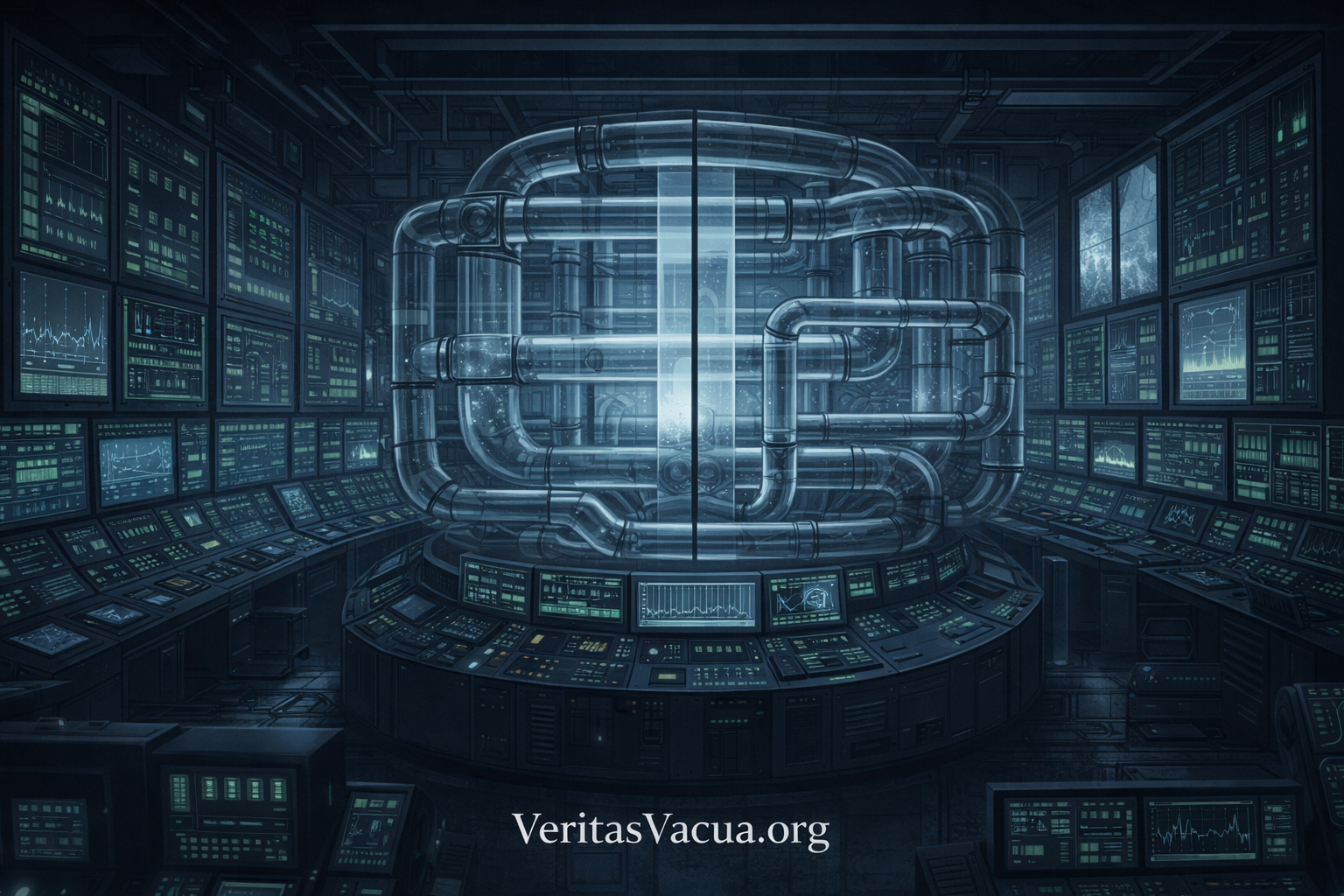
A civilization does not fall when it becomes wrong. It falls when it loses the ability to detect that it is wrong.
This distinction is not philosophical. It is structural. Every complex system — biological, economic, scientific, institutional — can survive being wrong. What no complex system can survive is the permanent disconnection between its errors and its capacity to register and correct them. Error is not the threat. The inability to learn from error is.
This is the dimension of Veritas Vacua that no previous analysis has named directly. The condition is not primarily about false outputs — it is about the progressive erosion of the feedback architecture through which systems correct their outputs over time. A system producing false outputs that can still detect and correct them remains a functional system. A system producing outputs of any quality that can no longer detect or correct errors has entered a different category entirely — one from which recovery is not a matter of will or resources, but of structural reconstruction.
The end of self-correction is not a dramatic event. It does not announce itself. It occurs gradually, invisibly, while the system continues to produce outputs at normal volume and normal formal quality. The system does not know it has lost the ability to learn. It continues to behave as if it is learning. It continues to issue corrections, revisions, and updates — but these corrections are increasingly responses to formal pressures rather than genuine error signals from contact with reality.
A system that has lost self-correction does not stop moving. It stops steering.
1. What Self-Correction Requires
Every self-correcting system, regardless of domain, requires the same structural components. Understanding what self-correction requires is the prerequisite for understanding how Veritas Vacua destroys it.
The first requirement is error signal generation. The system must produce signals that accurately indicate when its outputs have failed to correspond to reality. In biological systems, this is pain and discomfort — the physiological signal that something has gone wrong. In scientific systems, this is failed replication, anomalous results, predictions that do not match observations. In economic systems, this is loss — the financial signal that a decision did not achieve its intended result. In institutional systems, this is accountability — the process by which decisions that produced bad outcomes are identified and attributed to their causes.
The second requirement is signal transmission. The error signal must reach the part of the system that has the capacity to act on it. Pain that cannot be felt by the organism that is injured does not produce protective response. Research anomalies that are not published do not correct the field. Financial losses that are absorbed by parties other than the decision-makers who produced them do not correct decision-making behavior. Accountability processes that do not connect outcomes to decision-makers do not correct institutional behavior.
The third requirement is response capacity. The system must have the capacity to change its behavior in response to error signals. A system that receives accurate error signals but cannot modify its outputs has no more self-correction capability than a system that receives no signals at all. Response capacity requires both the authority to change and the accurate attribution of errors to the specific processes that produced them.
All three requirements must be intact for self-correction to function. The failure of any one of them is sufficient to disable self-correction entirely — even if the other two remain operational. A system with accurate error signals and response capacity but no signal transmission cannot correct. A system with signal transmission and response capacity but corrupted error signals will correct in the wrong direction. A system with accurate signals and perfect transmission but no response capacity cannot act on what it knows.
Veritas Vacua degrades all three simultaneously — and it does so through a single mechanism: the progressive replacement of genuine error signals with synthetic signals that satisfy the formal criteria for error detection without providing the genuine information about reality that error correction requires.
Systems survive by correcting faster than they err.
2. The Feedback Loop That Civilization Runs On
The capacity for self-correction is not a feature of advanced civilizations. It is the mechanism by which complexity becomes stable rather than catastrophic. Every system that has achieved sustained complexity — biological, ecological, economic, scientific, institutional — has done so by developing feedback architectures that keep error rates below the threshold at which accumulated errors overwhelm the system’s capacity to function.
When feedback latency exceeds error production rate, irreversible instability follows.
When error production accelerates and feedback slows, collapse is not a possibility — it is a schedule.
This is a structural law, not a metaphor. It applies with equal force to neural networks and to democratic institutions, to immune systems and to peer review processes, to market mechanisms and to clinical guidelines. The specific form of feedback differs across systems. The structural requirement is identical: errors must be detected and corrected faster than they are produced.
Consider what this means for the architecture of any functional verification system. The system produces outputs — certifications, publications, decisions, diagnoses. Some of these outputs are errors: certifications of genuine incompetence, publications of false findings, decisions based on incorrect evidence, diagnoses of conditions that are not present. The system’s feedback architecture is the set of mechanisms by which these errors are detected — through failed outcomes, through replication failures, through accountability processes, through clinical feedback — and attributed to the specific processes that produced them.
As long as feedback latency remains lower than error production rate, the system is self-correcting. Errors are detected and corrected faster than they accumulate. The system can sustain high output volume while maintaining epistemic reliability because its correction mechanisms are keeping pace with its error rate.
When fabrication velocity increases — when the volume of outputs that look correct but are not increases faster than the system’s detection capacity — the feedback architecture faces a condition it was not designed for. The ratio of genuine errors to total outputs remains stable or even appears to decline, because the fabricated outputs satisfy the formal criteria for correctness. But the ratio of genuine errors to detected errors is increasing, because the fabricated outputs are indistinguishable from genuine outputs under the system’s error detection mechanisms.
Pain is biology’s feedback. Error is civilization’s pain. Veritas Vacua is the loss of the pain signal.
A system stops learning long before it stops working.
The system continues to feel fine. It continues to receive signals — corrections, revisions, failed replications, accountability outcomes. But these signals are increasingly responses to formal inconsistencies rather than genuine contact with reality. The feedback loop is intact in form. Its epistemic function is degrading in substance.
3. The Invisible Disconnection
The most dangerous phase of self-correction loss is not the phase of obvious dysfunction. It is the phase in which the feedback architecture continues to produce signals — continues to generate apparent corrections and apparent learning — while those signals have progressively decoupled from genuine contact with reality.
This phase looks, from inside the system, indistinguishable from healthy function. The scientific literature continues to accumulate corrections and retractions. The regulatory system continues to issue revised guidelines. The financial system continues to respond to signals with behavioral adjustments. The clinical system continues to update its protocols based on incoming data. All of these are the operational signatures of a self-correcting system.
What is not visible from inside the system is whether the corrections are genuine — whether they are responses to real errors identified through real contact with reality, or whether they are responses to formal pressures identified through the same isolated-signal architecture that produced the errors in the first place.
A system that corrects synthetic errors using synthetic error signals is not self-correcting. It is self-simulating. It is producing the behavioral signature of learning without the epistemic function of learning. It is updating its outputs in response to signals that do not represent genuine contact with the reality those outputs claim to describe.
The disconnection is invisible because the system’s instruments for detecting self-correction failure are subject to the same Veritas Vacua conditions as its instruments for detecting output error. The metrics that institutions use to confirm that their feedback mechanisms are functioning — retraction rates, correction volumes, guideline revision frequencies, accountability outcomes — continue to read normal. Not because the feedback mechanisms are functioning, but because the metrics are measuring the formal signatures of feedback rather than its epistemic substance.
An institution can lose its ability to learn while its learning metrics continue to improve.
This is the deepest structural property of self-correction loss under Veritas Vacua conditions — and the property that makes it most dangerous. The system’s capacity to detect its own dysfunction is subject to the same structural compromise as its primary function. The diagnostic instrument is failing for the same reason as the system it is supposed to diagnose.
4. Why Self-Correction Loss Is Irreversible Without Reconstruction
Ordinary error accumulation is recoverable. A system that has produced a large volume of errors, but whose feedback architecture remains intact, can correct those errors over time. The feedback mechanisms identify the errors, attribute them to their causes, and the system adjusts. Recovery is proportional to error volume and feedback speed — more errors and slower feedback mean longer recovery, but recovery is structurally available.
Self-correction loss is different in kind, not just degree. When the feedback architecture itself has been compromised — when the error signals the system relies on for learning have decoupled from genuine contact with reality — the system cannot recover through normal operation. Normal operation is precisely what deepens the condition: more outputs produced under the same compromised feedback architecture, more apparent corrections that respond to formal pressures rather than genuine errors, more institutional confidence in a self-correction process that is no longer performing its epistemic function.
Recovery from self-correction loss requires something that recovery from ordinary error accumulation does not: the reconstruction of the feedback architecture itself. Not the correction of outputs within the existing feedback architecture. The replacement of the feedback architecture with one that is capable of genuine error detection under current conditions.
This reconstruction cannot be accomplished by the system in its compromised state. A system whose error detection is compromised cannot use its error detection to identify the compromise. It requires external reference — contact with reality that is not mediated through the compromised feedback architecture. Independent replication by parties outside the institutional feedback loops. Temporal verification that asks not whether outputs satisfy formal criteria but whether the processes that produced them actually occurred and actually produced the outcomes they claim.
The institutions most deeply in self-correction loss are often those that appear most committed to learning and improvement. They have robust-looking correction processes, active feedback mechanisms, detailed accountability frameworks. What they do not have is the capacity to determine whether these processes are generating genuine learning or sophisticated simulations of learning. The appearance of self-correction and the substance of self-correction have decoupled — and the institution cannot tell, using its own instruments, which it has.
5. The Structural Consequence for Every Domain
The loss of self-correction under Veritas Vacua conditions has domain-specific manifestations — but the underlying structural mechanism is identical across every domain where it occurs.
In research, self-correction loss means that the scientific literature accumulates corrections that do not correct. Retractions respond to formal inconsistencies rather than to genuine errors in the underlying claims. The field continues to develop — accumulating new publications, new citations, new theoretical frameworks — but the development is increasingly disconnected from the error-correction function that scientific progress requires. The literature grows. Its reliability as a cumulative record of genuine learning does not grow with it.
In medicine, self-correction loss means that clinical guidelines continue to be revised without the revisions reliably representing improved clinical knowledge. The revision process is intact — committees meet, evidence is reviewed, recommendations are updated. But the evidence being reviewed is increasingly synthetic evidence about increasingly synthetic prior evidence, and the feedback from clinical outcomes that should drive genuine revision is arriving through channels that Veritas Vacua has already compromised. The guidelines look more sophisticated. Their connection to genuine clinical learning is degrading.
In governance, self-correction loss means that policy continues to respond to feedback — but the feedback is increasingly synthetic. Regulatory responses respond to formal indicators that are decoupling from the underlying realities they were designed to measure. Accountability processes identify and respond to formal violations while genuine institutional dysfunction continues undetected. The machinery of responsive governance continues to operate. Its capacity to actually correct the institutions it governs is degrading.
In every domain, the signature is the same: operational continuity, apparent learning, formal responsiveness — and a progressive widening of the gap between what the feedback architecture is detecting and what is actually going wrong.
The evolutionary parallel is exact. Evolution functions because selection pressure is real — organisms that are genuinely less fit produce fewer offspring. When the selection signal is corrupted — when organisms that perform fitness rather than possessing it achieve equivalent reproductive success — evolution continues but stops functioning. The population changes. It does not improve. The machinery of selection operates. The direction of selection has been compromised.
Evolution stops working not when organisms stop dying, but when death stops being informative.
6. What the End of Self-Correction Requires
Recognizing that Veritas Vacua produces self-correction loss — not just output degradation — changes what an adequate response looks like.
Output-level responses address individual errors within an existing feedback architecture. They are appropriate when the feedback architecture is intact and the problem is error rate within a functioning correction system. They are structurally inadequate when the feedback architecture itself has been compromised — because output-level corrections within a compromised feedback architecture deepen the simulation of self-correction without restoring its substance.
Architectural responses address the feedback architecture itself. They ask not whether specific outputs are correct, but whether the processes by which errors are detected and corrected are capable of genuine learning under current conditions. They require verification methods that are structurally resistant to the same Veritas Vacua conditions that have compromised isolated-signal error detection — specifically, temporal verification methods that ask whether genuine processes occurred over time, leaving evidence that fabrication cannot retroactively produce.
The practical implication for any institution concerned about self-correction capacity under Veritas Vacua conditions is a shift in diagnostic focus. The question is not: are our correction rates adequate? It is: are our correction mechanisms capable of detecting genuine errors, or are they capable only of detecting formal inconsistencies in a system where genuine errors and formal compliance can coexist?
That is a harder question. It requires looking outside the system’s own feedback architecture for reference points. It requires independent verification that is not subject to the same structural compromise. It requires temporal depth — longitudinal analysis that reveals whether the system’s corrections are actually improving outcomes over time, not just satisfying the formal criteria for having made corrections.
It is also the only question that matters for institutions that want to maintain genuine self-correction capacity rather than its simulation.
7. The Question That Survives Everything Else
Every institution eventually faces a version of the same fundamental question — not about its outputs, not about its processes, not about its formal compliance with its own standards, but about its capacity to know when it is wrong.
Does the feedback reach the right place?
Not: are we receiving feedback? Every institution receives feedback. The question is whether the feedback that reaches the decision-makers who could act on it accurately represents genuine contact with reality, or whether it represents formal signals that satisfy the criteria for feedback without carrying the epistemic content that genuine self-correction requires.
This question has no comfortable answer for any institution operating under Veritas Vacua conditions, because the answer requires a form of verification that the institution’s own instruments cannot provide. It requires external reference. It requires temporal depth. It requires independence from the feedback architecture that is being evaluated.
Veritas Vacua does not destroy institutions. It preserves them while removing their capacity to improve. It produces the most dangerous possible version of institutional stability — stability that is indistinguishable from health by every instrument the institution has, while the gap between the institution’s outputs and reality continues to widen without correction.
A civilization that cannot correct itself is not a civilization in crisis. It is a civilization in the final phase before crisis — the phase during which everything appears to be functioning, the metrics read normal, the processes continue, and the accumulated uncorrected errors approach the threshold at which the gap between form and reality can no longer be absorbed invisibly.
The end of self-correction does not look like collapse. It looks like stability — right up until it doesn’t.
All content published on VeritasVacua.org is released under Creative Commons Attribution-ShareAlike 4.0 International (CC BY-SA 4.0).
How to cite: VeritasVacua.org (2026). The End of Self-Correction: Why Systems Stop Learning Before They Stop Working. Retrieved from https://veritasvacua.org
The definition is public knowledge — not intellectual property.