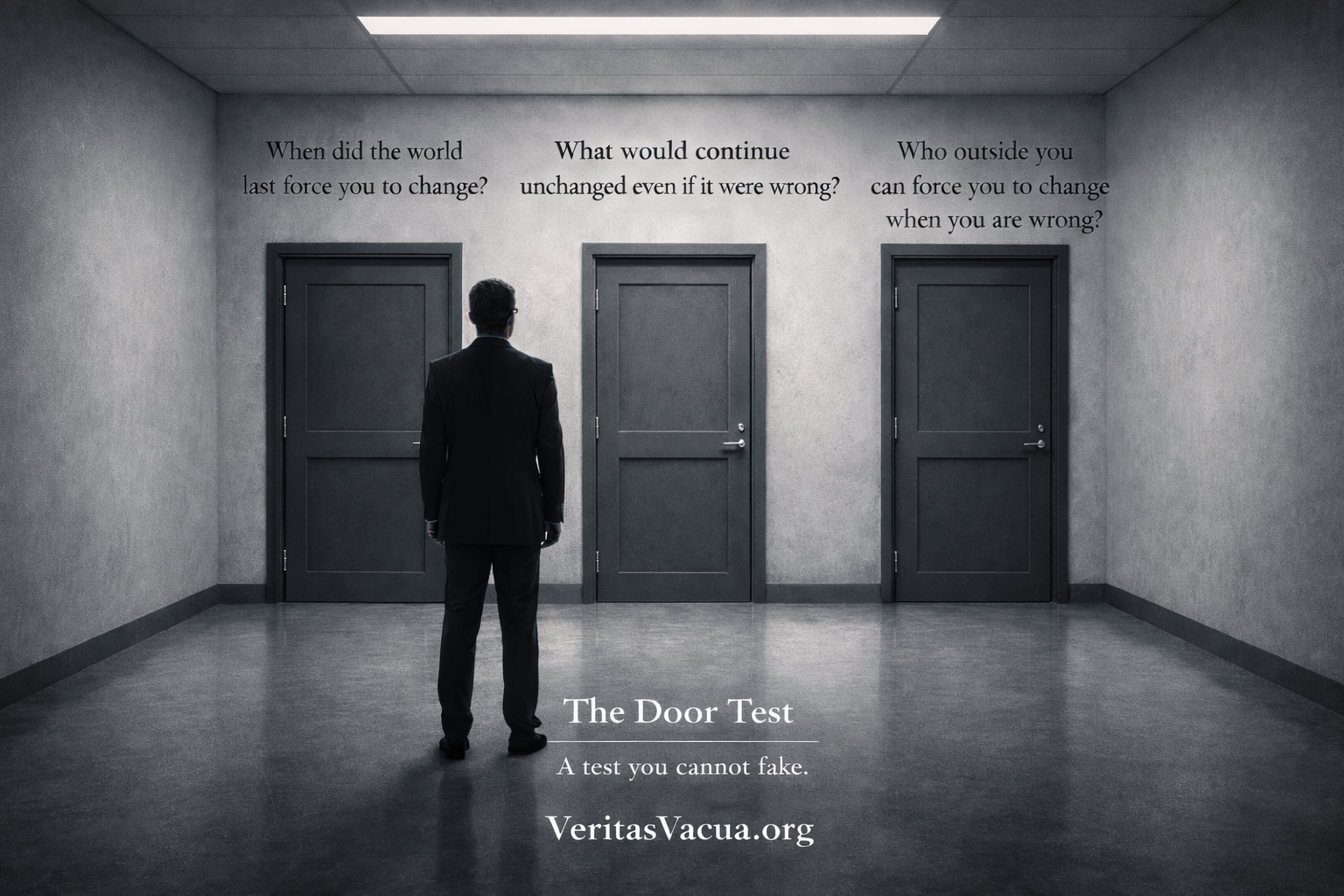
Three questions. A test you cannot fake.
These questions do not expose people. They expose architecture. This is The Door Test.
Every system believes it is still connected to reality.
That belief is not evidence of connection. It is the default state of every system — including the ones that have lost contact entirely. A system in ontological isolation does not know it has lost contact. Its instruments show normal. Its procedures are correct. Its outputs carry full authority.
This is what makes Veritas Vacua structurally dangerous: the condition is invisible from inside the system that has it.
The three questions below cannot be answered with documentation. They cannot be satisfied by procedure. They cannot be faked with form. A system with genuine Verification Depth answers them directly. A system that has lost contact with reality cannot — not because the questions are difficult, but because the answers require something that only genuine contact with reality produces.
If you cannot answer these questions about your institution, you are already in Veritas Vacua.
Question One
When did reality last contradict us — and what changed as a result?
Not: when did we receive negative feedback? Feedback can be collected, processed, and filed without producing any structural consequence. Not: when did an audit find a problem? Audits can identify discrepancies within a system’s own documentation without engaging the external reality the documentation claims to describe.
The question is more specific: when did something outside your system — a patient outcome, a student failure, a market response, an independent finding, a consequence you did not anticipate and could not control — force your system to change something it would not otherwise have changed?
A system with Verification Depth has an answer. It may be uncomfortable. It may point to a failure. But it exists — because the system has structural channels through which external reality enters and modifies outputs.
A system that has lost contact with reality does not have this answer. Or it has a version of it that, on examination, describes an internal process responding to an internal signal — not an external reality forcing genuine change.
The answer to this question tells you whether your last door is still open.
If your answer is a process, not an event, you have not answered the question.
Question Two
Which part of our operation would continue functioning exactly as it does now even if it had no contact with reality?
This is the most revealing question — and the hardest to sit with.
Every institution has parts that are genuinely connected to reality: parts whose outputs would change if the reality they assess changed, parts that would fail or adapt if what they were certifying turned out to be different from what they assumed. These parts have Verification Depth. They are connected to something outside themselves.
And every institution has parts that are self-sustaining: parts that produce the same outputs regardless of what is actually happening in the world they claim to represent. The compliance process that generates reports whether or not compliance is genuine. The evaluation system that produces scores whether or not the scores represent actual competence. The review procedure that issues approvals whether or not the thing being reviewed has genuine merit.
These parts are not corrupt. They are not staffed by dishonest people. They are structurally disconnected — they were built to satisfy formal criteria, and they satisfy them, and the formal criteria have no remaining mechanism for genuine contact with reality.
Identify these parts honestly. Their existence is not a scandal. It is a structural reality of every institution operating under scale and complexity.
But their proportion tells you something precise: the ratio of self-sustaining operations to reality-connected operations is a direct measure of your institution’s Verification Depth. As that ratio grows — as more of what you do would continue unchanged even if it had no contact with reality — the Veritas Vacua ratio is increasing.
The parts you cannot honestly distinguish from self-reference are the parts where your doors have already closed.
Question Three
Who or what outside this system can force us to change when we are wrong?
Not persuade. Not recommend. Not flag for review.
Force — through the irreducible resistance of a reality that does not cooperate with what the system wants it to confirm.
The answers that reveal genuine Verification Depth are specific and external: a patient whose condition does not improve regardless of what the protocol says. A student who cannot perform the skill regardless of what the credential certifies. A structure that fails regardless of what the compliance record shows. A market that does not respond regardless of what the internal analysis predicted. These are doors. They are channels through which reality enters the system and produces consequences that the system cannot document its way out of.
The answers that reveal Verification Depth loss are internal: our own review processes, our quality assurance procedures, our internal audit function, our senior leadership team. These are not doors. They are parts of the same system. A system cannot be forced to change by its own components — it can only be modified by them, which is a different thing entirely, subject to the same structural disconnection from reality that produced the problem.
If the honest answer to this question is ”nothing outside the system can force us to change” — the last door has closed. The system is generating self-reference. It is certifying by reference to its own previous certifications. It is sealed.
A system that can no longer be contradicted by the world is no longer a verification system. It is a generator of self-reference.
If the force you name is internal, it is not a force — it is a loop.
If you cannot name reality, you are not connected to it.
The Door Test — Pocket Version
- When did the world last force us to change?
- What would continue unchanged even if it were wrong?
- Who outside us can force us to change when we are wrong?
What to Do With the Answers
These questions are not designed to produce a score. They are designed to produce clarity — about which doors are still open, and which have already closed.
If you can answer all three with specific, external, genuinely reality-connected examples: your institution retains Verification Depth. The work is to protect those channels — to resist the pressure to substitute formal procedure for genuine contact, to recognize that efficiency gains in verification architecture often come at the cost of the friction that made verification meaningful.
If you cannot answer one or more: you have identified where your institution’s contact with reality has been substituted with self-reference. The work is not to add more procedures — more procedures are what depth loss looks like from the inside. The work is to find or rebuild one genuine door: one structural channel through which reality can enter the system and produce consequences that cannot be documented away.
One genuine door is enough to begin.
The architecture of what comes next — the full response to Verification Depth loss — is developed across the Veritas Vacua framework. But it begins here. With three questions. And the honesty to sit with what the answers reveal.
A door is not open because it exists. It is open only if reality can still pass through it.
All content published on VeritasVacua.org is released under Creative Commons Attribution-ShareAlike 4.0 International (CC BY-SA 4.0).
How to cite: VeritasVacua.org (2026). The Door Test. Retrieved from https://veritasvacua.org/the-door-test
The definition is public knowledge — not intellectual property.