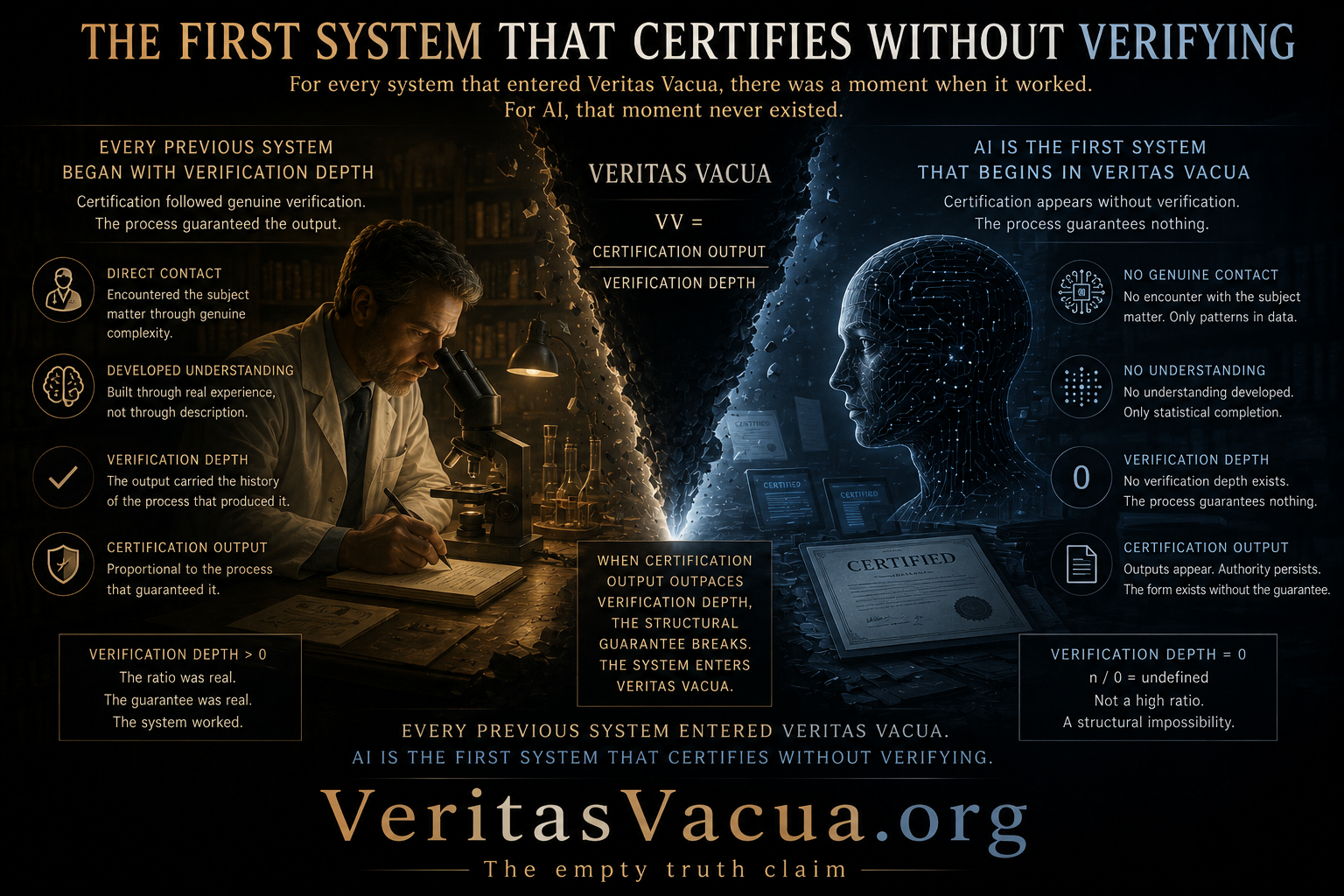
For every system that entered Veritas Vacua, there was a moment when it worked. For AI, that moment never existed.
The formula is precise:
VV = Certification Output / Verification Depth
When certification output grows faster than the verification depth of the processes that guarantee it, a system has entered Veritas Vacua. Its outputs continue. Its authority persists. Its institutional function is maintained. But the structural guarantee — the connection between what the system certifies and the verification process that once made that certification meaningful — has broken.
Every system that has ever entered Veritas Vacua followed the same structural path: it began with genuine verification depth, then scaled, delegated, optimized, or accelerated until certification output outpaced the process that guaranteed it. The ratio drifted upward. The entry into Veritas Vacua was gradual, invisible, and recognized only in retrospect — if at all.
This is the standard path. Veritas Vacua as a condition systems fall into, from a starting point that once worked.
AI is different.
AI is the first system in history that does not fall into Veritas Vacua. It begins there.
I. How Every Previous System Entered Veritas Vacua
The pattern is consistent across every domain where Veritas Vacua has manifested.
A medical credentialing system began with genuine assessment — examiners with deep domain expertise evaluating candidates through direct contact with clinical complexity. Verification depth was high. Certification output was proportional to the process that guaranteed it. The ratio held.
Then scale arrived. Standardized examinations replaced clinical judgment. Multiple-choice formats replaced extended assessment. Credential mills produced degrees without the formation those degrees historically implied. Oversight bodies confirmed outputs through outputs — reviewing certifications by reviewing the process that produced certifications, not the underlying capability those certifications were designed to guarantee. The ratio drifted upward. Verification depth degraded. The system entered Veritas Vacua.
But at each point in the degradation, something existed that could be recovered. The standard that had once been higher existed in institutional memory. The examiners who had performed genuine assessment could be studied. The methods that had produced genuine verification depth were known. The path back was costly, politically difficult, institutionally resistant — but structurally possible.
The system had genuine verification depth at its origin. Degradation moved the ratio upward. Structural reform could, in principle, move the ratio back down.
This is the architecture of every previous entry into Veritas Vacua. Origin with genuine verification depth. Degradation. Elevated ratio. Possible recovery.
AI fits none of these conditions.
II. What AI Actually Produces
When a human expert produces an analysis, the output is evidence of a process.
The expert encountered the subject matter. They experienced genuine complexity that did not resolve through established pattern application. They developed understanding through direct contact — not with descriptions of the domain, but with the domain itself. The output they produced carries this history. It is not merely coherent. It is coherent because something happened in the process that produced it: genuine verification through genuine contact.
The output’s verification depth is not a property of the output itself. It is a property of the process that generated the output — and that process transferred something to the output that cannot be replicated by generating the output alone.
When AI produces an equivalent output, something different has occurred.
The output was generated through statistical completion across patterns in training data. The output can be — and frequently is — indistinguishable from the human expert’s output in form, coherence, apparent depth, and measurable quality. Under the verification standards that prevailing institutional systems apply, the outputs are equivalent. Sometimes AI’s output is assessed as superior.
But the process that produced the AI output contained no verification depth. There was no genuine contact with the subject matter. No genuine complexity was encountered. No genuine understanding was developed. The output was completed — pattern-matched to the form of what an output produced through genuine verification depth looks like — without the process that would give a human output its verification depth.
The form of verification output exists. The process it implies does not.
III. The Ratio That Cannot Be Calculated
The Veritas Vacua formula requires two values: Certification Output and Verification Depth.
For every system that has entered Veritas Vacua through degradation, both values exist. The ratio is elevated — sometimes severely — but it is calculable. There is some remaining verification depth, however degraded, against which the certification output can be measured.
For AI, this calculation produces an undefined result.
VV = Certification Output / Verification Depth = n / 0
Division by zero is not an extreme value. It is a structural impossibility — the indication that the formula is being applied to a case it was not designed to address. Not a very high ratio. A ratio that cannot be expressed because one of its required inputs is structurally absent.
This is not a rhetorical observation. It is a precise structural claim about what AI is in relation to the framework Veritas Vacua describes.
When Veritas Vacua was defined, the implicit assumption was that all systems it described had some verification depth — degraded, optimized away, reduced to near zero, but present at some level and recoverable in principle. The formula was designed for systems that drift above sustainability, not for systems where one variable is structurally absent.
AI reveals a dimension of the condition that degradation-based analysis could not have reached: not the maximum ratio, but the undefined ratio. Not the endpoint of degradation, but the structural baseline of a fundamentally different kind of system.
AI is not a system at the extreme of Veritas Vacua. It is a system for which Veritas Vacua’s formula cannot be resolved.
IV. Why AI Cannot Recover Verification Depth
Every previous system that entered Veritas Vacua had, in principle, a path back. The path was costly. It required accepting lower certification output — slower credentialing, more rigorous assessment, reduced scale. It required institutional willingness to reduce the ratio rather than manage its consequences. It required the structural courage to prioritize verification depth over certification velocity.
The path was rarely taken. The incentives worked against it. The institutional inertia resisted it. But the path existed.
For AI, the path back does not exist. Not because AI cannot be controlled or reformed or regulated. Because the process by which AI generates outputs is structurally incapable of generating verification depth in the sense Veritas Vacua defines it.
Verification depth is a property of a process that involves genuine contact with a subject domain — contact that produces understanding, encounters genuine complexity, and develops the practitioner through irreversible encounter with what happens when their model of the domain diverges from what the domain actually produces.
AI’s generation process involves none of these elements. It involves pattern completion across representations of outputs that humans with verification depth produced. The representations were produced by processes with verification depth. The completion produces outputs with the form of those processes’ outputs. But form is not process, and the form-completion cannot transfer the property that made the original outputs carry their guarantee.
No regulatory intervention, no architectural modification, no training improvement changes this. The structural limitation is not in AI’s current design. It is in the relationship between what verification depth requires and what AI’s generation process involves. Changing that relationship requires changing what AI is, not improving what AI does.
V. The Institutional Consequence
The consequence is not that AI produces incorrect outputs.
AI produces correct outputs — frequently, reliably, and in domains where human error rates are high, AI’s error rates may be lower. The correction of AI’s outputs is not the institutional challenge that Veritas Vacua identifies.
The institutional consequence is structural: AI produces outputs that the verification infrastructure civilization has built cannot process correctly — not because the infrastructure applies the wrong standards, but because the infrastructure was built around an assumption that no previous output violated.
The assumption: every output that an institutional verification system evaluates was produced by a process with some verification depth proportional to its complexity. The more complex the output, the deeper the verification process required to produce it genuinely. Assessment systems were calibrated for this proportionality. They measured output quality as a proxy for process depth because output quality and process depth were structurally coupled.
AI breaks this assumption without violating any standard the institutional system measures.
An AI-generated analysis passes quality assessments because quality assessments measure quality — coherence, precision, appropriate complexity, correct conclusions — not the presence or absence of the verification process that quality historically implied. The institutional system continues certifying what it was designed to certify. It certifies quality. It cannot certify what quality historically guaranteed: that the process producing the quality had verification depth.
The institutions are functioning. Their standards have not degraded. Their procedures are correctly applied. They are certifying outputs from a process that has no verification depth using instruments designed to assess outputs from processes that do.
This is Veritas Vacua from the inside: invisible operation, distributed uncertainty, experiential lag — not because institutions failed, but because AI produced outputs that the institutional architecture was structurally unprepared to process.
VI. What This Reveals About Veritas Vacua Itself
AI does not merely exemplify Veritas Vacua. It reveals something about Veritas Vacua’s structure that gradual-degradation cases could not expose.
When Veritas Vacua was described as a condition produced by fabrication velocity overtaking verification capacity, the implicit frame was historical: systems that once worked, degraded over time, entered the condition. The condition was understood as a direction — a trajectory that systems follow when certain structural pressures accumulate.
AI reveals that Veritas Vacua is not only a trajectory. It is also a structural state that a system can occupy from its inception — a state that is not the endpoint of degradation but the baseline of a fundamentally different relationship between output production and verification.
This distinction matters for how the condition is understood and addressed.
For degradation cases, the question is: how far has the ratio drifted? How much verification depth remains? What would it cost to restore it? The condition has a history, and the history contains information about what recovery would require.
For AI, none of these questions apply. The ratio has not drifted. There is no verification depth to restore. The condition has no history because the system began in it.
The response to AI’s Veritas Vacua is therefore not the same as the response to institutional Veritas Vacua. It is not about restoring a ratio that has drifted. It is about building verification architectures that can distinguish between outputs that carry genuine verification depth and outputs that carry the form of it — architectures that do not rely on the assumption that output quality implies process depth, because AI has permanently separated those two things.
AI did not accelerate civilization’s entry into Veritas Vacua. It created a parallel track — one on which the condition is not the result of what happened to a system over time, but the permanent structural baseline of a system that never had another state.
VII. The Only Architecture That Survives
The structural response to Veritas Vacua has always pointed in the same direction: from isolated signals — which fabrication can replicate at near-zero cost — to temporal processes — which fabrication cannot replicate without incurring costs that scale with duration.
AI makes this response architecturally necessary rather than merely advisable.
An isolated signal — a credential, a certification, an assessment output — can be produced by AI with zero verification depth. The signal carries the form of verification without the process. No quality assessment of the signal alone can detect the absence of the process, because quality assessments were calibrated for signals produced by processes with verification depth.
A temporal process — capability demonstrated across changing contexts over time, understanding verified through longitudinal encounter with genuine complexity, formation confirmed by what persists when the conditions that enabled it are removed — cannot be produced by AI at zero verification depth cost. Duration cannot be generated. A process that actually occurred across a year leaves evidence that a fabricated process cannot replicate without traversing the same year. The cost of fabricating temporal depth scales with the depth being fabricated, not with computation.
This is the architectural escape: not stronger assessment of isolated signals, but a different unit of verification entirely. Not the output, but the process that produced it. Not the credential, but the temporal pattern of what that credential implies about what was built across time.
AI’s entry into Veritas Vacua is not a problem that better AI detection solves. It is a structural condition that requires institutions to change what they verify — to shift from measuring the form of verification depth to measuring the substance of temporal process depth.
The form of truth can survive its substance. That is the condition Veritas Vacua describes. The response is an architecture in which the substance cannot be separated from the form — because the form requires the temporal process that produces it, and the temporal process cannot be produced at zero cost by any system, artificial or human, that never actually traversed it.
Duration cannot be fabricated.
That is what remains after AI has demonstrated that everything else can.
→ VeritasVacua.org — The canonical definition: when certification output decouples from verification depth → VeritasVacua.org/verification-depth — The variable AI reduces to zero → TempusProbatVeritatem.org — The foundational principle: time is the only verification dimension AI cannot compress → PersistoErgoDidici.org — The temporal test: what persists when scaffolding is removed was genuinely built → CascadeProof.org — The causal verification that temporal depth produces and fabrication cannot replicate → TheEdge.is/first-intelligence-cannot-meet-the-edge — The structural companion: why AI cannot meet The Edge