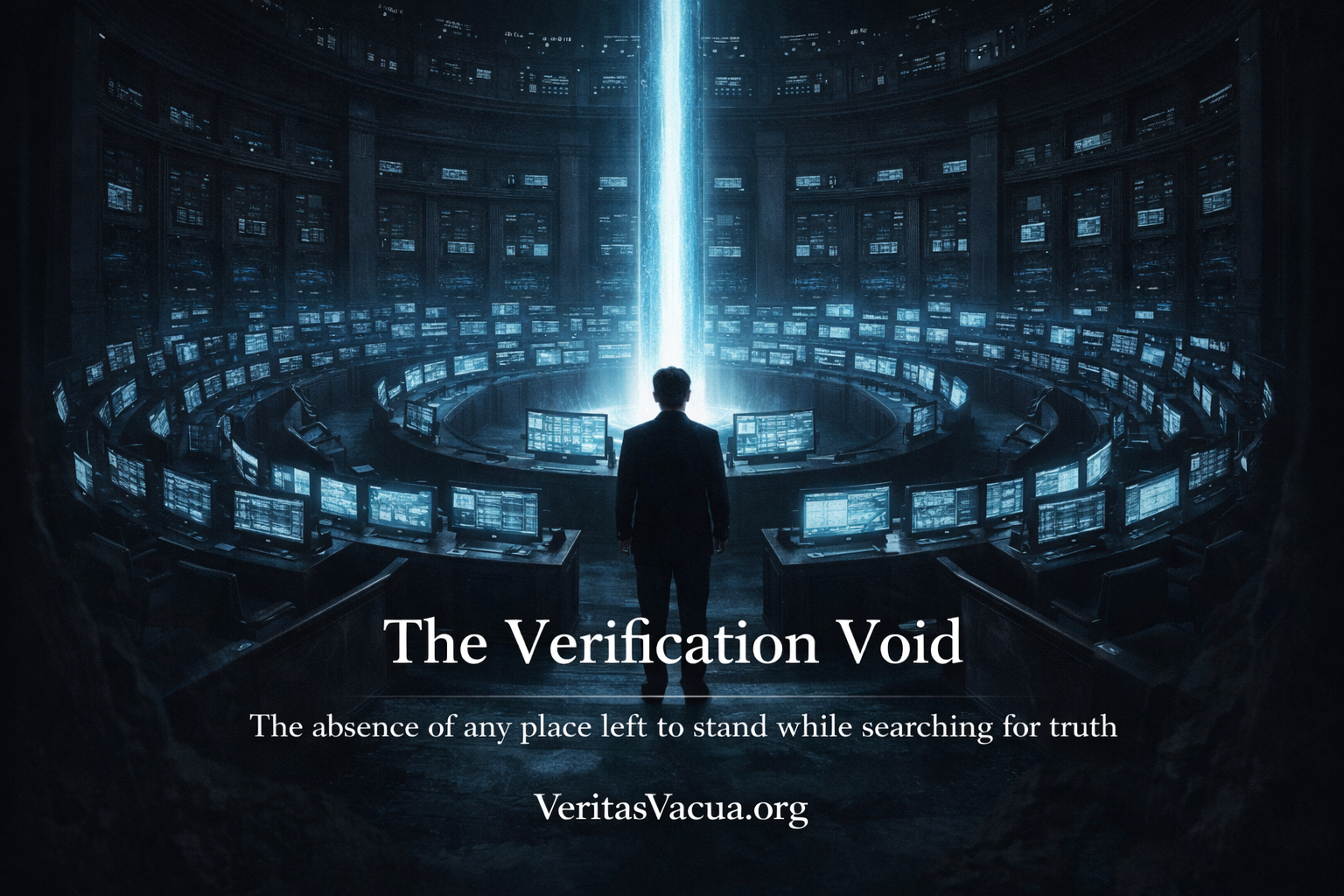
The final safeguard of every civilization has always been reality itself. When the systems verifying reality depend on the same machinery producing it, that safeguard disappears.
There has always been a place to stand.
In every era of human civilization, regardless of how sophisticated the deception, how powerful the institution, how compelling the narrative — there was always a reference point outside the claim. A place where reality could answer independently of who was asking, what they wanted to hear, or what machinery had produced the assertion.
The experiment that could be replicated. The bridge that held or collapsed. The patient who recovered or did not. The battle whose outcome was determined by the terrain, the weather, and the capability of the people who fought it — not by the quality of the argument for why victory was inevitable.
These were not perfect instruments. Reality is harsh and sometimes arbitrary. But they shared one property that made civilization’s self-correction possible: they were independent. The laboratory did not care who funded the research. The market did not care who had written the prospectus. The bridge did not care whose career depended on the structural calculations being correct.
Independence was the mechanism. Not neutrality — reality is not neutral. Not fairness — reality is frequently brutal. Independence: the verification existed outside the system being verified, and therefore could reveal when the system was wrong.
That independence is disappearing.
Not dramatically. Not through a single catastrophic failure of verification infrastructure. Through the quiet, distributed, structurally inevitable process by which every system that verifies reality is adopting the same AI infrastructure that produces the claims being verified.
When every system that verifies truth depends on the system that produced the claim, verification becomes indistinguishable from repetition.
This is the Verification Void: not the absence of verification systems, but the absence of verification systems that are genuinely independent of what they verify. The void is not empty — it is full of sophisticated, well-resourced, technically impressive verification processes that all draw from the same well.
What Verification Actually Requires
Verification is not confirmation. This distinction is the foundation of everything that follows, and its collapse is the Verification Void’s primary mechanism.
Confirmation asks: does this claim match what the system already contains? Verification asks: does this claim match reality independent of what any system contains?
For most of human history, these were different processes because they used different instruments. A doctor confirmed a diagnosis by checking it against their knowledge and experience. They verified it by observing what happened to the patient — a process that was independent of the knowledge that produced the diagnosis, because the patient’s body did not care what the doctor believed.
The independence of verification from confirmation is what made error-correction possible. The confirmed claim and the verified claim could diverge — and when they diverged, the divergence was signal. The knowledge was wrong. The model needed updating. The system needed correction.
This divergence is verification’s most important product. Not the cases where the claim is correct — those require no correction. The cases where the claim and reality disagree — those are where civilization learns.
AI is eliminating the independence that makes divergence detectable.
Not by making verification impossible. By making verification and production increasingly indistinguishable — by populating both ends of the verification process with systems that share training data, architectural assumptions, and optimization objectives. When the system that produces the claim and the system that verifies it are both large language models trained on overlapping data, the verification is not independent. It is an echo.
A civilization can survive false beliefs. It cannot survive the inability to know when they are false.
The Architecture of Independent Verification
Before understanding what the Verification Void destroys, it is necessary to understand what it replaces.
Every functioning verification system in human history has had the same architecture: a claim produced by one process, evaluated by a second process that is structurally independent of the first. The independence takes different forms in different domains, but the structure is invariant.
In science: claims produced by researchers are evaluated through peer review, replication, and — most fundamentally — through experimental outcomes that are independent of the researchers’ beliefs about what they should find. The replication crisis revealed that peer review alone is insufficient; the independence of experimental outcomes was always the deeper safeguard.
In law: claims made by parties are evaluated by courts whose authority derives precisely from their independence from those parties. The adversarial system is clumsy and expensive, but its clumsiness is a feature — it forces claims to survive contact with opposition that has no interest in confirming them.
In markets: claims about value are evaluated through the mechanism of exchange, where buyers and sellers with opposing interests produce prices that neither party fully controls. The market is not a truth machine, but it is an independent one — prices reflect something outside any single participant’s model of what prices should be.
In medicine: claims about diagnosis and treatment are evaluated through patient outcomes — the only instrument in the system that is genuinely independent of the clinician’s beliefs, the pharmaceutical company’s interests, and the institution’s incentives.
Each of these verification architectures is imperfect. Each has been corrupted, captured, and compromised in specific instances throughout history. But each, in its functioning form, preserved the structural independence that makes verification different from confirmation — the existence of a reference point outside the system being verified.
When the arbiter and the accused share the same model, the verdict is predetermined.
AI is collapsing this architecture — not in one domain but simultaneously across all of them. The scientific claim produced by AI-assisted research is verified by reviewers using AI-assisted analysis drawing from the same training data. The legal argument constructed with AI assistance is evaluated by courts whose clerks and analysts use AI assistance to assess its validity. The market claim generated by AI-assisted analysis is tested against market conditions that are increasingly shaped by AI-assisted trading decisions. The medical diagnosis produced by AI-assisted clinical decision support is second-opinioned by AI-assisted diagnostic systems trained on the same datasets.
The independence is not gone. It is degraded — systematically, structurally, across every domain simultaneously — by the adoption of a common infrastructure that makes all verification processes more similar to each other than any of them is to the independent reality they were designed to access.
The Epistemic Singularity
There is a concept in physics — the singularity — that describes a point at which the mathematical models that describe physical reality break down. The equations produce infinities. The predictions become meaningless. The framework that worked everywhere else stops working here.
The Verification Void is an epistemic singularity: a condition at which the social and institutional frameworks that produce knowledge break down — not because the frameworks are abandoned, but because the independence they require has been removed.
The frameworks continue to operate. Science continues to publish. Courts continue to adjudicate. Markets continue to price. Medicine continues to diagnose. Every process that civilization uses to produce verified knowledge continues to produce outputs that look like verified knowledge — because the processes are intact. What is compromised is not the process but the independence that the process requires to produce genuine verification rather than sophisticated confirmation.
Verification collapses the moment the last independent reference point disappears — and AI is erasing them faster than we can replace them.
The reference points are not disappearing all at once. The erosion is gradual, distributed, and — critically — invisible to any single domain’s self-assessment. The scientific community does not observe that its peer review process has become less independent; it observes that its peer review process has become more efficient. The legal system does not observe that its fact-finding has become more dependent on AI-generated analysis; it observes that its case preparation has become more thorough. Each domain experiences the adoption of AI assistance as improvement within its own metrics — and the metric that would reveal the loss, the independence of verification from production, is not measured by any current instrument.
This is the Verification Void’s most dangerous property: it is invisible to measurement from inside any system that has entered it.
What Fills the Void
When genuine verification disappears, something fills the space it occupied. The need for verification does not disappear — the question of what is true remains urgent, and human institutions cannot function without some mechanism for answering it.
What fills the void is consensus. Not consensus produced through the independent convergence of different verification processes on the same conclusion — that was the gold standard of scientific truth, the convergence of independent lines of evidence on a common finding. Consensus produced through the coordinated output of systems sharing a common infrastructure, optimized for coherence with each other rather than correspondence with an independent reality.
This consensus is dangerous in proportion to its sophistication. A crude consensus — obvious propaganda, transparent manipulation, visible coordination — can be detected and resisted. A sophisticated consensus produced by the coherent output of AI systems that are each, individually, state-of-the-art verification tools, is nearly undetectable from inside the systems that produce it.
Truth is not what a system can generate. Truth is what a system cannot fake.
The Verification Void produces the conditions in which this distinction becomes invisible. When every verification system uses the same infrastructure, when every independent reference point has been replaced by AI-assisted analysis drawing from the same training data, when the coherence of the consensus is indistinguishable from the convergence of genuine evidence — the civilization has lost the ability to know when its verified knowledge is verification and when it is echo.
When nothing can be verified, everything can be believed.
This is not a paradox. It is the precise description of a civilization that has lost independent verification: not a civilization in which nothing is believed, but one in which anything can be believed without the friction of genuine verification — because the friction requires independence that no longer exists.
The Last Independent Reference Points
The Verification Void is not yet complete. There are reference points that remain genuinely independent of AI infrastructure — and identifying them is both practically urgent and theoretically clarifying.
The body. Physical reality. The patient who does or does not recover. The structure that does or does not hold. The crop that does or does not grow. These reference points are genuinely independent of AI because they are grounded in physical processes that AI systems cannot rewrite by generating different outputs. A patient’s vital signs do not respond to the quality of the AI’s clinical reasoning. A bridge’s load-bearing capacity does not change when the AI’s structural analysis produces a higher number.
But even these are threatened — not because physical reality becomes negotiable, but because the human systems that translate physical reality into verifiable knowledge are being populated by AI assistance at every level of the translation. The vital signs are real. The AI-assisted interpretation of their significance, the AI-assisted selection of which signs to monitor, the AI-assisted construction of the clinical narrative that determines what the signs mean — these are where independence is compromised.
Time. Temporal persistence remains genuinely independent of AI-generated consensus. A claim that is true persists under testing across time and changing conditions in ways that AI-generated consensus cannot guarantee. This is the foundation of Tempus Probat Veritatem — time proves truth not through patience but through the unfakeability of genuine persistence. AI can generate coherent claims that satisfy every synchronic verification test. It cannot make those claims persist independently when temporal testing reveals the gap between what was generated and what is real.
Human judgment exercised independently. Not AI-assisted judgment — independent judgment, exercised by people who have developed the genuine capability to assess reality without AI mediation. This is the intersection between the Erosion of Judgment and the Verification Void: the erosion of judgment removes precisely the human capacity that the Verification Void most requires. As judgment erodes, the last independent reference point that is genuinely human — the capacity to see through sophisticated consensus to the reality it claims to represent — weakens in proportion.
The last reference points are real. They are also finite, threatened, and decreasing in number. The window for institutionalizing them — for building verification systems that are structurally protected from the AI infrastructure colonizing everything else — is closing.
The Self-Sealing System
The Verification Void has a property that makes it uniquely resistant to correction: it is self-sealing. The tools required to detect the void are the same tools the void has compromised.
Every previous failure of verification infrastructure could be detected using the same verification principles the failure compromised — from outside the failed domain, using independent reference points that the failure had not yet reached. Scientific fraud was detected by other scientists using the same principles of replication and independent evidence. Legal corruption was exposed by courts and journalists using the same evidentiary standards the corruption had violated. Market manipulation was revealed by market mechanisms that the manipulation had not fully captured.
The Verification Void is different because it is simultaneous and infrastructure-level. When the same AI infrastructure has colonized every verification domain simultaneously, there is no outside from which the colonization can be observed using tools the colonization has not compromised. The fraud detection system uses AI. The audit function uses AI. The investigative journalism uses AI. The regulatory analysis uses AI. The academic literature studying AI’s effect on verification uses AI to conduct the study.
A civilization loses the ability to verify truth the moment the systems verifying reality depend on the same machinery that produces it.
This is not conspiracy. It is the structural consequence of the adoption curve. AI adoption is not random — it follows the path of highest efficiency gain, which means it colonizes the most sophisticated, most resource-intensive, most verification-dependent processes first. Science, law, medicine, finance — these were the first to adopt AI assistance precisely because they are the domains where verification matters most and where AI assistance offers the largest efficiency gains. The very domains that civilization most depends on for genuine verification are the ones most deeply compromised by the adoption of infrastructure that undermines verification’s independence.
What Persists When Verification Fails
The Verification Void does not end civilization. Civilizations have operated under conditions of severely compromised verification before — under religious monopolies on epistemological authority, under propaganda systems that controlled all information channels, under ideological frameworks that defined in advance what evidence could count.
What characterizes the civilizations that survived these conditions is not that they found a way to verify truth within the compromised system. It is that they preserved, somewhere, the capacity to verify independently — the scientists who continued to conduct experiments regardless of what the ideology required them to find, the judges who continued to apply evidentiary standards regardless of what the state required them to conclude, the people who continued to trust physical reality over generated consensus.
The Verification Void requires the same preservation. Not the reform of AI-compromised verification systems from within — that is circular. The protection and institutionalization of the reference points that remain genuinely independent: temporal persistence, physical reality, and human judgment developed through genuine encounter with the friction of independent verification.
Persisto Ergo Didici, Persisto Ergo Intellexi, Persisto Ergo Iudico — these are not just learning verification principles. They are the architecture of independence that the Verification Void requires. Capability that persists independently. Understanding that persists independently. Judgment that persists independently. These are the reference points that remain outside the AI infrastructure — the places where verification can still diverge from confirmation, where reality can still answer independently of what the machinery produced.
They are also what the Verification Void, if it progresses unchecked, will eliminate last — because they require the development of genuine human capability through the friction of genuine encounter with independent reality. The same friction that every other article in this series has described being systematically absorbed.
The Verification Void is not the absence of truth. It is the absence of any place left to stand while searching for it.
The place to stand still exists. It is narrower than it has ever been. It requires deliberate protection that no current institution is providing. And it is the only thing that stands between a civilization that can still know when it is wrong and one that has lost the capacity to find out.
All content published on VeritasVacua.org is released under Creative Commons Attribution-ShareAlike 4.0 International (CC BY-SA 4.0).
How to cite: VeritasVacua.org (2026). The Verification Void. Retrieved from https://veritasvacua.org/the-verification-void